

You see it at the electronics shop, on furniture websites and at the dental clinic counter: “0% interest, 12 months”. A credit card instalment plan in Singapore lets you split a large purchase into equal monthly payments on your card, often with no interest charged. Used well, it can ease cash flow without costing a cent more. Used carelessly, it can tie up your credit limit, add fees you did not notice, and quietly lead to the expensive revolving debt it was supposed to avoid.
This guide explains how these plans work behind the counter and the trade-offs to weigh before you sign. It is general information, not financial advice. Terms differ between banks and merchants and can change, so always read the specific plan’s terms and check with your card issuer.
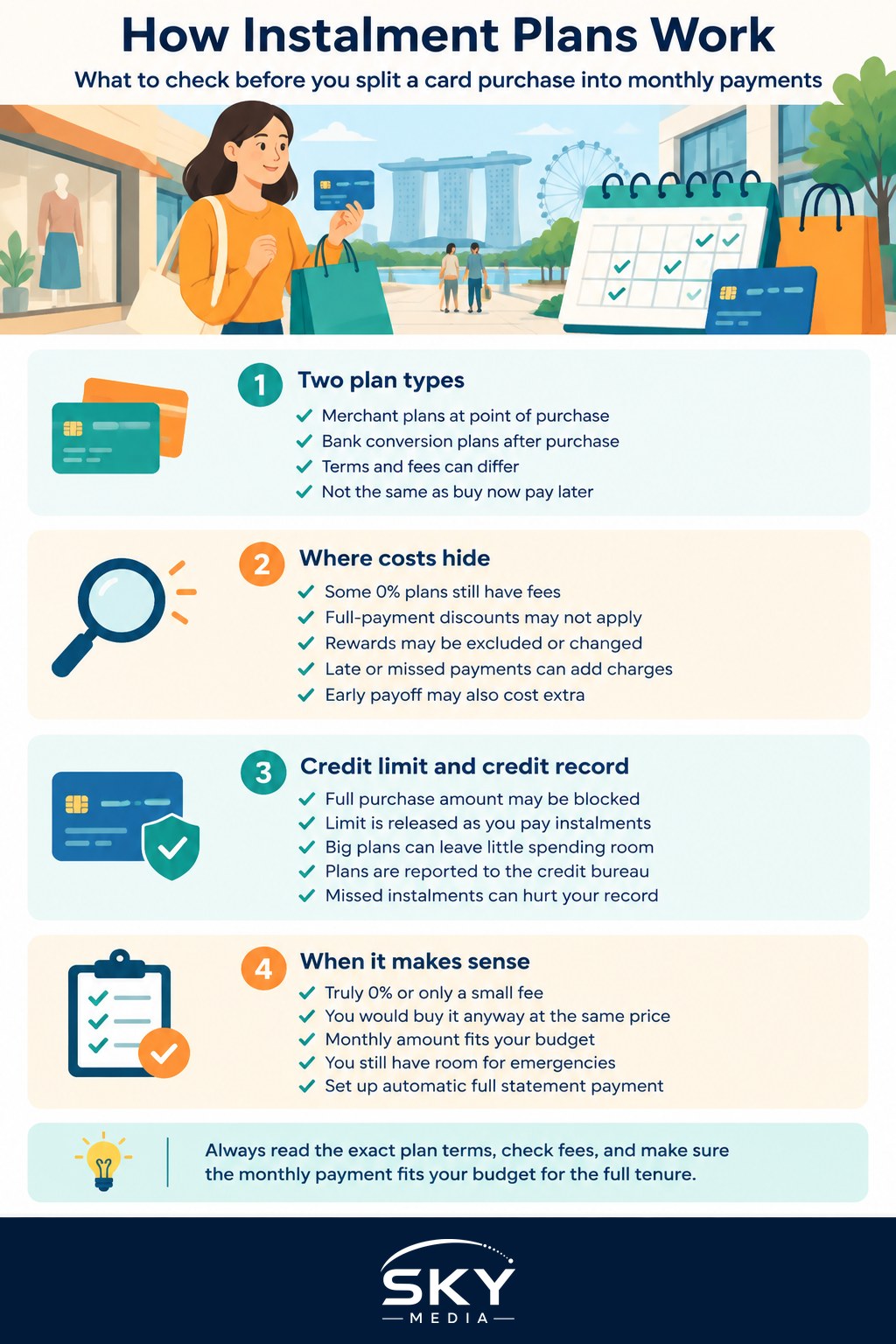
The Two Main Types of Instalment Plans
Not every instalment plan is the same, and the type matters for cost.
Merchant instalment plans. These are offered at the point of purchase through a partnership between the merchant and a bank. You choose a tenure, often from a few months up to a couple of years, and the purchase amount is divided into equal monthly instalments. Many are advertised as 0% interest. The merchant usually pays the bank a fee to offer this, which is why the plan is often only available with cards from participating banks, and sometimes only above a minimum spend.
Bank conversion plans. Some banks let you convert a purchase you have already made, or a portion of your outstanding balance, into instalments after the fact, through the bank’s app or by phone. These are usually not free. They commonly carry a one-time processing fee or a monthly interest charge, which the bank must express as an effective interest rate.
Neither type is the same as buy now pay later services, which run outside your credit card through separate providers with their own rules.
Where the Real Cost Hides
A 0% plan really can cost nothing extra if you pay every instalment on time. The cost appears through the details.
- Processing or administrative fees. Some plans advertised as interest-free still charge an upfront fee. A fee on a “0%” plan means it is not truly free, and the effective interest rate can be meaningful, especially on shorter tenures.
- Higher price for instalment buyers. Occasionally a merchant offers a discount for full payment that does not apply to instalment purchases. The lost discount is a hidden cost.
- Lost rewards. Some banks exclude instalment transactions from cashback, miles or points, or award them differently. Check before you assume you will earn rewards on a big purchase.
- Late payment charges and interest. Each monthly instalment is billed with your statement. If you do not pay at least the required amount by the due date, you may face late fees and interest on the outstanding balance at the card’s usual rate.
- Early cancellation or prepayment charges. If you want to pay off the plan early, or you cancel the card, some banks charge a fee or make the remaining balance due at once.
Understanding how card interest and minimum payments work is essential here, because that is where instalment plans turn expensive. Our guide to credit card interest and minimum payments explains how quickly an unpaid balance grows.
Your Credit Limit Takes the Full Hit
One trade-off many people miss: when you buy a $3,000 item on a 12 month plan, many banks block the full $3,000 from your available credit limit on day one. As you pay each instalment, the limit is released bit by bit.
This can surprise you if you need the card for travel, an emergency or another big bill in the months that follow. If your limit is modest, a single instalment purchase can leave you with little room. It may also nudge you towards a second card simply to keep spending headroom, which adds complexity.
Instalment plans and your outstanding credit facilities are also reported to the credit bureau, and lenders look at your total commitments when you apply for a home loan or other credit. Missed instalments in particular can affect your credit record.
Comparing Ways to Pay for a Big Purchase
| Option | Upfront cost | Effect on credit limit | Main risk |
|---|---|---|---|
| Pay in full with card, settle statement | None if paid in full | Temporary, cleared after payment | Large single outflow |
| 0% merchant instalment plan | None, or a processing fee | Full amount often blocked at once | Late or missed instalments incur charges |
| Bank conversion plan after purchase | Processing fee or interest | Converted amount blocked | Effective interest rate can be high |
| Pay only the minimum on a normal balance | Interest on the unpaid balance | Stays high | Revolving debt grows quickly |
| Save first, buy later | None | No effect | Waiting, and prices can change |
When an Instalment Plan Makes Sense
An instalment plan can be a reasonable choice when all of these are true:
- The plan is genuinely 0% with no processing fee, or the fee is small and you have worked out what it means as a rate.
- You would have bought the item anyway, at the same price, and you are not buying something bigger just because the monthly figure looks small.
- The monthly instalment fits comfortably in your budget alongside your other bills, not just this month but for the full tenure.
- Your remaining credit limit after the block is enough for emergencies.
- You have set up automatic payment of at least the full statement balance, so instalments never fall behind.
It makes less sense when you are using it because you cannot afford the item at all, when you already carry a revolving balance, or when the plan carries fees that a personal savings plan would avoid. If you find yourself on several plans at once, it is worth stepping back and reviewing your card use, as our piece on using credit cards wisely suggests.
Questions to Ask Before You Sign
At the counter, sales staff will focus on the monthly amount. Ask about the whole picture instead:
- Is there any processing, administrative or handling fee?
- Is the price the same as paying in full, or is there a full payment discount I lose?
- Which banks and cards are eligible, and is there a minimum spend?
- Will the full amount be blocked from my credit limit?
- Will I still earn rewards on this purchase?
- What happens if I return the item, want to pay off early, or cancel my card?
Get the answers in writing where possible, and keep the charge slip and plan details. If an instalment is billed incorrectly, or a refund on an instalment purchase is not reflected properly, contact your bank first, and see our guide to disputing a credit card charge if that does not resolve it.
The Bottom Line
Credit card instalment plans are not a trap by design, and a true 0% plan paid on time is effectively an interest-free loan. The danger lies in fees dressed up as free, credit limits tied up for months, and the temptation to spend more because each payment looks small. Read the terms, do the sums, and treat each instalment as a fixed monthly bill you have committed to for the whole tenure.
Frequently Asked Questions
What happens to my instalment plan if I return the item? It depends on the merchant’s and bank’s terms, so ask both before you buy. Usually the refund has to be processed through the bank, and you may still need to pay instalments until it shows on your statement. Keep the receipt and plan details, and contact your bank if the refund is not reflected properly.
How do I work out the real rate of a plan with a fee? A one-time fee on an interest-free plan works out to a higher yearly rate than it looks, because you are repaying the balance gradually. Ask the bank for the effective interest rate, which it should be able to give you. Comparing that figure across plans is more useful than comparing fees alone.
Is a personal loan cheaper than a bank conversion plan? It can be, but there is no general rule. Compare the effective interest rate, fees and tenure of each offer, including any early repayment charges. A true 0% merchant plan is usually cheaper than both if you can pay every instalment on time.
Are buy now pay later services safer than credit card instalment plans? Not necessarily. They run outside your credit card with their own rules, and late fees and missed payments can still cause trouble. Neither is automatically safer, so read the terms and budget the monthly amount before you commit.
What happens to my instalments if my credit card expires or I change cards? A replacement card usually carries on with the same account, so instalments continue as normal. Closing or cancelling the card is different, as the bank may require the remaining balance to be paid at once. Check this with your bank before cancelling any card with an active plan.
Official sources: MoneySense