
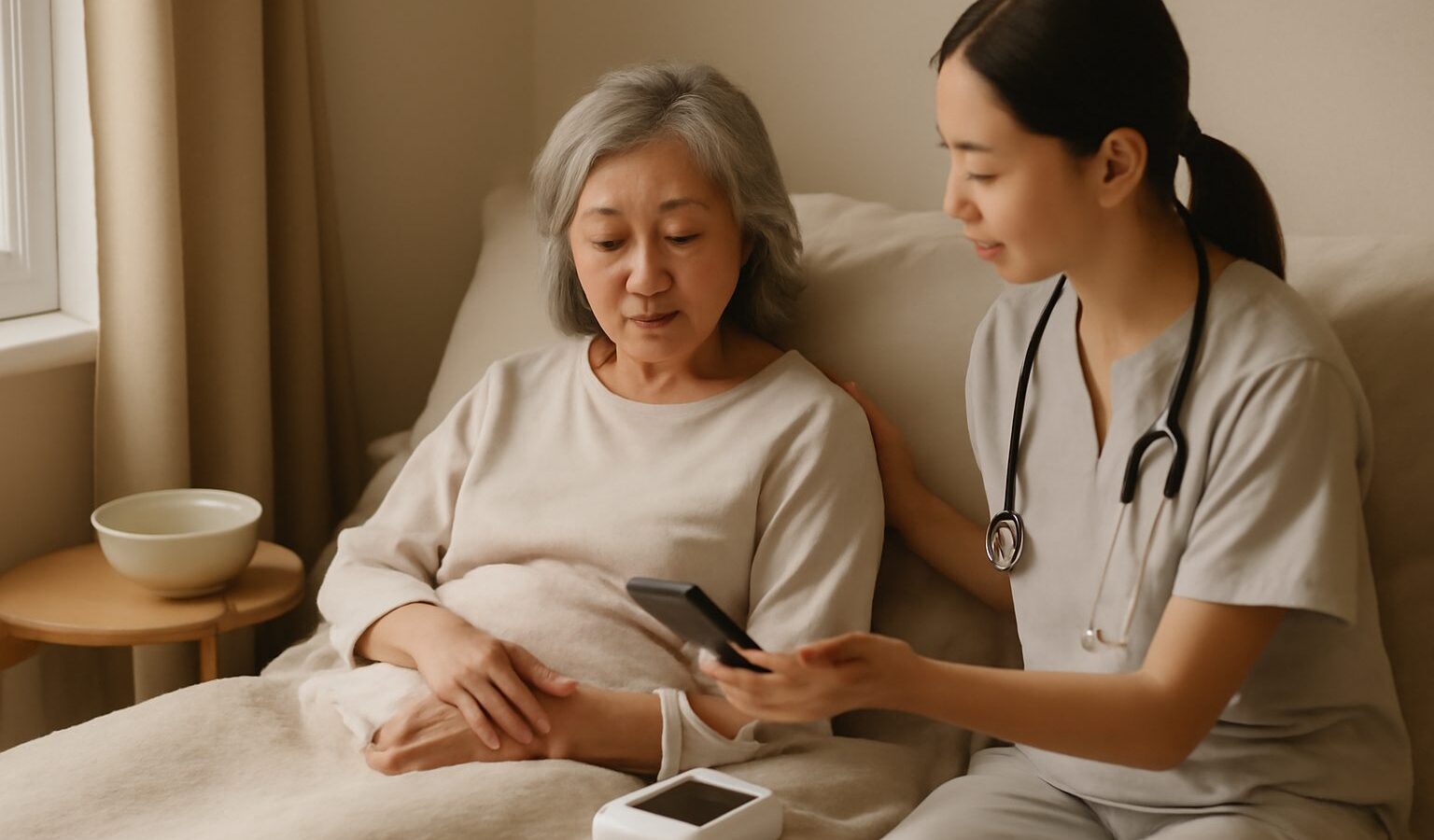
For many older Singaporeans, a hospital admission means a noisy ward, broken sleep and worried family shuttling back and forth. Mobile inpatient care at home offers a different route for some patients: you are still formally admitted as a hospital inpatient, but the “ward” is your own bedroom.
In Singapore this model is commonly known as MIC@Home (Mobile Inpatient Care @ Home). It began as a Ministry of Health (MOH) sandbox with several public hospitals and has since been expanded. This guide explains how the hospital-at-home model works, who tends to qualify, and how it differs from ordinary home care and from being discharged. It is general information, not medical advice. Whether it suits you is always a clinical decision made by the hospital team.
What Mobile Inpatient Care at Home Actually Is
The key idea is simple: you are an inpatient, just not in the building.
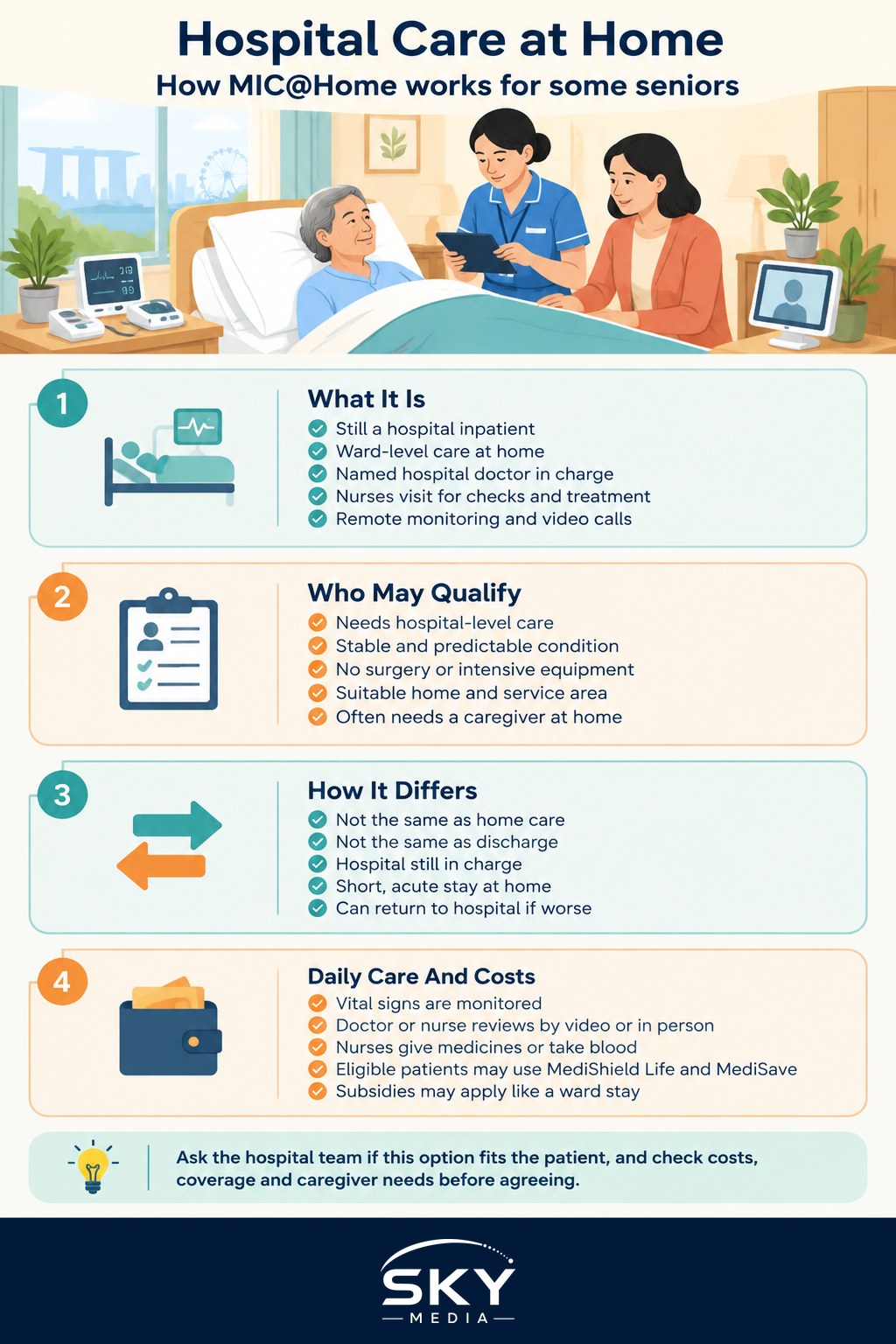
When a senior is admitted under mobile inpatient care at home, the hospital takes responsibility for their acute care in the same way it would on a ward. In practice this usually means:
- A named hospital doctor in charge of your care for the admission, who reviews your condition regularly.
- Scheduled visits from nurses or other clinical staff to do checks, give treatments and take samples.
- Remote monitoring, often through devices that record vital signs such as blood pressure, heart rate, temperature or oxygen levels and send readings to the care team.
- Teleconsultations by video call between visits.
- Treatments that would normally happen on a ward, such as intravenous (drip) medicines, wound care or blood tests, depending on the hospital and your condition.
- A way to escalate quickly. You are given a contact number to reach the team, and if your condition worsens, you can be brought back to the hospital.
At the end of the admission, you are discharged from the programme just as you would be discharged from a ward, with a summary, follow-up appointments and medicines as needed.
Who Tends to Qualify for Hospital Care at Home
Not every patient can be treated this way, and each hospital sets its own clinical criteria. The decision is made by the doctors, usually when you come to the emergency department or while you are already on a ward and stable enough to move home for the rest of your stay.
Broadly, the patients who are considered tend to share some features:
- A condition that needs hospital-level care but is stable and predictable. Examples often cited include some chest, urinary or skin infections and settling flare-ups of long-term conditions. Your doctor judges whether your case fits.
- No need for intensive monitoring, surgery or equipment that only a hospital can provide.
- A suitable home. The team needs to be able to reach you, set up monitoring devices and work safely.
- Living within the hospital’s service area, since staff need to travel to you.
- A caregiver or support at home in many cases, especially for seniors who are frail or have memory problems., such as a family member or live-in helper who can call the team if something changes.
- Your consent. You and your family are asked whether you want to be cared for at home. It is entirely fine to say you would prefer to stay in the ward.
If you are curious whether mobile inpatient care at home might be an option, you can ask the doctor or nurse in the emergency department or ward. Do not expect it to be offered in every situation, and never delay going to hospital for an emergency in the hope of being treated at home.
How It Differs From Home Care and From Discharge
Families often confuse hospital-at-home with other services delivered at home. Here are the main differences.
| Feature | Mobile inpatient care at home | Home care services | Being discharged home |
|---|---|---|---|
| Your status | Still a hospital inpatient | Community patient, not admitted | No longer admitted |
| Who is responsible | Hospital team, with a doctor in charge | Home care provider, alongside your GP or specialist | Your GP, polyclinic or specialist clinic at follow-up |
| Type of care | Acute, ward-level treatment and monitoring | Ongoing support such as nursing, therapy or personal care | Self-care, medicines and follow-up appointments |
| How long it lasts | Usually short, for the length of the admission | Can continue for months or longer | Not applicable |
| If you get worse | Team escalates and can bring you back to hospital | Provider advises and refers, or you go to A&E | You see a doctor or go to A&E |
In short, home care supports people with ongoing needs, such as help with bathing, medication or regular wound dressing, and can continue long term. Our guide to home care and day care for seniors covers those options in detail. Mobile inpatient care at home is short, intense and acute: it replaces days in a ward, not months of support.
It is also different from a normal discharge. When you are discharged, the hospital’s active treatment ends and responsibility moves back to community doctors. Under hospital-at-home, active treatment is still going on, and the hospital is still in charge. Once that treatment finishes, you go through the usual hospital discharge planning steps, which may include arranging home care or rehabilitation if needed.
What a Typical Day Looks Like
A day under mobile inpatient care at home often looks like this:
- Morning readings. Monitoring devices send your vital signs to the care team.
- A review by the team. A doctor or nurse checks in by video or in person and adjusts your treatment.
- Treatment visits. Nurses arrive at agreed times to give medicines, change dressings or draw blood.
- Meals and rest at home. You eat your own food and sleep in your own bed.
- Evening and overnight cover. You have a number to call at any hour. If you have chest pain, breathing difficulty, confusion or any sudden change, call the team or 995 immediately, as instructed.
Staying active at home may help seniors avoid some of the weakness that comes from days in a hospital bed. If you do need extra help to regain strength afterwards, senior rehab services can be arranged.
Costs, Coverage and Practical Questions to Ask
Because you are an inpatient, the stay is generally billed as a hospital admission. MOH has indicated that eligible patients can use MediShield Life and MediSave, and government subsidies may apply as they would for a ward stay. The exact arrangements, including what your Integrated Shield Plan covers, can change and depend on your policy and the hospital. Ask the hospital’s financial counsellors for an estimate before you agree, and check your policy wording or call your insurer.
Useful questions to ask the care team:
- Which treatments will I get at home, and how often will someone visit?
- What devices will you leave with me, and what do I need to do with them?
- What role do you expect my caregiver or helper to play?
- What symptoms should make us call you, and what number do we use?
- How will you decide when I am well enough to finish the admission?
- What happens if I or my family change our minds and want me back in the ward?
Is Mobile Inpatient Care at Home Right for Your Family?
Hospital-at-home works best when the senior is medically suitable, comfortable at home and well supported. It may suit less well if you live alone without help or feel anxious away from the ward. There is no wrong choice.
Talk it through with your parent, siblings and the doctors. If ongoing support will be needed afterwards, think ahead about equipment too. Our home care equipment and hospital bed guide is a good starting point.
For the latest information on mobile inpatient care at home, including which hospitals offer it, check the MOH website or ask your hospital directly, as programme details can change over time.
Frequently Asked Questions
Does my home need Wi-Fi or special equipment for mobile inpatient care? The hospital sets up what is needed, such as monitoring devices and a contact number. Some devices may need a phone signal or home internet connection, so ask the care team what your home must have and how they will test it before you go home.
Can a domestic helper be the caregiver for hospital care at home? In many cases a helper can serve as the day-to-day support person, as long as they can follow instructions, use the monitoring devices and call the team or emergency services if there is a change. The hospital will assess whether the setup is safe.
Is mobile inpatient care at home the same as being sent to a community hospital? No. A community hospital provides ongoing recovery or rehabilitation in a facility, usually after the acute illness has settled. Mobile inpatient care at home delivers acute, ward-level treatment in your own bedroom under hospital doctors. Ask your doctor which stage of care you need.
Is hospital care at home suitable for seniors with dementia? It can be considered, but the unfamiliar ward environment is stressful for some people with dementia, while a home setting may feel calmer. Suitability depends on their condition, safety at home and caregiver support. The hospital doctors will make the decision together with the family.
Official sources: Ministry of Health (MOH)
Further reading: How to Choose Between Home Hospice and Inpatient Hospice · How to Choose an Adjustable Bed for Senior Comfort · Managing Your Own Care as a Solo Ager in Singapore