

Helping a parent get out of bed and into a wheelchair is one of the most common tasks family caregivers do, often several times a day. It is also where many falls and caregiver back injuries happen. A safe bed to wheelchair transfer depends on good preparation, the right technique for your parent’s ability and, often, a simple aid such as a transfer belt or board. This guide walks through the basics for caregivers in Singapore.
This is general information, not medical advice. Every person’s strength, balance and medical condition is different. Before you start doing transfers regularly, ask your parent’s doctor, physiotherapist or occupational therapist to assess them and show you the right method in person.
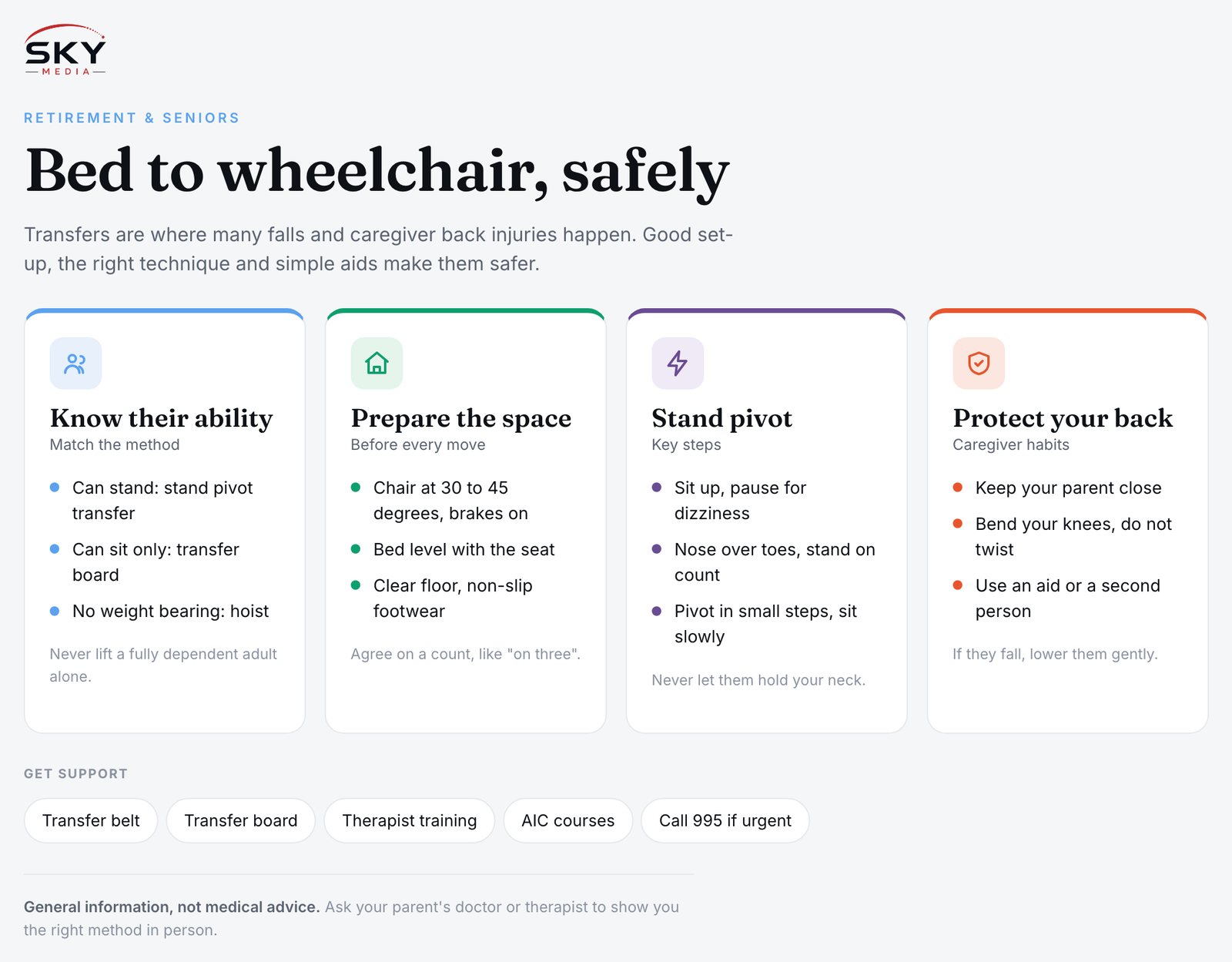
First, Know How Much Your Parent Can Help
The right technique depends on how much weight your parent can bear and how well they understand instructions. Therapists usually think about it in broad levels:
- Can stand with light help: your parent can take most of their own weight and pivot with you guiding and steadying them.
- Can bear some weight but is unsteady: they need more physical support and often benefit from a transfer belt.
- Cannot stand but can sit upright with support: a sliding transfer with a transfer board may be suitable.
- Cannot bear weight or sit unsupported: a mechanical hoist and trained handling are usually needed. Do not try to lift a fully dependent adult on your own.
Abilities can change from day to day, especially after illness, a fall or a hospital stay. Check how your parent is feeling before every transfer, and if they seem weaker, dizzy or confused, pause and get help.
Prepare the Space Before You Move Anyone
Most transfer accidents start with poor set-up. Before each transfer:
- Position the wheelchair close to the bed, angled at about 30 to 45 degrees, on your parent’s stronger side if one side is weaker.
- Lock both wheelchair brakes and swing away or remove the footrests. If the armrest nearest the bed is removable, take it off for sliding transfers.
- Lower or raise the bed so the mattress is roughly level with the wheelchair seat. If you have an adjustable bed, this makes a big difference.
- Clear the floor of rugs, cables, slippers and clutter.
- Dress your parent in non-slip footwear or socks with grips, never loose slippers or bare feet on a smooth floor.
- Explain what you will do and agree on a count, such as “on three, we stand”.
Step-by-Step Stand Pivot Transfer
For a parent who can bear weight on at least one leg, the stand pivot transfer is the most common method. A therapist should demonstrate it first, but the general sequence is:
- Help your parent sit up. Roll them onto their side facing the wheelchair, then lower their legs over the edge of the bed while you help them push up with their arms into a sitting position.
- Let them sit for a moment. Older adults can feel dizzy when they sit up quickly. Wait until they feel steady.
- Scoot to the edge. Help them shift forward so their feet are flat on the floor, slightly apart, and their knees are bent.
- Get into position. Stand facing your parent with your feet apart, knees bent and back straight. If using a transfer belt, hold it at the sides or back, not their arms or clothing.
- Lean and stand on the count. Ask them to lean forward (“nose over toes”) and push up from the bed with their hands as you count together and rise with them, using your legs, not your back.
- Pivot in small steps. Turn together towards the wheelchair with small steps. Never twist your own spine.
- Sit down slowly. Once the backs of their legs touch the seat, ask them to reach back for the armrests and lower down gently as you bend your knees.
- Settle them safely. Help them shift back into the seat, replace the footrests, position their feet and check their posture before releasing the brakes.
Never let your parent hold on to your neck or shoulders. If they start to fall, do not try to hold them up. Lower them gently to the floor, protecting their head, and call for help.
Transfer Aids That Make a Real Difference
Simple equipment can make transfers much safer for both of you. The comparison below gives a general overview; your therapist can advise which suits your parent.
| Aid | What it does | Usually suits | Things to note |
|---|---|---|---|
| Transfer belt (gait belt) | A sturdy belt around the waist giving the caregiver a secure handhold | Parents who can stand but are unsteady | Fit snugly over clothing; never lift by the belt alone |
| Transfer board | A smooth board bridging bed and wheelchair for a sliding transfer | Parents who can sit upright but cannot stand | Needs a removable armrest and similar seat heights |
| Swivel or turning disc | A rotating disc under the feet to help pivot | Parents who can stand but struggle to step | Use only on a stable floor and as trained |
| Bed rail or grab handle | Gives your parent something to push or pull on | Parents with some arm strength | Must be fitted correctly to avoid entrapment |
| Mechanical or ceiling hoist | Lifts the person in a sling | Parents who cannot bear weight | Requires training; usually needs two people |
Grants may help with the cost of assistive devices for eligible seniors. The Agency for Integrated Care (AIC) is the main source of information on caregiving support and schemes such as the Seniors’ Mobility and Enabling Fund. Check AIC’s website for current eligibility and how to apply.
Protect Your Own Back
Caregiver injuries are common and can leave a family without its main helper. Good habits include:
- Keep your parent close. Lifting at arm’s length strains your back far more.
- Bend your knees, not your waist, and keep your back straight.
- Do not twist. Move your feet to turn.
- Know your limit. If your parent needs more than a little help to stand, use an aid or get a second person.
- Rest and stretch. Repetitive transfers through the day add up.
If you are feeling strain or pain, speak to a doctor, and consider asking for a home assessment so the setup can be adjusted.
Get Trained and Get Support
You do not have to learn this alone. Practical options in Singapore include:
- Hospital and rehab teams: before your parent is discharged, ask the physiotherapist or occupational therapist to teach you transfers and observe you doing one.
- Caregiver training courses: AIC lists caregiver training courses, and grants such as the Caregivers Training Grant may help with the cost for eligible caregivers. Check current details with AIC.
- Home therapy services: community providers can send therapists to assess your home and recommend changes, such as bed height or grab bars.
- Foreign domestic workers: if you employ a helper, make sure she is trained in safe transfers too.
For the wider picture of caring at home, our guide to caring for an elderly parent in Singapore covers support services and routines. When you need to take your parent out, see how to transport a wheelchair in a car safely for the next step after the transfer.
When to Stop and Seek Help
Pause transfers and contact a doctor or therapist if your parent:
- Has had a fall, or nearly fallen, during a transfer
- Complains of new pain, dizziness or weakness
- Seems more confused than usual
- Is becoming harder to move each week
In an emergency, call 995. Safe transfers protect your parent’s independence and your own health, so invest the time to learn them properly.
Frequently Asked Questions
What should I do if my parent starts to fall during a transfer? Do not try to hold them up. Lower them gently to the floor, protect their head and call for help. Never let your parent hold on to your neck or shoulders during a transfer.
Can I lift my parent alone if they cannot stand at all? No. A parent who cannot bear weight or sit unsupported usually needs a mechanical hoist and trained handling, and often two people. Do not try to lift a fully dependent adult on your own.
Which transfer aid should I get, a belt or a board? A transfer belt suits a parent who can stand but is unsteady, while a transfer board suits one who can sit upright but not stand. Your therapist can advise which fits your parent, and AIC has information on assistive device support.
How do I avoid hurting my own back during transfers? Keep your parent close, bend your knees instead of your waist, keep your back straight and move your feet to turn rather than twisting. If your parent needs more than a little help to stand, use an aid or get a second person.
Where can a caregiver learn the correct transfer technique in Singapore? Ask the hospital physiotherapist or occupational therapist to teach you and observe you doing one before discharge. AIC lists caregiver training courses, and community providers can send therapists to assess your home. Helpers should be trained too.
Further reading: Should You Open a Joint Bank Account With an Elderly Parent? · What to Do When an Elderly Parent Falls and Can’t Get Up · Tube Feeding Care at Home for an Elderly Parent