
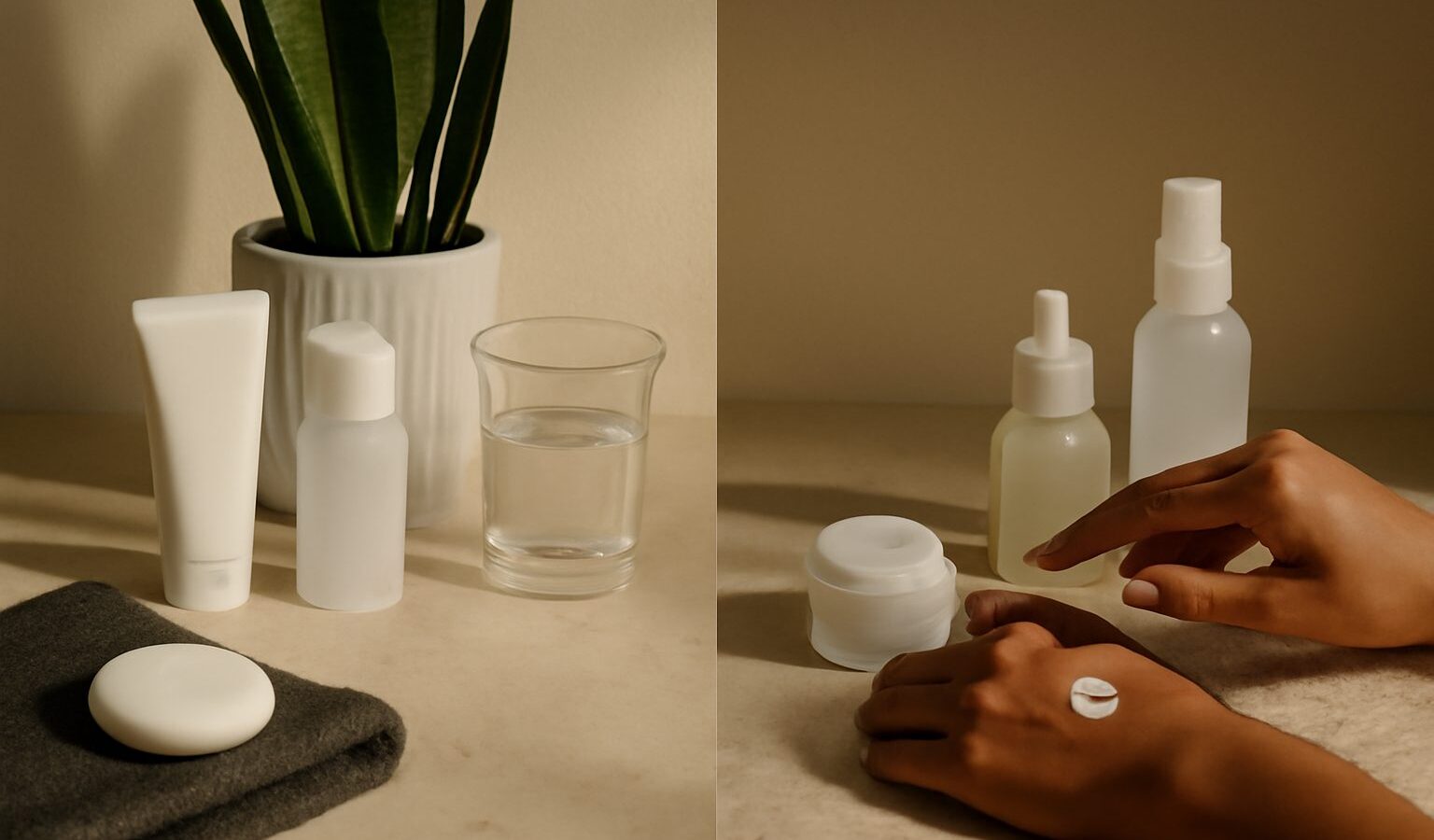
If you have ever wondered whether your morning and evening routines should really be different, the short answer is yes. Morning vs night skincare comes down to two different jobs: the day is about protection, and the night is about repair. Once you understand that split, deciding what to use and when becomes far simpler, and you stop wasting good products at the wrong time.
This guide breaks down what each routine is for, which steps belong to the day and which to the night, and how to keep both realistic in Singapore’s year-round heat and humidity.
Why day and night skincare have different jobs
Your skin behaves differently across the day. In daylight hours it faces the outside world: UV rays, pollution, haze, sweat and the drying blast of office aircon. A morning routine is therefore defensive. It hydrates, adds a layer of antioxidant support if you like, and finishes with sunscreen to shield against the strong UV that reaches Singapore even on grey days.
At night, the picture changes. Your skin is not fighting the sun, so this is the window for repair and renewal. It is when many people apply treatment actives, because ingredients that make skin more sun-sensitive can work overnight without that risk. Sleep is also when skin naturally recovers, so a night routine leans into supporting that process with hydration and, where suitable, targeted treatments.
Understanding this difference stops two common errors: wasting a delicate night active in the morning sun, and skipping sunscreen because the routine felt “complete” already.
Your morning routine, built for the heat
A good morning routine here is light, quick and protective. The goal is to prep and shield without layering so much that you are greasy by mid-morning.
A sensible AM sequence looks like this:
- Cleanse gently. A mild cleanser, or even a plain water rinse, removes overnight oil without stripping the skin.
- Hydrate. A hydrating toner or essence, then a lightweight, water-based serum such as a vitamin C if you enjoy one.
- Moisturise. Choose a light, fast-absorbing moisturiser suited to humid weather so it does not sit heavy under sunscreen.
- Protect. Finish with a generous layer of broad-spectrum sunscreen. This is the single most important daytime step, and it goes on last.
Reapplying sunscreen through the day matters too, especially if you are outdoors, sweating or commuting in the heat. Keep the whole routine simple enough that you actually do it before rushing out the door.
Your night routine, for repair and treatment
The evening is when your skin gets to recover, so this routine can be a little more involved, though it still does not need to be long. The priority is cleaning off the day and, if it suits you, applying a treatment.
A workable PM sequence:
- Cleanse properly. If you wore sunscreen or makeup, double cleanse: an oil-based or micellar first step to lift it, then a gentle cleanser. This clears the day’s grime, sweat and sebum.
- Hydrate. Toner or essence as in the morning.
- Treat. This is the place for actives such as a retinoid or an exfoliating acid, used a few nights a week rather than nightly at first. Introduce one at a time.
- Moisturise. Seal everything with a moisturiser, going slightly richer only if your skin feels genuinely dry.
Because you are not layering sunscreen at night, the evening routine can feel more nourishing. Just avoid going so heavy that you wake up congested; in this climate a lighter finish often works better than a thick cream.
Morning vs night skincare at a glance
The table below sums up how the same broad steps take on different roles depending on the time of day.
| Feature | Morning routine | Night routine |
|---|---|---|
| Main goal | Protect and defend | Repair and renew |
| Cleansing | Gentle rinse or mild cleanser | Thorough, often a double cleanse |
| Key active | Antioxidant, such as vitamin C | Retinoid or exfoliating acid |
| Moisturiser | Light, humidity-friendly | Slightly richer if skin is dry |
| Non-negotiable step | Broad-spectrum sunscreen | Removing the day’s sunscreen and grime |
| Overall feel | Quick and lightweight | Slower, more restorative |
Use this as a map rather than a rigid rulebook. Plenty of people thrive on cleanser, serum, moisturiser and sunscreen in the morning, and cleanser, treatment and moisturiser at night. The essentials are sunscreen every morning and a proper cleanse every evening.
Making both routines stick in Singapore
The best routine is the one you keep. A few adjustments help it survive the local climate and a busy schedule:
- Match textures to the weather. Gel and water-based formulas tend to feel better than heavy creams in high humidity, morning and night.
- Do not double up on strong actives. If you use vitamin C in the day, keep retinoids or acids for the night, and never assume more is better.
- Always patch test something new. Try a new active on your inner arm or jaw for a few days first, and remember daily sunscreen is essential once you use exfoliating acids or retinoids.
- Keep it short on tired days. A quick cleanse, moisturiser and, in the morning, sunscreen is a perfectly respectable minimum.
If your skin is persistently irritated, breaking out, or showing a rash or reaction that does not settle, ease back to a plain gentle routine and see a doctor, dermatologist or pharmacist. This is general information, not medical advice, and a professional can guide anything stubborn or worsening.
Split your care into protect-by-day and repair-by-night, keep both light enough for the humidity, and you have a routine that works with your skin rather than against it.
Explore more
Getting the timing right is easier once you nail the sequence, so read our guide to layering your skincare in the right order alongside this one. If you want a structured way to rotate your evening actives, try skin cycling, and pick a daily base with our guide to choosing a moisturiser for humid weather.