

Most bank home loans in Singapore come with a lock-in period, often a few years, during which you pay a penalty if you repay or switch the loan early. When the lock in period ending date approaches, your interest rate may change and your options open up. Many borrowers only notice when the new rate appears on their statement. A little preparation in the months beforehand gives you time to compare offers and avoid paying more than you need to.
This guide focuses on the steps, decisions and paperwork to handle before the lock-in expires. It is general information, not financial advice. Rates, fees and lending rules change, so check the current terms with your bank, the Monetary Authority of Singapore (MAS) and HDB or CPF Board where relevant.
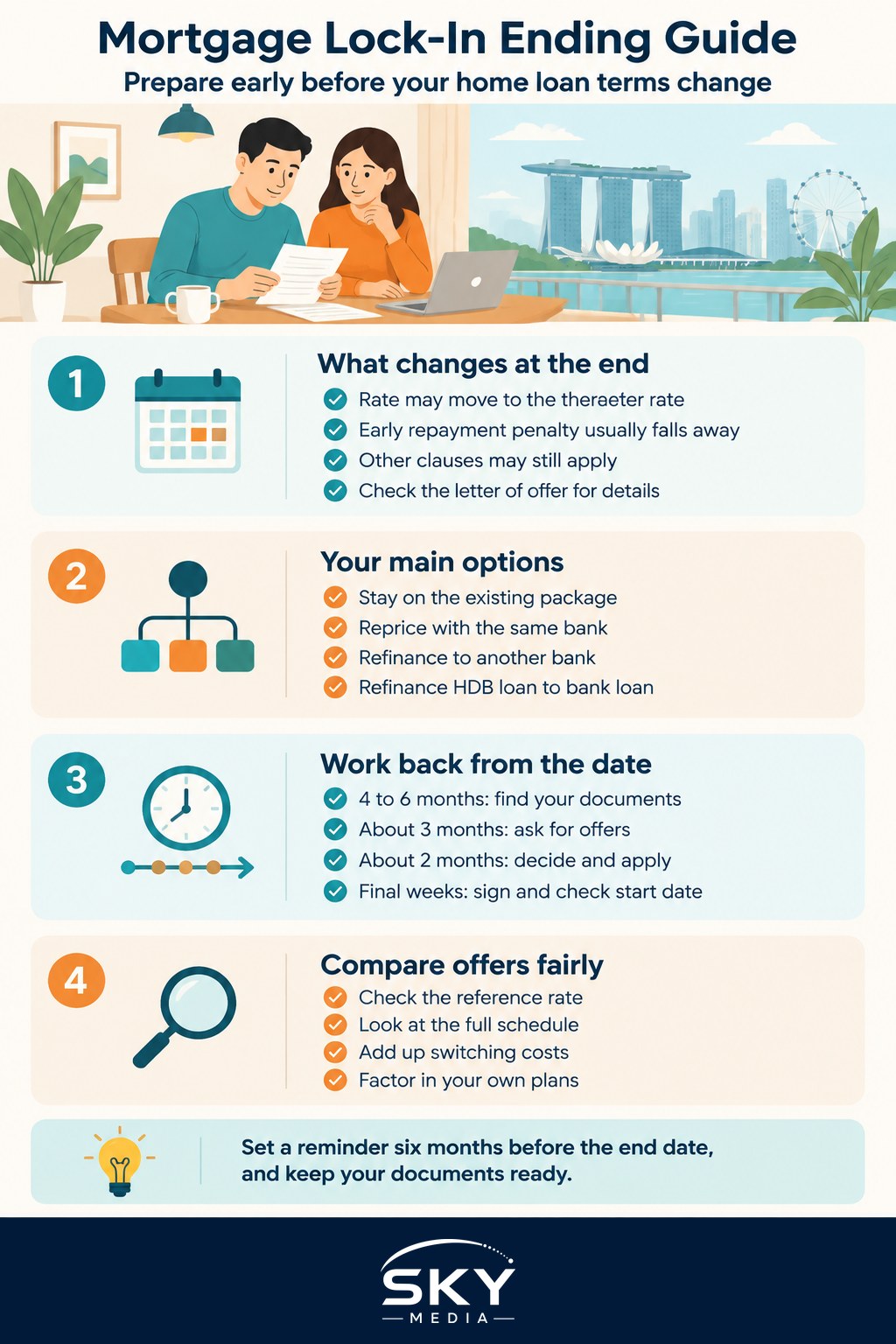
What Actually Changes When the Lock-In Ends
During the lock-in, your loan agreement usually fixes either the interest rate or the spread over a reference rate, and early repayment triggers a penalty. When the lock-in period ends:
- The rate often moves to the “thereafter” rate stated in your letter of offer. This is frequently higher than the promotional rate you started with.
- The early repayment penalty usually falls away, so you can switch packages or banks without that charge.
- Other clauses may still apply. Some packages have clawback clauses on legal or valuation subsidies, which can apply if you refinance within a set period. Check your letter of offer for these.
Find your letter of offer now. It states the lock-in end date, the rate after lock-in, and any clawback or notice requirements.
Your Main Options Before the Lock-In Expires
There are three common paths. Each has trade-offs, and the right choice depends on your loan amount, remaining tenure and how much effort you want to put in.
| Option | What it means | Typical paperwork | Points to weigh |
|---|---|---|---|
| Stay on the existing package | Do nothing and move to the thereafter rate | None | Simple, but often the most expensive over time |
| Reprice with the same bank | Switch to a new package with your current lender | Repricing form, acceptance of new letter of offer | Usually quicker; check any admin or conversion fee and new lock-in |
| Refinance to another bank | Take a new loan with a different lender to repay the current one | Full application, valuation, legal work, notice to current bank | Wider choice of rates; consider legal and valuation costs and timing |
| Refinance an HDB loan to a bank loan | Move from an HDB concessionary loan to a bank loan | Bank application and HDB procedures | One-way move, as you generally cannot switch back to an HDB loan |
The last row applies only if you have an HDB loan, which has no lock-in period, but people sometimes compare it at the same time. Confirm the current rules with HDB before deciding.
A Timeline to Work Back From
Start early. Bank and legal processes can take longer than expected, and some banks require written notice before you can redeem the loan.
Around four to six months before the end date
- Locate your letter of offer and latest loan statement.
- Note the lock-in end date, outstanding balance, remaining tenure and the thereafter rate.
- Check for any clawback period and the notice period your bank requires for full redemption.
Around three months before
- Ask your current bank for its repricing packages.
- Request indicative offers from other banks or speak to a mortgage broker. Brokers can compare several banks, but confirm how they are paid and that they are not limiting your choices.
- Compare offers on the total cost over the next few years, not only the headline rate.
Around two months before
- Decide whether to reprice or refinance.
- If refinancing, submit the application, arrange valuation and appoint a law firm, which banks often help to arrange.
- Give the required written notice to your current bank, if your loan requires it.
Final weeks
- Sign and return the acceptance of the new letter of offer.
- Check that the new loan starts on or after the lock-in end date, so you do not trigger a penalty.
- Keep copies of every document.
Paperwork to Gather in Advance
Having documents ready speeds up both repricing and refinancing. Banks commonly ask for:
- Identity documents for all borrowers.
- Latest loan statement and the original letter of offer.
- Proof of income, such as recent payslips, the IRAS Notice of Assessment for self-employed borrowers, or CPF contribution history.
- Property details, such as the title, purchase documents or the property tax bill.
- CPF usage statements if you service the loan with CPF savings, which you can access through the CPF website.
Requirements differ by bank and by borrower profile, so ask each lender for its current checklist.
How to Compare Offers Fairly
Headline rates can be misleading. When comparing:
- Check the reference rate. Packages may be fixed, or floating against a benchmark such as SORA (the Singapore Overnight Rate Average) or a bank’s own board rate. Understand how the rate can change.
- Look at the full schedule, including the rate after the new lock-in ends.
- Add up switching costs, such as legal fees, valuation fees, and any subsidies that might be clawed back if you switch again soon.
- Consider the new lock-in length. A shorter or no lock-in gives flexibility; a longer one may come with a better rate.
- Factor in your plans. If you expect to sell, upgrade or make a large partial repayment soon, flexibility may be worth more than a small rate difference.
Your borrowing is also subject to rules such as the Total Debt Servicing Ratio (TDSR) for some refinancing cases, set by MAS. Exemptions and conditions can apply, so ask the bank how these affect you.
When Life Changes Around the Same Time
A lock-in expiry is a good moment to review the bigger picture. If you plan to rent out the property or move, our guide to renewing or ending a tenancy in Singapore covers the landlord side. Older homeowners thinking about unlocking value from their property may also find reverse mortgages explained useful background, though these are different products with their own risks.
Putting a reminder in your calendar six months before the lock in period ending date is the simplest habit of all. It turns a surprise rate jump into a planned decision, made on your own timing and with your documents in order.
Frequently Asked Questions
Should I reprice with my current bank or refinance with another bank? Repricing is usually quicker and simpler, though you should check any admin fee and the new lock-in. Refinancing offers a wider choice of rates, but legal and valuation costs and timing come into play. Compare the total cost over the next few years, not just the headline rate.
Do I have to give my bank notice before I switch loans? Often, yes. Many loans require written notice before full redemption, and the required period depends on your loan agreement. Look for it in your letter of offer, and ask the bank how much notice it wants so the new loan starts on or after your lock-in end date.
What is a clawback clause in a home loan package? It is a term letting the bank recover subsidies it gave you, such as legal or valuation subsidies, if you refinance within a set period. Even after the lock-in ends, clawback may still apply. Check your letter of offer for the exact conditions before you decide to switch.
Is it worth using a mortgage broker to compare loan packages? A broker can save effort by comparing several banks, but confirm how they are paid and whether they limit your options to certain lenders. You can still check your own bank’s repricing offer. Compare every option on total cost, not on what is easiest to arrange.
Will I be affected by TDSR if I refinance my home loan? Possibly. MAS sets the Total Debt Servicing Ratio, and it can apply to some refinancing cases, though exemptions and conditions exist. Ask your prospective bank how it affects you before you apply. Check the latest rules on the MAS website, as lending rules change.
Official sources: MoneySense
Further reading: Mortgage Refinancing and Repricing Explained