

You signed up for a new life or health policy, the documents arrived, and now you are having second thoughts. Maybe the premium feels heavier than it did at the meeting, or you found that an existing plan already covers the same thing. This is exactly what the free look period in insurance is for. It is a short window after you receive your policy during which you can change your mind and cancel, usually without the penalties that apply to a normal surrender.
This guide explains how the free-look period works in Singapore, what you get back, the traps that catch people out, and how to cancel cleanly. It is general information, not financial advice. Your policy wording and your insurer have the final say on the details.
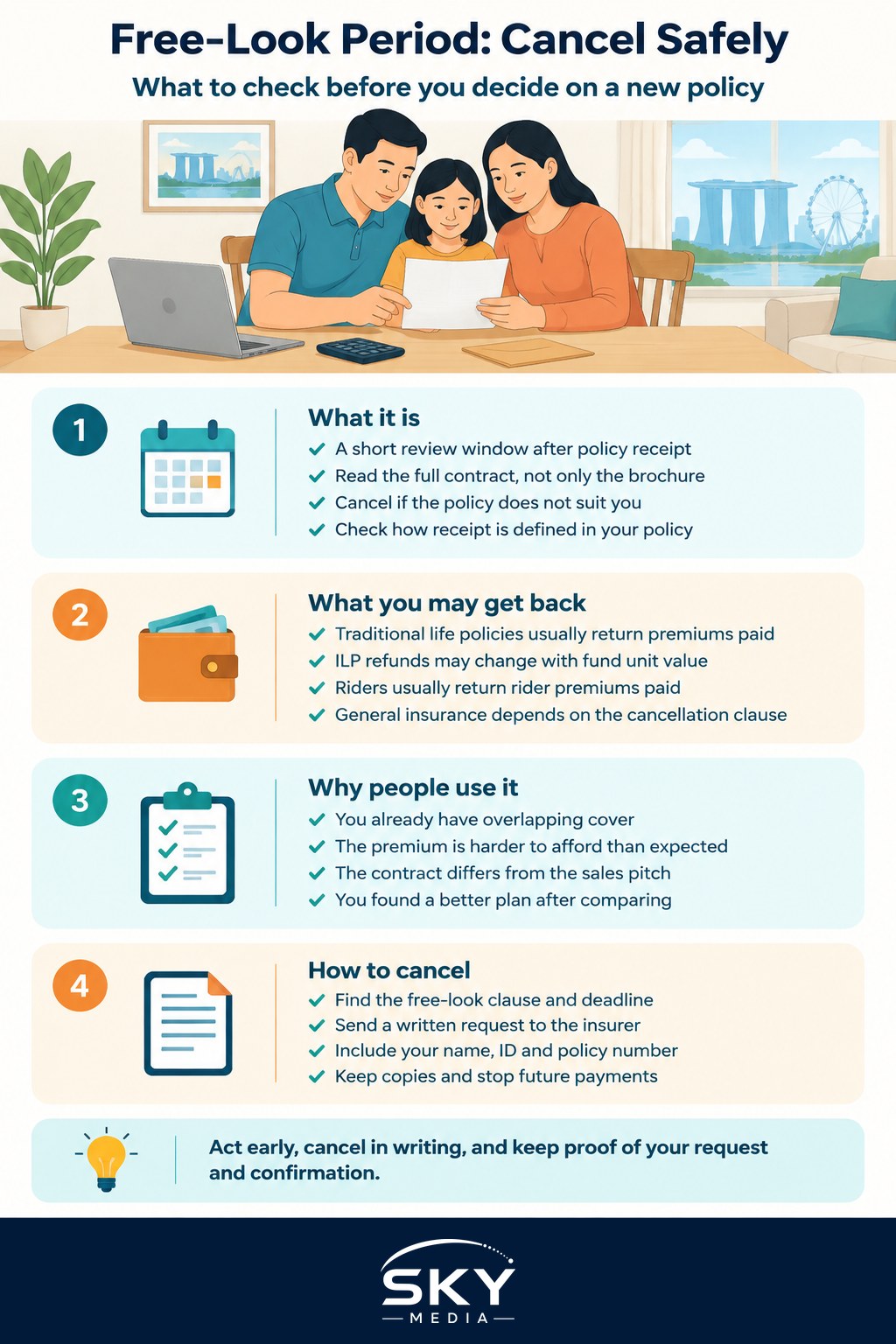
What the Free-Look Period Actually Is
The free-look period is a review window that starts once you have received your policy documents. During it, you can read the full contract (not just the sales brochure or benefit illustration) and decide whether it suits you. If it does not, you can return the policy and ask the insurer to cancel it.
In Singapore, life insurers that are members of the Life Insurance Association (LIA) commonly offer a free-look period of 14 days from the date you receive the policy. Many insurers also treat a posted policy as received a set number of days after it was sent, so the clock may start even if you never opened the envelope. Health policies such as Integrated Shield Plans and their riders usually have a free-look window too. The exact length, and how “receipt” is defined, is stated in your policy document, so check that page first.
General insurance products, such as travel, motor or home cover, work differently. Some have a cancellation clause with a pro-rated refund, while short-term covers like single-trip travel insurance may offer little or no refund once cover has started. Do not assume the life insurance free-look rules apply to every product you buy.
What You Get Back When You Cancel
The headline promise is that you can walk away “without penalty”, but that does not always mean every dollar comes back. What you receive depends on the type of policy.
| Policy type | What a free-look cancellation usually returns | Deductions to watch for |
|---|---|---|
| Traditional life (term, whole life, endowment) | Premiums you have paid | Costs the insurer incurred for medical checks or reports, if your policy allows this |
| Investment-linked policy (ILP) | Premiums paid, adjusted for any change in the value of the units bought | A fall in unit prices, plus medical costs if applicable |
| Health and hospitalisation riders | Premiums paid for the rider | Medical examination costs, if allowed by the policy |
| General insurance (travel, motor, home) | Depends on the cancellation clause, often pro-rated or none | Admin fees, minimum premium, or no refund once cover has begun |
The investment-linked case surprises people the most. Your premium was used to buy units in a fund, and if the fund has dropped by the time you cancel, the refund may be lower than what you paid. If it has risen, insurers often still cap the refund at what you paid. Read the free-look clause in an ILP carefully before assuming a full refund.
Reasons People Use the Free-Look Window
There is nothing awkward about using a right the contract gives you. Common, reasonable reasons include:
- Overlapping cover. You find your employer’s group plan, an existing rider or MediShield Life already handles much of what the new policy covers.
- Affordability. On a second look at your monthly budget, the premium is a long-term commitment you are not comfortable with.
- Mismatch with the sales pitch. The contract’s definitions, exclusions or waiting periods are narrower than you understood from the conversation.
- A better alternative. You compared options afterwards and found a plan that suits you better.
- Pressure at signing. You agreed on the spot and now realise you wanted more time to think.
If the reason is a misrepresentation by the adviser, rather than a simple change of mind, raise that with the insurer as well. Cancelling gets you out of the policy, but a complaint is the right channel for conduct issues.
How to Cancel Within the Free-Look Period
The process is usually simple, but timing matters. Work through these steps as soon as you decide.
- Find the free-look clause. Look in the policy contract or the cover letter for the number of days and how the start date is counted. Note the last day.
- Contact the insurer directly. Most insurers accept a written cancellation request, a signed form, or an online request through their customer portal. You can also go through your adviser, but sending it to the insurer yourself means there is no delay in passing it on.
- Put it in writing. State your name, NRIC or passport number, policy number, and that you are cancelling within the free-look period. Ask for written confirmation.
- Return the documents if required. Some insurers ask for the original policy contract back. Keep copies of everything you send.
- Stop future payments. If premiums are on GIRO or a recurring card charge, confirm the insurer has cancelled them. Check your next bank or card statement.
- Track the refund. Note the amount you expect and follow up if it does not arrive in a reasonable time.
If your request is late by a day or two, still ask. The insurer may treat it as a normal surrender, which can mean a much smaller payout for policies with cash value, so acting early protects you.
Mistakes That Cost People Money
- Cancelling the old policy first. If the new plan was meant to replace an existing one, do not terminate the old policy until you are sure about the new one. Once you lapse an older policy, you may not get the same terms again, especially if your health has changed.
- Letting the clock run out. The window is short and counts calendar days, not working days, in many policies. Diarise the deadline the day the documents arrive.
- Assuming the adviser has acted. Verbal requests can get lost. A written request to the insurer is your proof.
- Forgetting about linked riders. Cancelling a base plan usually ends its riders too. If you wanted to keep a rider, ask whether that is possible before cancelling.
- Ignoring underwriting consequences. A new application later may need fresh medical declarations. Being honest on every form is essential either way.
It is a bit like the checks you would do before you cancel an old credit card: sort out what depends on it, stop automatic payments, and get confirmation in writing.
Making the Most of the Window Before You Decide
You do not have to cancel to benefit from the free-look period. Use it as a structured review:
- Read the definitions and exclusions sections, not just the benefit summary.
- Check waiting periods, survival periods and any pre-existing condition exclusions.
- Compare the premium against what you pay for existing cover, and look at how premiums may change with age.
- Ask the adviser for answers in writing to anything unclear.
- For ILPs, read the product highlights sheet and fund information so you understand the charges.
If you remain unsure, MoneySense, the national financial education programme, and the Life Insurance Association both publish plain-language guides on buying and reviewing insurance. For disputes with an insurer that you cannot resolve directly, the Financial Industry Disputes Resolution Centre (FIDReC) handles complaints between consumers and financial institutions. Check their websites for current procedures, since rules and practices can change.
Quick Recap
The free-look period gives you a short, valuable second chance after buying a policy. Find the clause, note the deadline, cancel in writing to the insurer, and expect your premiums back minus any deductions the contract allows, including unit price changes for investment-linked plans. Used well, it turns a rushed decision into a considered one.
Frequently Asked Questions
Should I send a free-look cancellation to my adviser or the insurer? Send it to the insurer directly, even if you also tell your adviser. Going through the adviser can work, but a request sent to the insurer means no delay in passing it on, and you hold your own proof. Keep a copy and ask for written confirmation.
Does the free-look period apply to travel insurance? Usually not in the same way. Travel, motor and home policies are general insurance and follow their own cancellation clauses, which may give a pro-rated refund, an admin charge or no refund once cover has started. Read the cancellation wording on the policy itself before buying.
What if I miss the free-look deadline by a few days? Ask anyway, since the insurer may have some discretion, but do not count on it. A late request is often treated as a normal surrender, and for policies with cash value that can mean a much smaller payout. Note the last day as soon as the documents arrive.
Can I buy the same policy again after cancelling during the free-look period? You can apply again, but it would be a fresh application. The insurer may ask for new medical declarations, and premiums or terms can differ if your age or health has changed. Cancel only if you are sure, and be honest on every form.
Where can I complain if my adviser misled me about a policy? Raise it first with the insurer’s complaints channel, in writing. If you cannot resolve it, the Financial Industry Disputes Resolution Centre (FIDReC) handles disputes between consumers and financial institutions. Cancelling within the free-look period ends the policy, but a complaint is the proper route for conduct issues.
Official sources: MoneySense
Further reading: Buying Insurance Without an Agent: Direct Purchase Insurance and compareFIRST · What to Declare When Buying Insurance: Non-Disclosure Explained · How to Decide Between Annual and Monthly Insurance Payment