

For most upper secondary students, the mother tongue oral exam is the first national paper of the exam year. It usually happens around July, weeks before the National Day celebrations and months before the written papers in October and November. Because it comes so early, it is easy to underestimate. But the oral counts towards your final Mother Tongue Language (MTL) grade, and it is one of the few components where steady practice makes a visible difference.
This guide is for secondary students sitting the national MTL oral, whether in Chinese, Malay or Tamil. It explains the format, what each component tests, how marking generally works, and how to prepare. Exact details, such as preparation time, weightings and marking descriptors, are published by the Singapore Examinations and Assessment Board (SEAB) in the syllabus document for your subject. Your MTL teacher will also brief you, so treat this as a plain-language overview to help you make sense of that briefing.
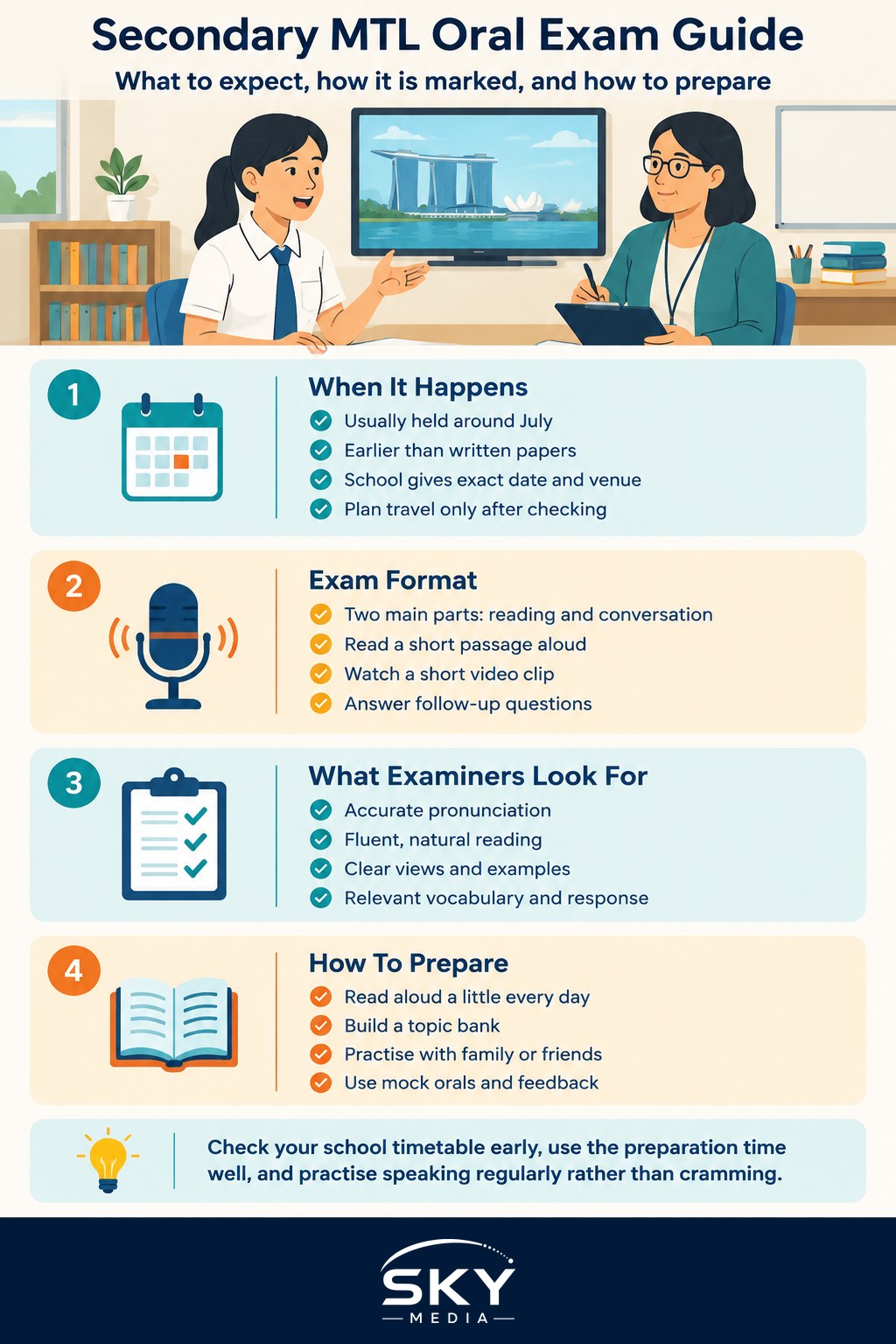
When the Oral Happens and Why It Is Early
The national exams are spread across the year. The Mother Tongue oral and listening comprehension components are usually scheduled around the middle of the year, often in July. Your school will give you your exact date, time and venue, typically via an exam timetable and an entry proof or similar document.
Why so early? Holding orals mid-year spreads out the load for schools and examiners, and it lets students finish one component before the written papers. For you, it means the oral overlaps with the mid-year holidays and the National Day lead-up. If your family is planning travel, check your exam date before anything is booked. Missing a national exam paper is not something you can simply reschedule.
The Two Main Components: Reading Aloud and Conversation
The secondary MTL oral has two main parts. The names may differ slightly between languages and syllabuses, but the structure is broadly similar.
1. Reading aloud
You are given a short passage to read aloud to the examiners. Before you enter the exam room, you usually get some time in a preparation room to read the passage silently and get familiar with it. Examiners listen for:
- Accurate pronunciation of words
- For Chinese, correct tones and handling of less common characters
- Fluency, so you read smoothly without long pauses or repeated restarts
- Expression, so your pace, pauses and emphasis match the meaning of the passage
2. Conversation based on a video stimulus
In the same preparation time, you watch a short video clip. The clip shows a situation or issue that teenagers can relate to, such as family life, school, community, technology or national topics. In the exam room, the examiners ask you questions linked to the video. The first question is usually about what you saw, and later questions move to your own views and experiences.
Examiners are looking for:
- Whether you understood the video
- How well you express and support your opinions
- Whether you can give relevant personal examples
- Range of vocabulary and accuracy of language
- How naturally you interact, including responding to follow-up questions
There are typically two examiners in the room. One may lead the conversation while both assess. This is normal and not a sign that something has gone wrong.
How Each Part Is Marked
Here is a simple overview of what each component asks of you and where students commonly lose marks.
| Component | What you do | What examiners reward | Common ways to lose marks |
|---|---|---|---|
| Preparation room | Read the passage and watch the video | Using the time well | Spending it all on one part and rushing the other |
| Reading aloud | Read the passage to the examiners | Accuracy, fluency, natural expression | Mispronounced words, flat reading, long pauses |
| Video conversation | Answer questions about the video and related issues | Clear views, relevant examples, good vocabulary | Short answers, memorised scripts that do not fit the question |
| Follow-up questions | Respond to the examiner’s prompts | Thinking on your feet, extending ideas | Saying “I don’t know” and stopping there |
The oral is one component of your MTL grade, alongside written papers and listening comprehension. The exact weighting is set out in SEAB’s syllabus for your subject and level. Ask your teacher if you are unsure how much it counts, and do not rely on figures passed around online, because syllabuses are revised from time to time.
How to Prepare in the Weeks Before
Oral preparation works best in short, regular sessions rather than one long cram. A practical plan:
- Read aloud every day. Pick newspaper articles, past school passages or textbook excerpts in your MTL. Read for five to ten minutes, ideally recording yourself so you can hear where you stumble.
- Build a topic bank. List common themes: family, friendship, school life, volunteering, technology and screen time, environment, health, festivals, National Day and community spirit. For each, note one or two personal experiences you could use.
- Learn useful phrases, not full scripts. Have a few ways to state an opinion, give a reason, compare views and conclude. Examiners can tell when a student recites a memorised essay, and it often does not answer the question asked.
- Practise with someone. Ask a parent, grandparent, sibling or friend to ask you questions in your mother tongue. Answer for at least a minute each time.
- Watch and discuss short clips. News segments or short videos in your MTL are good practice for the video component. Summarise what you saw, then give your opinion.
- Use your teacher’s mock orals. Schools usually run practice sessions. Take the feedback seriously and work on one or two points at a time.
If you are also preparing presentations for other subjects, our broader guide on preparing for oral exams and presentations has tips on nerves and delivery that apply here too.
On the Day: Practical Tips
- Arrive early and follow your school’s instructions about uniform, entry documents and where to report.
- Use the preparation time fully. Mark tricky words in the passage in your head, and note two or three points about the video.
- Speak clearly and at a steady pace. Nerves make most people speed up. Slow down slightly on purpose.
- Expand your answers. Aim for a clear opinion, a reason and an example. If the examiner asks a follow-up, treat it as a chance to show more.
- If you blank out, keep going. Ask politely for the question to be repeated, or say you need a moment to think. That is better than silence.
- Stay polite and natural. Greet the examiners and thank them at the end. Good manners will not replace content, but they help you settle.
When Mother Tongue Feels Hard
Not every student grows up speaking their mother tongue at home. If you find the oral especially difficult, talk to your MTL teacher early in the year. They can suggest targeted practice and explain what support the school offers. For background on how the system works, including different syllabuses and exemption, see Mother Tongue and bilingual learning in schools and our guide to applying for Mother Tongue exemption, which is a separate and specific process handled through your school and MOE.
The oral is short, but it rewards students who have been speaking and reading their mother tongue regularly. Start practising now, keep it consistent, and you will walk into the exam room in July knowing exactly what to expect.
Official sources: Ministry of Education (MOE)
Further reading: Taking Hindi, Bengali or Other Non-Tamil Indian Languages in Singapore Schools · Higher Mother Tongue in Secondary School: Who Can Take It After PSLE · Helping China-Born Children Prepare for the PSLE Chinese Oral