

You have just started junior college, and your timetable includes H1 Mother Tongue. Your friend, sitting next to you, does not have it at all. Why the difference? And does H1 Mother Tongue at A-Level actually matter when you apply to university?
This guide explains who takes H1 Mother Tongue Language (MTL) in JC, who is exempt, when the paper is usually taken, and how it counts in university admission. The rules come from the Ministry of Education (MOE), the Singapore Examinations and Assessment Board (SEAB) and the universities themselves, and some of them have been adjusted in recent years. Use this as a map, then confirm your own situation with your JC and the admission pages of the universities you are interested in.
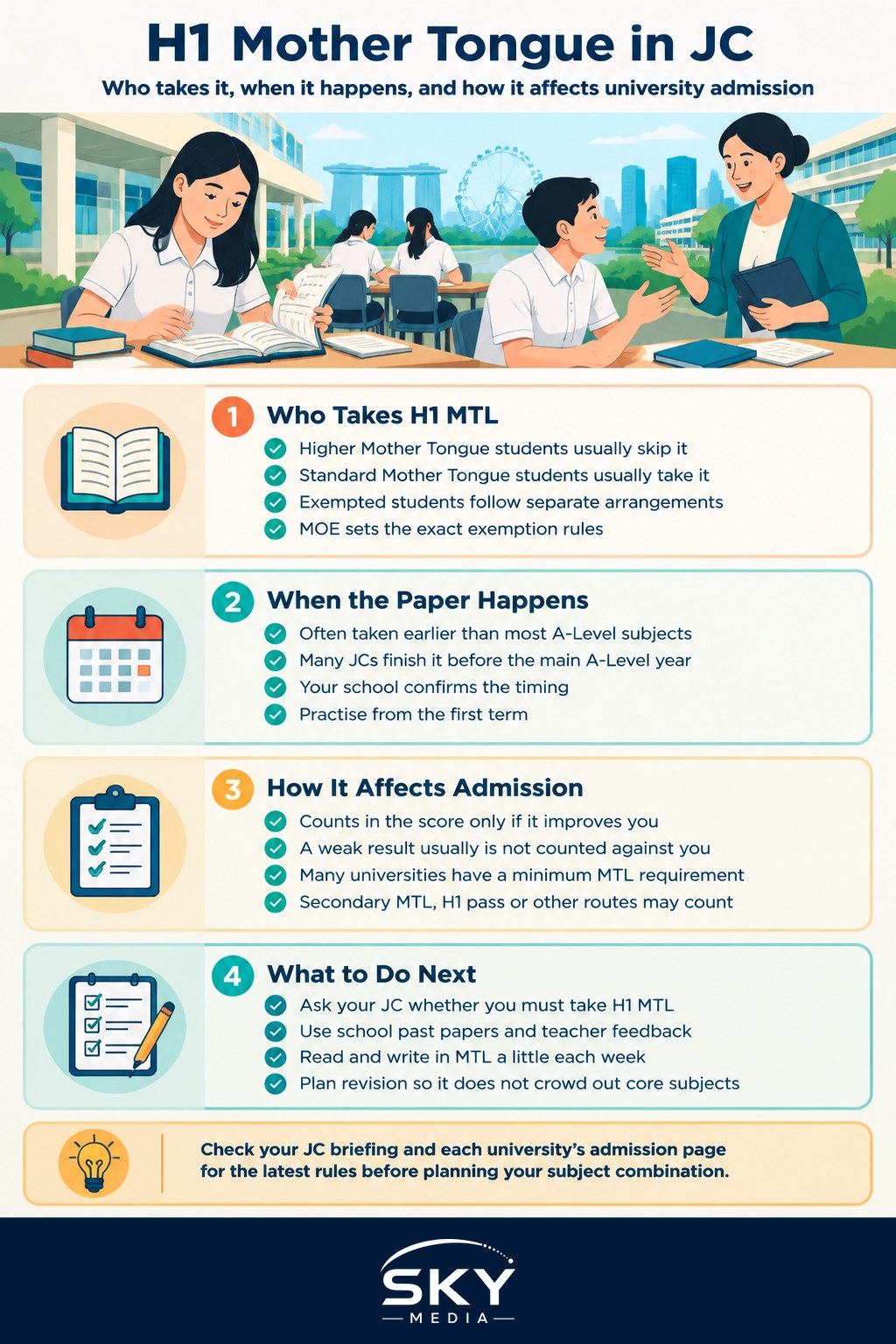
Why Some JC Students Take H1 Mother Tongue and Others Do Not
Singapore’s bilingual policy means most students continue studying a Mother Tongue Language through secondary school. When you reach JC, whether you still need to study MTL depends mainly on what you achieved at the end of secondary school.
In general:
- Students who took Higher Mother Tongue in secondary school and met the required standard usually do not need to take H1 MTL in JC. Their secondary result already fulfils the MTL requirement.
- Students who took the standard Mother Tongue syllabus usually take H1 MTL in JC, so they continue to develop the language to a higher level.
- Students who were exempted from Mother Tongue in school follow separate arrangements. If that is you, ask your JC how exemption affects your A-Level subject combination and university applications.
The exact grade needed for an exemption, and how this works for students with Singapore-Cambridge Secondary Education Certificate (SEC) results instead of O-Level results, is set by MOE. Your JC will tell you during orientation whether you are required to take H1 MTL, so pay attention to that briefing and ask if anything is unclear.
When You Sit the H1 Mother Tongue Paper
Unlike most of your A-Level subjects, which you sit at the end of JC2, H1 MTL is often taken earlier. Many JCs schedule it so that students complete it before the main A-Level year, which frees up time for their other subjects in JC2. Your school will confirm the timing.
Because the paper comes earlier, you have less time to settle in before it counts. Practical tips:
- Treat H1 MTL as a real exam from the first term, not a side subject.
- If you have an oral component, practise speaking regularly, not just in the weeks before.
- Use school past papers and teacher feedback, since the format is specific to the A-Level syllabus.
- Check whether your school offers a chance to retake the paper if your first attempt does not go well, and what the timeline would be.
How H1 MTL Counts in University Admission
This is the part most students care about. Admission to the local autonomous universities uses a University Admission Score built from your A-Level subjects, along with other factors depending on the course. How MTL fits into that score has a specific rule worth understanding.
In general, Mother Tongue is counted in the admission score only if it improves your score. If including your MTL grade would pull your score down, it is left out. That means a good H1 MTL result can help you, while a weaker one does not usually count against you in the score itself.
There is also a separate point to keep in mind:
- Many universities have a minimum Mother Tongue requirement. This is not about the score; it is a basic requirement for admission. It can often be met through your secondary MTL result, a pass in H1 MTL, or other recognised routes. If you do not meet it, the university may admit you on the condition that you meet it later. Check each university’s admission page for its current rules.
MOE has also revised A-Level scoring in recent years, including changes to how Project Work and subject combinations are treated. These changes affect the overall score structure, so check the latest university admission information when you are planning, rather than relying on what older students tell you.
Comparing Your Situation
Here is a quick general comparison of common situations. Your JC and the universities have the final word.
| Your secondary MTL background | Usual JC arrangement | What it means for university |
|---|---|---|
| Higher Mother Tongue, met the required standard | Usually not required to take H1 MTL | Minimum MTL requirement usually already met |
| Standard Mother Tongue | Usually take H1 MTL in JC | H1 MTL result counts in the score only if it helps; a pass can meet the minimum requirement |
| Standard Mother Tongue, H1 MTL not passed on the first try | May be able to retake, depending on school arrangements | Check whether the minimum requirement can be met later or by another route |
| Exempted from Mother Tongue | Separate arrangements set by the school and MOE | Check each university’s policy for exempted students |
Making H1 MTL Work for You
Even if H1 MTL only counts when it helps, it is worth doing well. A strong result is a safety net if one of your other subjects disappoints, and it keeps your language skills useful for work, travel and family life.
Some practical ways to approach it:
- Know your target. Find out from your teacher what grade would help your admission score, given your other subjects.
- Do a little often. Read a news article or short essay in your Mother Tongue a few times a week. Write short responses to stay in practice.
- Link it to real topics. H1 MTL papers often deal with current issues. Following news in your MTL helps with both content and vocabulary.
- Balance your load. Since the paper often comes before your H2 subjects, plan revision so it does not crowd out your core content subjects. Our guide on how to study for the A-Levels has a good overall framework.
- Plan your subject combination with MTL in mind. If you are still deciding on subjects, see how to choose between H1, H2 and H3 subjects, and factor in whether you will also have H1 MTL in your first year.
Where to Check the Rules
The MTL rules for JC and university touch several bodies, so it helps to know where to look:
- Your JC: whether you must take H1 MTL, when you sit it, and retake options
- MOE: the policy on Mother Tongue requirements, exemption and A-Level subject combinations
- SEAB: the H1 MTL syllabus, exam format and timetable
- Each university’s admission page: how MTL counts in the admission score and the minimum MTL requirement
For background on why Singapore requires Mother Tongue in the first place, read the bilingual and Mother Tongue policy explained. If you were exempted earlier, our guide to applying for Mother Tongue exemption explains how that process works.
H1 Mother Tongue is a small subject on your timetable, but understanding how it works early in JC1 means no surprises when university applications open.
Official sources: SEAB · Ministry of Education (MOE)
Further reading: How the Mother Tongue Oral Exam Works in Secondary School