

In Singapore’s national schools, every student usually studies two languages: English, and a Mother Tongue Language (MTL), most commonly Chinese, Malay or Tamil. For families arriving from overseas, the MTL requirement can raise questions, especially for children who have studied in a different system. A mother tongue exemption in Singapore allows some students to be excused from studying or being examined in MTL, but it is granted only in specific situations.
This guide explains who may be considered, how the application usually works through the school, what exemption means for exams such as the PSLE (Primary School Leaving Examination), and alternatives to think about. It is general information. The Ministry of Education (MOE) sets and reviews the rules, so confirm current details with your child’s school and on the MOE website.
A Note for Families From Mainland China
If you are moving from mainland China, your child will most likely take Chinese as their MTL. In China, Chinese (语文) is the main language of teaching. In Singapore, it is the opposite: English is the main language of instruction for almost all subjects, and Chinese is taught as one subject.
For most children who studied in China, this means Chinese is a strength, not a problem. Their Chinese may already be at or above the level of their Singaporean classmates, while English is the area that needs more support. In this situation, applying for MTL exemption is usually unnecessary and may not be in your child’s interest, because a good MTL result can help their overall exam performance.
Exemption becomes relevant for some newcomer families when:
- The child grew up mainly in an English-speaking country and has little or no Chinese.
- The child’s family language is not one of the MTLs offered, and they have had no opportunity to learn one.
- The child has a diagnosed learning difficulty that makes learning two languages extremely hard.
For background on why Singapore requires two languages, see our explainer on the bilingual and Mother Tongue policy.
Who May Be Considered for Exemption
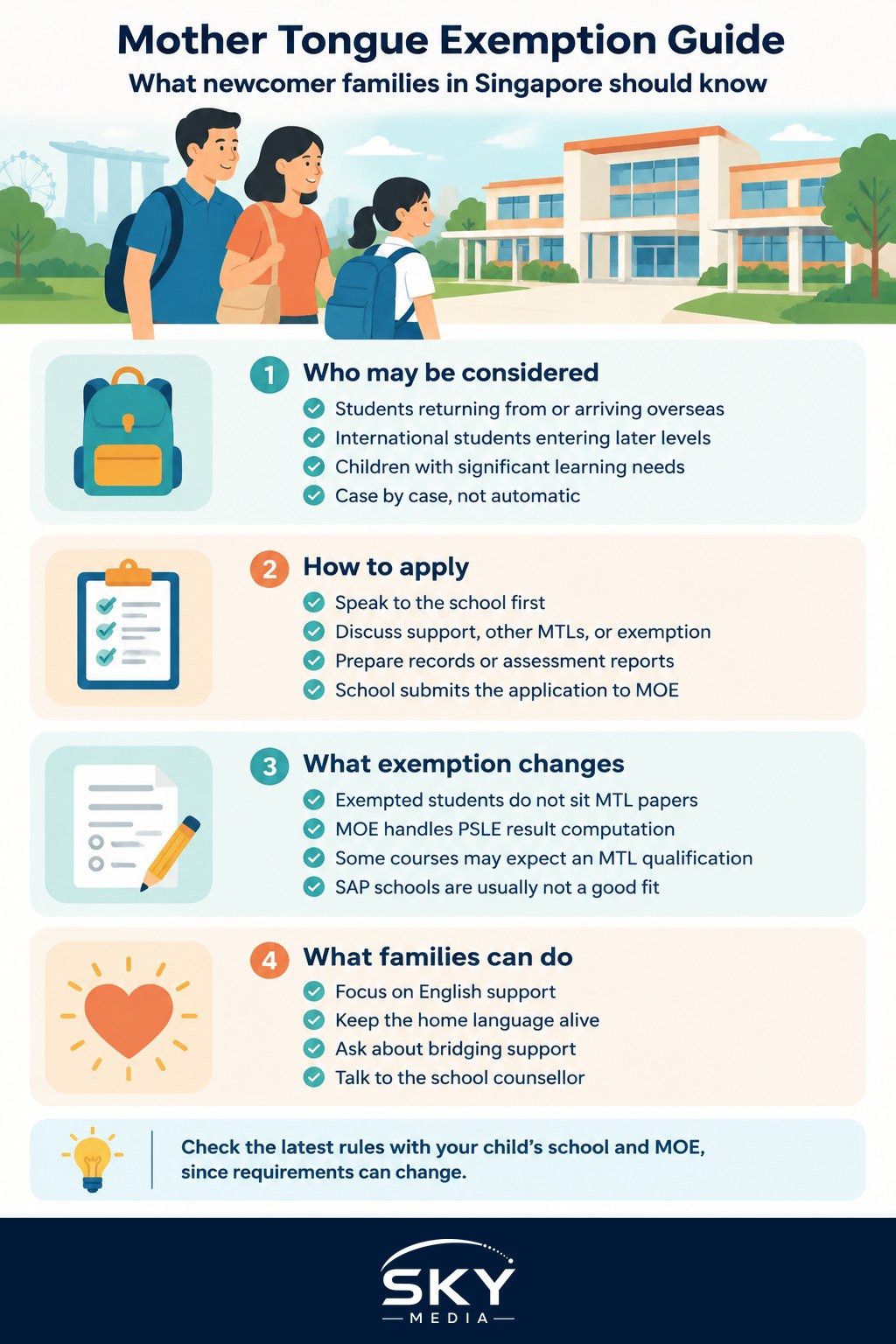
MOE considers MTL exemption on a case-by-case basis. Commonly, students in these broad situations may be considered:
- Students returning from or arriving from overseas. Children who have lived abroad for a long period and did not study an MTL, joining the Singapore system partway through.
- International students. Foreign students admitted into national schools at a later level, who have not learned an MTL before.
- Students with special educational needs. Children with significant learning difficulties, supported by professional assessment reports, where studying an MTL would be a heavy burden.
Being a foreigner, or not speaking the language at home, does not automatically qualify a child. MOE looks at the child’s background and needs as a whole. Specific criteria, required documents and deadlines are set by MOE and can change, so ask the school for the current requirements.
How the Application Process Usually Works
Parents do not apply to MOE directly in most cases. The process normally goes through your child’s school.
- Talk to the school. Speak to the form teacher, the MTL department or the school’s administrative staff. Explain your child’s language background.
- Discuss options first. The school may suggest support for learning the MTL, a different MTL, or exemption, depending on your child’s situation.
- Prepare documents. These may include school records from overseas, evidence of time spent abroad, or professional assessment reports for learning difficulties. Translate documents into English where the school asks.
- School submits the application to MOE. The school sends the application with its recommendation.
- MOE decides. MOE reviews the case and informs the school of the outcome, which the school then shares with you.
- Plan the next steps. If exemption is approved, ask the school how your child’s timetable will change. If it is not approved, ask what support is available.
Timing matters
Applying early helps. Raise the question when you first enrol your child, especially if they are joining in upper primary or secondary school. Late applications close to major exams may be harder to arrange. Ask the school about any cut-off dates.
What Exemption Means for Exams and Progression
Exemption affects how your child is assessed:
- PSLE. An exempted student does not sit the MTL papers. MOE has its own method for computing the overall result and for posting to secondary school in such cases. Ask the school how this works for your child.
- Secondary school and beyond. Admission to some programmes, schools or courses may expect an MTL qualification. Exemption may limit some options, so check requirements for the paths your child is interested in.
- Special Assistance Plan (SAP) schools. These schools have a strong emphasis on Chinese. An exempted student is unlikely to be a good fit for them.
| Option | What it involves | Points to consider |
|---|---|---|
| Take Chinese as MTL | Study Chinese alongside English, like most classmates | Usually best for children educated in China, focus support on English |
| Take another MTL or approved language | Study a different language MOE allows | May suit children with a different family language |
| Apply for MTL exemption | Be excused from MTL lessons and exams, if MOE approves | Granted case by case, may affect some later education options |
| Stay in MTL with extra support | Remain in MTL with tuition or school support | Keeps options open while the child catches up |
Supporting Your Child Through the Decision
Whatever route you choose, focus on your child’s confidence and wellbeing:
- Be realistic about English. For many China newcomers, English is the bigger gap. Look into the school’s English support, reading programmes and library resources.
- Keep the home language alive. Even if your child is exempted, continuing to read and speak Chinese at home has long-term value.
- Ask about bridging support. Schools may offer extra help for newcomers adjusting to a new curriculum.
- Talk to the school counsellor if your child is anxious about language or exams.
For a broader look at how MTL classes are taught, read Mother Tongue and bilingual learning in schools.
Key Takeaways for Newcomer Parents
- Most children from mainland China take Chinese as their MTL and do well in it, so exemption is usually not needed.
- Exemption is decided by MOE case by case, mainly for children from overseas backgrounds without MTL study, international students joining later, and students with significant learning needs.
- Applications usually go through the school, with supporting documents.
- Exemption affects PSLE computation and may affect later education options.
- Rules change, so always confirm the latest details with the school and MOE.
Official sources: Ministry of Education (MOE)
Further reading: Taking Hindi, Bengali or Other Non-Tamil Indian Languages in Singapore Schools · How the Mother Tongue Oral Exam Works in Secondary School