
Cars in Singapore cost a lot to own, so it is no surprise that many owners want to keep the paint looking new for the whole COE period. Paint protection film, usually shortened to PPF, has become one of the most popular ways to do that. This guide explains what paint protection film in Singapore actually protects against, how coverage options and costs differ, how PPF compares with ceramic coating and how to choose an installer.
What Paint Protection Film Is
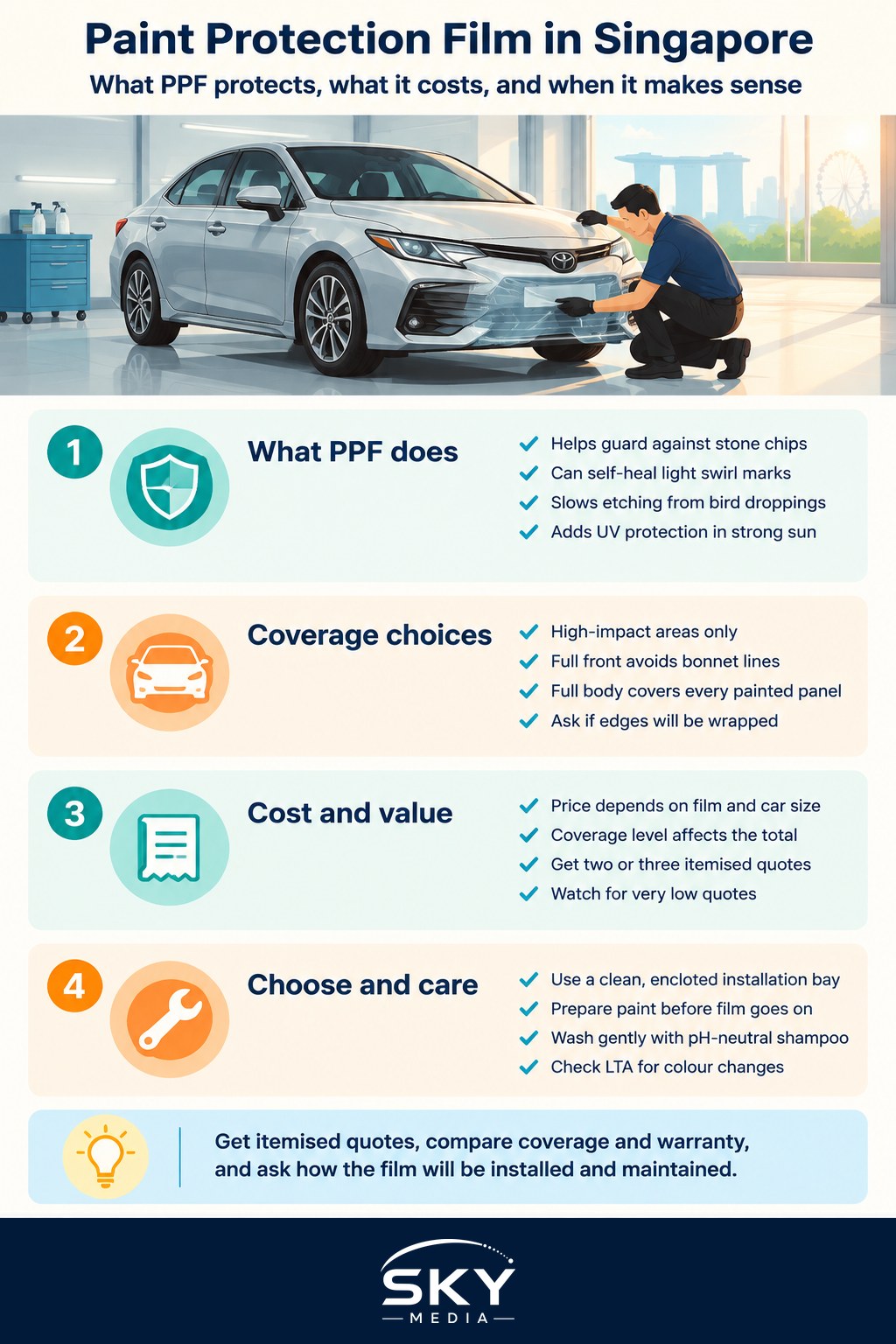
PPF is a clear, flexible film applied over a car’s painted panels. Most modern films are made of thermoplastic polyurethane (TPU), with a protective top coat. Once installed, it is hard to see, but it acts as a sacrificial layer between your paint and the road.
What PPF is good at:
- Stone chips. Small stones and debris thrown up on expressways are the main reason people buy PPF. The film absorbs impacts that would otherwise chip the paint on the bumper and bonnet.
- Light scratches and swirl marks. Many films have a self-healing top layer. Fine scratches from washing or brushing past the car fade with heat from the sun or warm water.
- Bird droppings, tree sap and insect residue. The film gives you a little more time before these acidic deposits etch into the clear coat.
- Sun exposure. Quality films carry UV inhibitors, which helps under Singapore’s strong, year-round sun.
What PPF does not do: it does not stop deep scratches from keys or sharp objects, it will not prevent dents, and it does not fix paint damage that already exists. Any chips or swirls should be corrected before the film goes on, or they will be sealed underneath.
Coverage Options
Installers usually offer several levels of coverage. The more area you cover, the higher the cost.
- High-impact areas only. Front bumper, the leading edge of the bonnet, side mirrors and sometimes headlights. This protects the most chip-prone spots at a lower price.
- Full front. The whole bonnet, front bumper, front fenders, mirrors and often the A-pillars and roof edge. This avoids a visible line partway across the bonnet.
- Full body. Every painted panel. This is the most expensive option and is popular with owners of new, high-value or dark-coloured cars.
- Extra add-ons. Door edges, door handle cups, boot sill and rocker panels, which take a lot of wear from shoes, bags and car park pillars.
Ask whether edges will be wrapped around panel edges or cut short. Wrapped edges look cleaner and are less likely to lift, but take more skill.
How Much Does PPF Cost?
Prices vary widely depending on the film brand and grade, the size and shape of your car, the coverage level, how much paint correction is needed and the installer’s experience. Full-body PPF on a large car can cost several times more than a partial front package on a compact car.
Rather than rely on figures you see online, get at least two or three itemised quotes for your specific car. Each quote should state:
- The exact film brand and product line
- Which panels are covered and whether edges are wrapped
- Whether paint correction and cleaning are included
- The warranty length and what it covers (yellowing, peeling, cracking, bubbling)
- Whether the warranty is from the manufacturer, the installer or both
Be wary of quotes that are much lower than the rest. They may use lower-grade film, skip paint preparation or rely on pre-cut kits that leave larger gaps.
PPF vs Ceramic Coating
The two are often confused, and some shops bundle them. They do different jobs.
| Feature | Paint protection film | Ceramic coating |
|---|---|---|
| What it is | A thick physical film over the paint | A thin liquid coating that bonds to the paint |
| Stone chip protection | Strong, absorbs impacts | Minimal |
| Light scratch resistance | Good, often self-healing | Some resistance to very fine marks |
| Gloss and easy cleaning | Good, better with a coated top layer | Excellent water beading and easier washing |
| Typical upfront cost | Higher, especially full body | Lower than full-body PPF |
| Removal | Can be peeled off by a professional | Wears off over time or is polished away |
Many owners choose a combination: PPF on the front and other high-impact areas, plus a ceramic coating over the whole car, including on top of the film, for easier washing and gloss. If you are deciding between traditional wax and ceramic only, that is a separate question, and our guide to protecting your car’s paint from the sun covers the basics of UV care.
Is PPF Worth It in Singapore?
PPF tends to make sense if you:
- Have just bought a new car and want to keep the original paint for resale
- Drive often on expressways, where stone chips are most common
- Own a dark-coloured car, where chips and swirl marks show easily
- Park outdoors under trees or at open-air car parks
- Plan to keep the car for most or all of its COE period
It may be less worthwhile if your car is older with existing paint damage, you mainly drive short distances in town, or you plan to sell soon and the buyer is unlikely to pay more for protected paint. In that case, a partial front package or a good ceramic coating may give better value.
Choosing an Installer
The film matters, but the installation matters as much. Look for:
- A clean, enclosed bay. Dust trapped under the film causes bumps that cannot be fixed without reapplying the panel.
- Proper preparation. A thorough wash, decontamination and paint correction where needed before film goes on.
- Experience with your model. Complex bumpers and sensors need careful cutting and trimming.
- Clear aftercare guidance. Most installers advise not washing the car for a few days while the film settles.
- Photos of past work. Ask to see close-ups of edges and corners, not just glossy wide shots.
Small bubbles or haze in the first days can be normal as moisture evaporates, but ask the installer what to expect and when to come back.
Caring for PPF and Other Practical Points
- Wash with a pH-neutral car shampoo and soft mitt. Avoid harsh solvents on the film.
- Avoid pointing a pressure washer directly at film edges at close range.
- Remove bird droppings promptly even with PPF.
- If a panel is damaged in an accident, the film on it will need replacing after repair.
- When film reaches the end of its life, have it removed professionally to avoid lifting the paint.
If you choose a coloured, matte or tinted film that changes the look of your car’s paint, check with the Land Transport Authority (LTA) whether you need to update the vehicle’s registered colour. Clear gloss film does not normally change the colour, but confirm current requirements on LTA’s website if you are unsure.
Explore more: Is a Weekend Car Worth It? for owners weighing the full cost of keeping a car in good condition.
Frequently Asked Questions
Do I need to update my car’s registered colour with LTA after PPF? Clear gloss film does not normally change the colour, but coloured, matte or tinted film that changes the look of your paint may. Check LTA’s website for the current requirements if you are unsure.
Can I wash my car right after getting PPF? Most installers advise not washing for a few days while the film settles. Small bubbles or haze in the first days can be normal as moisture evaporates, so ask the installer what to expect and when to come back.
What happens to PPF if my car is in an accident? If a panel is damaged in an accident, the film on it will need replacing after the repair. PPF does not prevent dents, so it will not save the panel itself.
Is PPF worth it on an older car with existing paint damage? Often not. PPF does not fix existing damage, and chips or swirls get sealed underneath if not corrected first. A partial front package or a good ceramic coating may give better value on an older car.
Can I combine PPF with a ceramic coating? Yes, many owners do. They put PPF on the front and other high-impact areas, then add a ceramic coating over the whole car, including on top of the film, for easier washing and gloss.
Further reading: How to Clean Tree Sap and Bird Droppings Off Your Car · Rust Prevention for Cars · Wax Versus Ceramic Coating