

Waiting for a Build-To-Order (BTO) flat can take several years, and life does not pause in the meantime. Couples get married, babies arrive, and living with parents or renting on the open market starts to feel tight on space or budget. The Parenthood Provisional Housing Scheme (PPHS) is HDB’s answer to that gap: a pool of interim rental flats that eligible young families can rent at a more affordable rate while they wait for their own home to be completed.
This guide explains how the scheme works in practice, who it is designed for, and how to decide whether it is the right move for your family. Eligibility rules, rents and application windows are set by the Housing & Development Board (HDB) and can change, so always confirm current details on the HDB website or HDB Flat Portal before you apply.
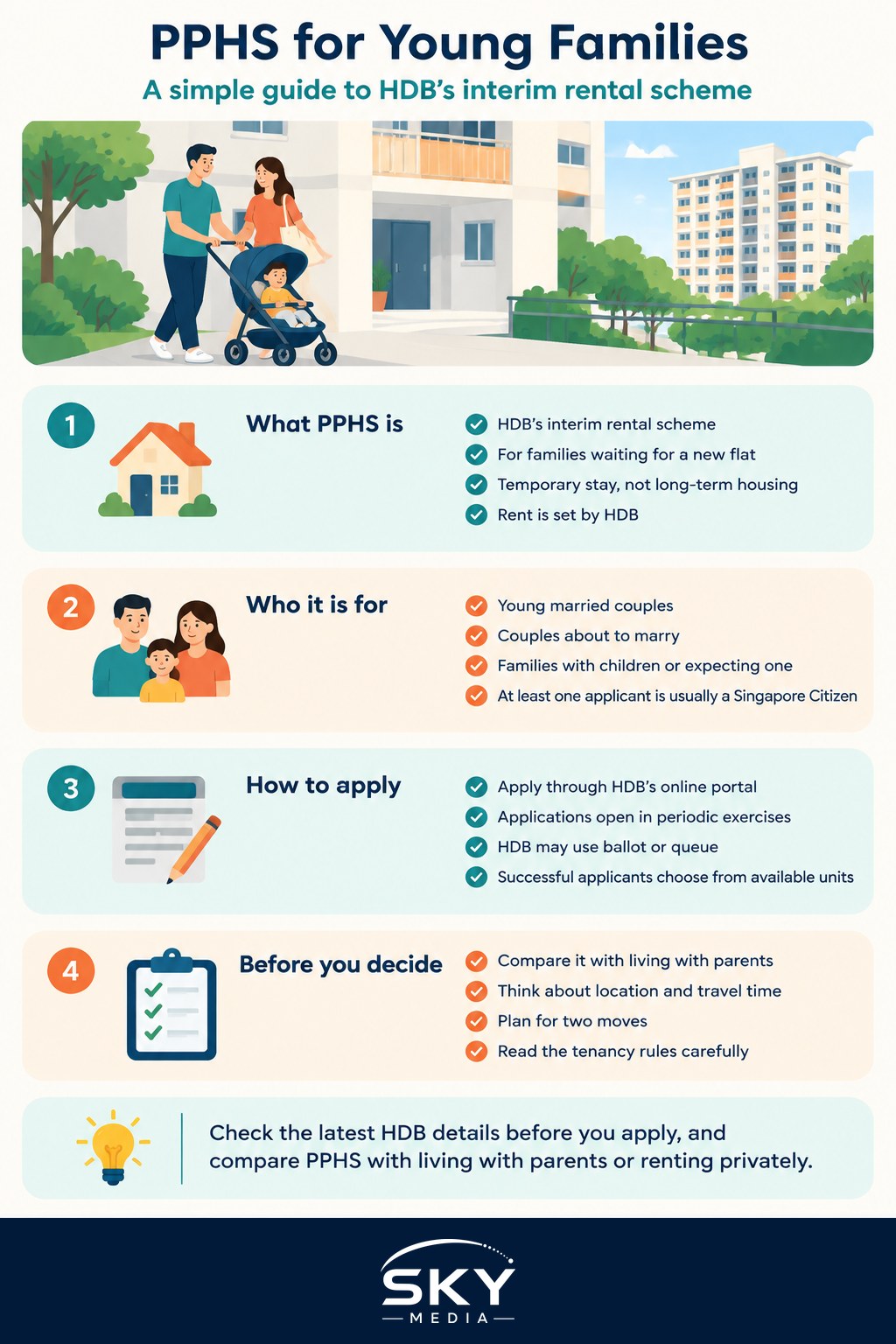
What the PPHS Is and How It Differs From Open-Market Renting
The PPHS is a government rental option, not a private tenancy. HDB sets aside flats in various estates and rents them to eligible families for a temporary period, typically until they collect the keys to their new flat.
The key differences from renting on the open market are:
- Who you rent from. Your landlord is HDB, not a private owner, so there is no agent negotiation and no bargaining over rent.
- Who can apply. Only families who meet HDB’s criteria can apply. Open-market rentals are open to anyone who can agree terms with the owner.
- Rent level. PPHS rents are set by HDB and are generally intended to be lower than comparable open-market rents. The exact amounts depend on the flat type and location, and HDB publishes the current figures.
- Choice and availability. You choose from what HDB offers in each exercise. Popular estates can be oversubscribed, and the flats on offer may not be near your workplace or your future BTO.
- How long you stay. The tenancy is tied to your waiting period. It is not designed as a long-term home.
If you are weighing PPHS against renting privately, it helps to know your full housing timeline first. Our guide to buying a home as a young couple in Singapore covers that bigger picture.
Who the Scheme Is Designed For
The PPHS targets young married couples and families who have committed to buying a new flat and are waiting for it, as well as some families with young children. In broad terms, HDB looks at factors such as:
- Marital and family status. The scheme is aimed at married couples, couples who are about to marry, and families with children or who are expecting a child. Some categories get priority, such as families with young children.
- Flat purchase status. Many applicants have booked a new HDB flat and are waiting for completion. HDB may also consider families in other situations, so check the current categories.
- Citizenship. At least one applicant is usually required to be a Singapore Citizen, with the other a Citizen or Permanent Resident, but the exact combination rules are set by HDB.
- Income and property ownership. There are typically income ceilings and restrictions on owning other property, locally or overseas.
Because these conditions are detailed and updated from time to time, use HDB’s eligibility checker rather than relying on a summary. The scheme sits alongside other family-focused support, which our guide to marriage and parenthood schemes in Singapore explains.
How the Application Usually Works
HDB runs PPHS applications through its online portal, usually in periodic exercises rather than as a first-come, first-served listing. The broad flow looks like this:
- Check eligibility. Log in with Singpass and review the current criteria for your household.
- Apply during an open exercise. Submit your application with details of both applicants, any children and your flat booking, if you have one.
- Wait for the outcome. If there are more applicants than flats, HDB allocates by ballot or queue, with priority groups given better chances.
- Select a flat. Successful applicants are invited to choose from available units, usually by flat type and estate.
- Sign the tenancy and collect keys. You pay a deposit and the first month’s rent, then move in.
- Renew if needed. Tenancies are usually for a fixed term and can often be renewed while you remain eligible and are still waiting for your flat.
- Return the flat. Once you collect your new home, you hand back the PPHS flat in good condition.
Expect to provide documents such as your marriage certificate or proof of intended marriage, your child’s birth certificate if applicable, and income documents. HDB will tell you exactly what it needs.
PPHS, Living With Parents or Open-Market Renting
Most waiting families end up in one of three arrangements. Here is how they typically compare:
| Option | Typical cost | Pros | Trade-offs |
|---|---|---|---|
| PPHS flat | HDB-set rent, generally below open market | Your own space, stable landlord, no agent fees | Limited choice of estate, may be oversubscribed, eligibility conditions apply |
| Living with parents | Usually lowest, though many contribute to household costs | Family support with childcare, no moving costs | Less privacy, can be cramped once a baby arrives |
| Open-market rental | Set by the market, can be high | Widest choice of location and flat type | Agent fees, rent changes on renewal, owner may not renew |
Many couples move between these over a long BTO wait. For example, they might live with parents during the first years, then apply for a PPHS flat once a baby is on the way.
Practical Tips for Families Considering the Scheme
- Map your timeline. Note your expected BTO completion date and work backwards. A PPHS flat is most useful when you still have a meaningful wait ahead.
- Think about location honestly. A cheaper flat far from both sets of grandparents may cost more in time and childcare than you save in rent.
- Budget for moving twice. You will move into the PPHS flat and then again into your BTO. Plan simple, movable furniture rather than built-ins you cannot take with you.
- Read the tenancy rules. There are conditions on subletting, renovations, pets and how you use the flat. Breaching them can end the tenancy.
- Keep your BTO plans on track. Taking up a PPHS flat does not change your obligations for your new flat, such as financing, the Ethnic Integration Policy or minimum occupation rules for that flat.
- Do not let it delay your financing. Keep track of your HDB Flat Eligibility (HFE) letter and loan arrangements so key collection goes smoothly. Our guide to using your CPF to buy a home is a good place to start on the money side.
Questions to Ask Before You Commit
Before signing a tenancy, ask yourself and, where relevant, HDB:
- How long am I likely to wait for my own flat, and how long can I stay in the PPHS flat?
- What happens if my BTO is delayed, or if my family circumstances change?
- What costs are included in the rent, and what will I pay separately, such as utilities and service and conservancy charges?
- What condition must the flat be returned in, and how is the deposit handled?
Answering these up front helps you avoid surprises during a period that is already busy with wedding plans, a new baby or both.
The Parenthood Provisional Housing Scheme will not suit every family, but for many it offers a stable, affordable bridge between marriage and moving into a first home. Check the latest details on HDB’s website, compare it honestly with your other options, and pick the arrangement that lets your family settle in calmly while you wait.
Frequently Asked Questions
Can I apply for a PPHS flat before my BTO is booked? The article says many applicants have already booked a new HDB flat and are waiting for completion, though HDB may consider other situations too. Eligibility categories change, so use HDB’s eligibility checker on the HDB website to see where your household stands before applying.
What costs come on top of rent for a PPHS flat? You pay a deposit and the first month’s rent when you sign the tenancy. Other charges, such as utilities and service and conservancy charges, may be paid separately, so ask what the rent includes. Current amounts are published by HDB.
What if my BTO is delayed while I am in a PPHS flat? Tenancies are usually for a fixed term and can often be renewed while you remain eligible and are still waiting for your flat. Ask HDB what happens if your completion date moves or your circumstances change, and check this before signing.
Can I renovate or keep pets in a PPHS flat? Expect restrictions. The tenancy has conditions on subletting, renovations, pets and how you use the flat, and breaching them can end the tenancy. Read the rules before signing, and choose movable furniture rather than built-ins.
Is the PPHS worth it if my BTO is only a few months away? Probably not. The scheme is most useful when you still have a meaningful wait ahead, because you must move in and then move out again. Work backwards from your expected key collection date, and weigh moving costs against rent saved.
Official sources: HDB
Further reading: HDB Interim Rental Housing: Who Qualifies and How It Works