

Coming into a bonus, an inheritance or simply a healthier savings balance often triggers the same thought: why not clear the car loan and stop paying interest? It sounds obviously smart, but car loan early repayment in Singapore works differently from paying down a home loan. Most car loans here use a flat interest rate and calculate your rebate using a method called the Rule of 78, and many lenders add an early settlement fee on top. The result is that you often save less than you expect.
This guide explains how that calculation works, what fees to look for in your loan agreement, and how to decide whether settling early is worth it. It is general information, not financial advice, so check your own agreement and speak to your lender before acting.
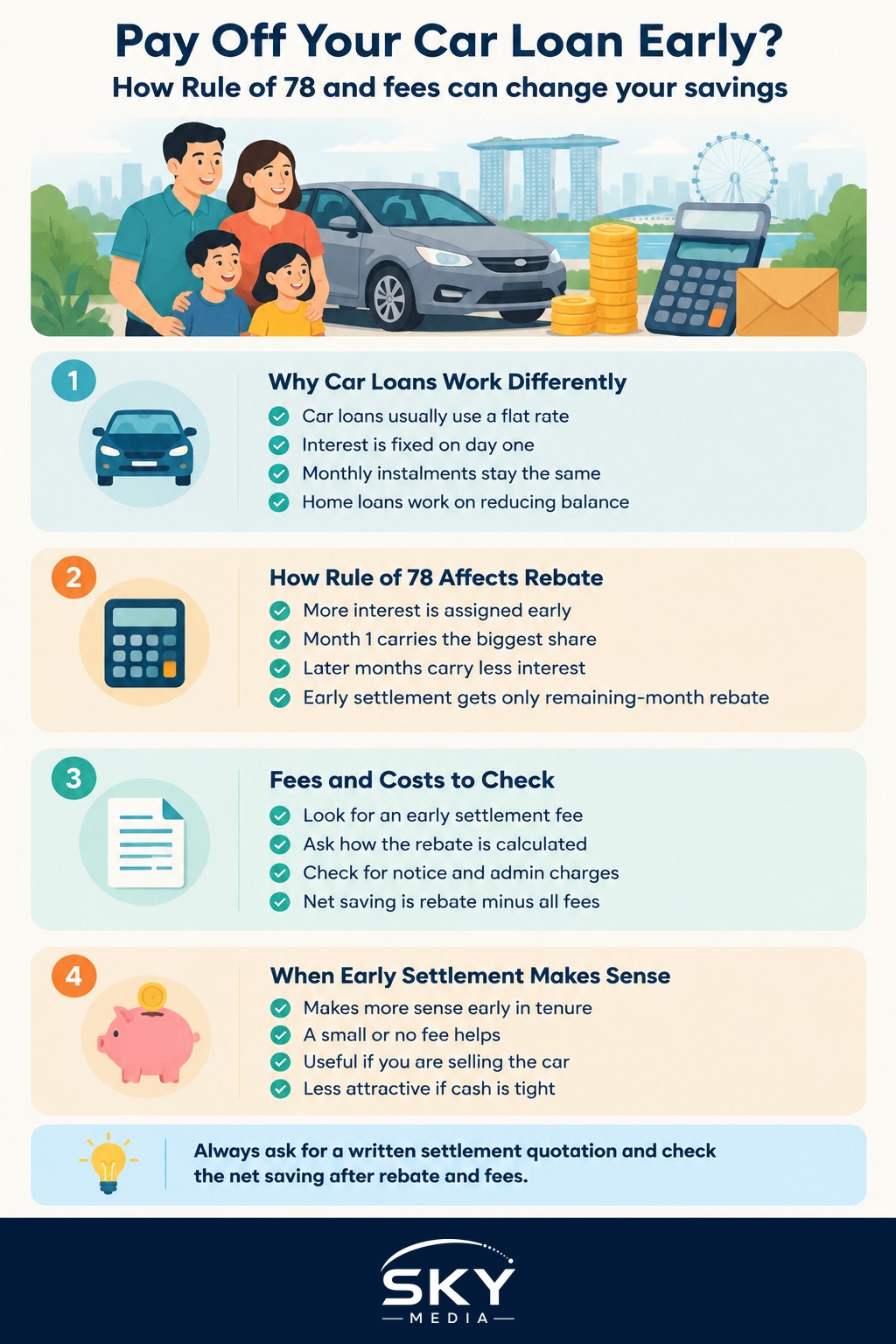
Why Car Loans Are Different From Home Loans
Most Singapore car loans are quoted as a flat rate. The interest is worked out on the original loan amount for the full tenure, added to the principal, and then divided into equal monthly instalments. You pay the same amount every month, and the total interest is fixed on day one.
Home loans, by contrast, usually charge interest on the reducing balance, so every extra dollar you repay immediately cuts future interest. Our guide to paying off your home loan early covers that very different situation.
With a flat-rate car loan, the question becomes: if you settle early, how much of that pre-calculated interest do you get back? That is where the Rule of 78 comes in. For a refresher on how car loans are structured in the first place, see our overview of car loans in Singapore.
How the Rule of 78 Works
The Rule of 78 is a way of splitting the total interest across the months of a loan so that more interest is assigned to the early months and less to the later ones. It gets its name from a 12-month loan: add up the numbers 1 to 12 and you get 78.
Here is the logic for a 12-month loan:
- In month 1, you are treated as paying 12/78 of the total interest.
- In month 2, 11/78.
- And so on, until month 12, which carries just 1/78.
For longer loans the same principle applies with a bigger total. A 60-month loan uses the sum of 1 to 60, which is 1,830. An 84-month loan uses the sum of 1 to 84, which is 3,570.
When you settle early, the lender rebates only the interest assigned to the remaining months. Because the early months carry the heaviest weighting, the rebate is smaller than a simple straight-line split would suggest.
A worked example (illustrative numbers only)
Imagine a 60-month car loan where the total interest charged is $10,000. You decide to settle after 24 months, so 36 months remain.
- Rule of 78 rebate: add up 1 to 36, which is 666. Divide by 1,830 and you get about 36.4%. Your interest rebate is roughly $3,640.
- Straight-line comparison: 36 of 60 months remain, which is 60%. A straight-line rebate would be $6,000.
So under the Rule of 78, you have effectively already “paid” about 63.6% of the total interest after just 40% of the tenure. These figures are hypothetical to show the method. Your lender’s statement will show the actual rebate, and some lenders may use a different formula, so always ask.
Early Settlement Fees and Other Costs
On top of a smaller rebate, many car loan agreements include an early settlement fee (sometimes called an early redemption fee or penalty). Lenders express it in different ways, for example as a percentage of the interest rebate, a percentage of the outstanding amount, or a fixed administrative charge. The amount and method vary by lender and by the date your loan was taken, so there is no single figure that applies to everyone.
Before you decide, look for these items in your loan agreement or ask your lender for a full settlement quotation:
- The outstanding principal
- The interest rebate and how it was calculated
- Any early settlement fee or penalty
- Any notice period required, since some lenders ask for written notice in advance
- Admin charges, such as a fee for releasing the loan or updating ownership records
The net saving is the interest rebate minus all the fees. That is the number that matters.
Early Settlement vs Other Options
| Option | What happens | Typical upside | Watch out for |
|---|---|---|---|
| Full early settlement | You pay the outstanding balance minus the interest rebate, plus any fees | Debt cleared, no more instalments | Rule of 78 shrinks the rebate; settlement fee may eat into savings |
| Keep paying as scheduled | Loan runs its full tenure | Keeps your cash available for emergencies or higher-return uses | You pay all the interest originally agreed |
| Refinance | A new lender pays off the old loan, you repay the new one | May lower your rate in some cases | Early settlement fee on the old loan still applies, plus new loan fees |
| Sell or deregister the car | The outstanding loan must be settled as part of the sale or scrapping | Clears the loan along with the car | Same settlement calculation applies; timing affects how much you save |
If you are weighing a new lender instead, our guide to refinancing your car loan goes into that route.
When Paying Off Early Makes Sense
Paying off a car loan early tends to make more sense when:
- You are early in the tenure. The rebate is largest in the first year or two, because the most heavily weighted interest months are still ahead of you.
- The settlement fee is small or nil. Some agreements have low or no penalties, which makes the maths much more attractive.
- You are selling the car anyway. If you are upgrading or deregistering, the loan has to be settled regardless, so focus on timing and the quotation.
- You value being debt-free. Peace of mind is a legitimate reason, as long as you keep an emergency fund.
It tends to make less sense when:
- You are in the last year or two of the loan. By then, most of the interest has already been allocated under the Rule of 78, so the rebate is small and the fee may wipe it out.
- Settling would drain your emergency savings. Cash on hand matters more than a modest interest saving if you lose your job or face a medical bill.
- You have more expensive debt elsewhere. Credit card balances and personal loans usually carry higher effective rates, so clearing those first often saves more.
Steps to Settle Your Car Loan Early
- Read your loan agreement and note the clauses on early settlement, notice and fees.
- Request a written settlement quotation from your lender for a specific date. Quotations are usually valid only for a short window.
- Work out the net saving: interest rebate minus all fees.
- Compare that saving with what the same cash could do elsewhere, including simply staying in your emergency fund.
- Pay by the method and date the lender specifies, and keep the receipt.
- Confirm the loan is closed and that any charge or financing record on the vehicle is discharged. Check that the LTA records for your vehicle reflect this where relevant, and ask your lender what they will do on their side.
If you are still at the buying stage, read our comparison of taking a car loan versus paying cash, which helps you avoid the question entirely.
A Quick Note on Rules and Sources
Rules on car financing, including maximum loan amounts and tenures set by the Monetary Authority of Singapore (MAS), are reviewed from time to time. Fees and rebate methods are set in each lender’s terms. For accurate figures, rely on your lender’s written quotation and the current information published by MAS and your bank or finance company.
Further reading: What Happens If You Cannot Pay Your Car Loan in Singapore