

The moment you sign a car sales agreement in Singapore and hand over a deposit, you are usually committed. The document you sign decides whether you get your money back if the COE price jumps, the loan falls through, or the car arrives in the wrong colour.
This guide walks through what to check, clause by clause, before you pay anything. It assumes you have already chosen the car; for help on that, see our guides to inspecting a used car before you buy and buying a Chinese car brand in Singapore. This is general information, not legal advice.
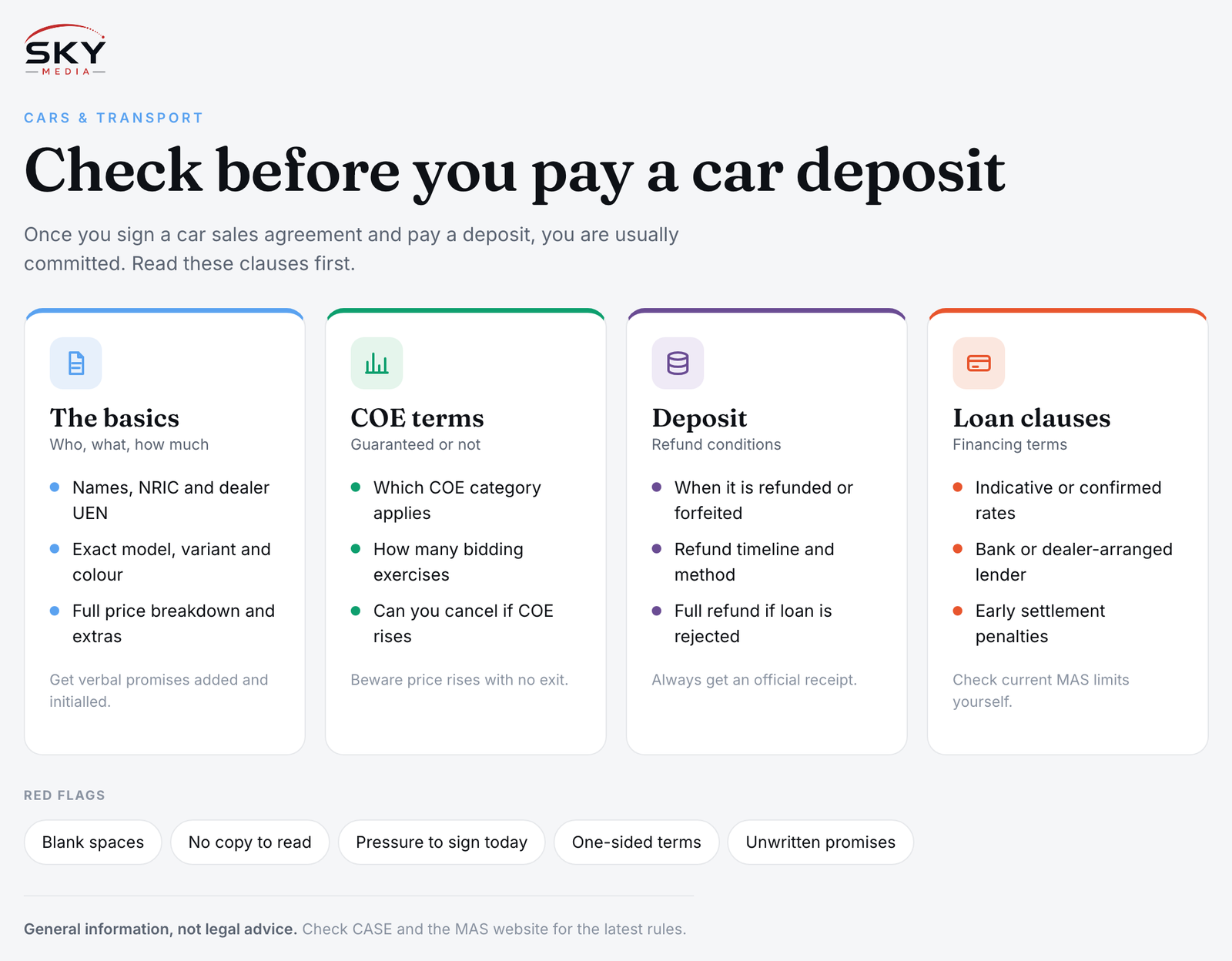
Start With the Basics: Who, What and How Much
Before the fine print, make sure the agreement correctly describes the deal. Errors here are surprisingly common and can be hard to fix later.
- Parties: Your full name and NRIC or FIN, and the dealer’s registered business name and UEN (Unique Entity Number). You can check the business on ACRA’s Bizfile portal.
- Vehicle details: Make, model, variant, engine capacity, colour, and year of manufacture. For a used car, the registration number and chassis number.
- Accessories and extras: Anything promised verbally, such as tinting, a dashcam, servicing packages or floor mats, should be listed in writing.
- Total price breakdown: The price should show what is included. Ask whether it covers COE, registration fees, road tax, insurance and any admin charges. “Package price” can mean different things at different dealers.
- Delivery timeline: An estimated or committed delivery date, and what happens if it is missed.
If the salesperson says something important that is not in the document, ask for it to be added and initialled. A verbal promise is very hard to enforce.
COE Clauses: Guaranteed or Not
For new cars, the Certificate of Entitlement (COE) is often the biggest variable. COE prices are set by open bidding conducted by the Land Transport Authority (LTA) and can swing between exercises. How the agreement handles this is critical.
Dealers typically offer some version of these arrangements:
| COE arrangement | What it usually means | What to check |
|---|---|---|
| Guaranteed COE | The dealer commits to securing a COE within the quoted price, often within a set number of bidding exercises | How many bidding exercises are covered and what happens if they fail |
| Non-guaranteed COE | You pay a base price plus whatever the COE costs when the dealer secures one | Whether there is a price cap, and your right to cancel if COE rises sharply |
| COE top-up | You agree to pay any amount above a stated COE figure | The reference COE figure and any limit on the top-up |
| COE rebate or bid-back | Dealer refunds the difference if COE comes in lower than quoted | Whether and how the difference is refunded, and by when |
Look for clear answers to these questions:
- Which COE category is the car in, and does the agreement state it?
- How many bidding exercises will the dealer bid in under the quoted price?
- What happens if COE is not secured within that period: can you cancel with a full refund, or are you forced to top up?
- Who decides when to bid? Some agreements give the dealer full discretion.
If a clause allows the dealer to raise the price because of COE movements without giving you the option to walk away, think carefully before signing.
Deposit and Refund Terms
The deposit clause is where many buyers lose money. Read it slowly.
- Amount and form: How much is the deposit and how will it be paid? Get an official receipt bearing the dealer’s name.
- Refundable or forfeitable: Under what circumstances is the deposit returned, and when is it kept? Common forfeiture triggers include changing your mind, failing to take delivery, or not providing documents on time.
- Refund timeline: If you are entitled to a refund, how many days will it take, and how will it be paid?
- Loan rejection: Does the deposit come back in full if your car loan is not approved? This is one of the most important lines in the agreement.
- Dealer default: What if the dealer cannot deliver the car, the model is discontinued, or the dealer ceases business? Some buyers ask whether deposits are protected; ask the dealer directly how theirs are handled.
Avoid paying a large deposit in cash without a receipt, and be wary of pressure to pay “today only” to lock in a deal.
Loan Conditions and Financing Clauses
Most cars in Singapore are bought with financing. The Monetary Authority of Singapore (MAS) sets limits on how much you can borrow and for how long, based on the car’s Open Market Value (OMV). Because these limits can change, check the current rules on the MAS website rather than relying on a salesperson’s figure.
In the agreement, check:
- Loan amount, tenure and interest rate quoted, and whether they are indicative or confirmed.
- The lender: Is the loan from a bank or a finance company arranged by the dealer? Dealers may earn commission, so compare with your own bank.
- Conditional approval: Is the sale conditional on your loan being approved at the stated terms? If the bank approves a smaller amount, are you obliged to pay the difference in cash?
- Early settlement terms: Many car loans charge penalties for paying off early, and interest is often front-loaded. Our explainer on paying off a car loan early covers the Rule of 78.
If you are still deciding how to pay, read car loan vs paying cash before you sign anything that locks in a lender.
Used Car Agreements: Extra Points to Check
Buying a used car adds a few specific concerns.
- Condition and inspection: Is the sale subject to a satisfactory independent inspection? Can you walk away if the report shows major issues?
- Mileage and history: Is the mileage stated? Is there a declaration on accident history or flood damage?
- Remaining COE and PARF: The remaining COE period and any Preferential Additional Registration Fee (PARF) rebate affect the car’s value. Make sure these are stated accurately.
- Warranty: Is there a warranty from the dealer, what does it cover, and for how long? “As is where is” means very limited recourse.
- Outstanding loans: The seller’s existing loan on the car must be settled before transfer. The agreement should state who handles this.
Singapore’s Lemon Law, under the Consumer Protection (Fair Trading) Act, gives consumers certain rights when goods are defective at the time of delivery. How it applies to a particular car depends on the facts. The Consumers Association of Singapore (CASE) explains your rights on its website.
Red Flags and Final Checks Before You Sign
Pause if you notice any of these:
- Blank spaces in the agreement that “will be filled in later”
- A dealer refusing to give you a copy to read before paying
- Pressure to sign immediately to secure a “last unit” or a promotion
- Terms that let the dealer change price or delivery date freely, but not let you cancel
- Verbal promises that the salesperson will not put in writing
Some practical habits help:
- Ask for the agreement in advance and read it at home.
- Check whether the dealer is accredited under CaseTrust, a scheme run by CASE, and whether it uses a standard sales agreement.
- Photograph or keep a copy of every page you sign, with all initials.
- Keep receipts, emails and messages with the salesperson.
- If something goes wrong, contact the dealer in writing first, then seek help from CASE or, for larger claims, the Small Claims Tribunals.
The Bottom Line
A car sales agreement is a binding contract, and the deposit you pay is often at risk the moment you sign. Focus on four areas: an accurate description of the deal, how the COE is handled, when the deposit is refunded, and what happens if your loan falls through. Take your time, ask questions, and get everything important in writing.