

If you studied pharmacy in mainland China and want to keep working in your profession after moving to Singapore, the key step is registration with the Singapore Pharmacy Council (SPC). Without it, you cannot practise as a pharmacist here, even if you are fully licensed in China. This guide explains how pharmacist registration in Singapore for foreign graduates generally works, what is different from the Chinese system, and how to plan your path. It is general information only. Requirements change, and the SPC website is the only authoritative source for your case.
Singapore has similar processes for other healthcare and technical professions. If a family member is a doctor or nurse, see our guides on China doctor registration with the SMC and SNB registration for China-trained nurses.
How Pharmacy Regulation in Singapore Differs From China
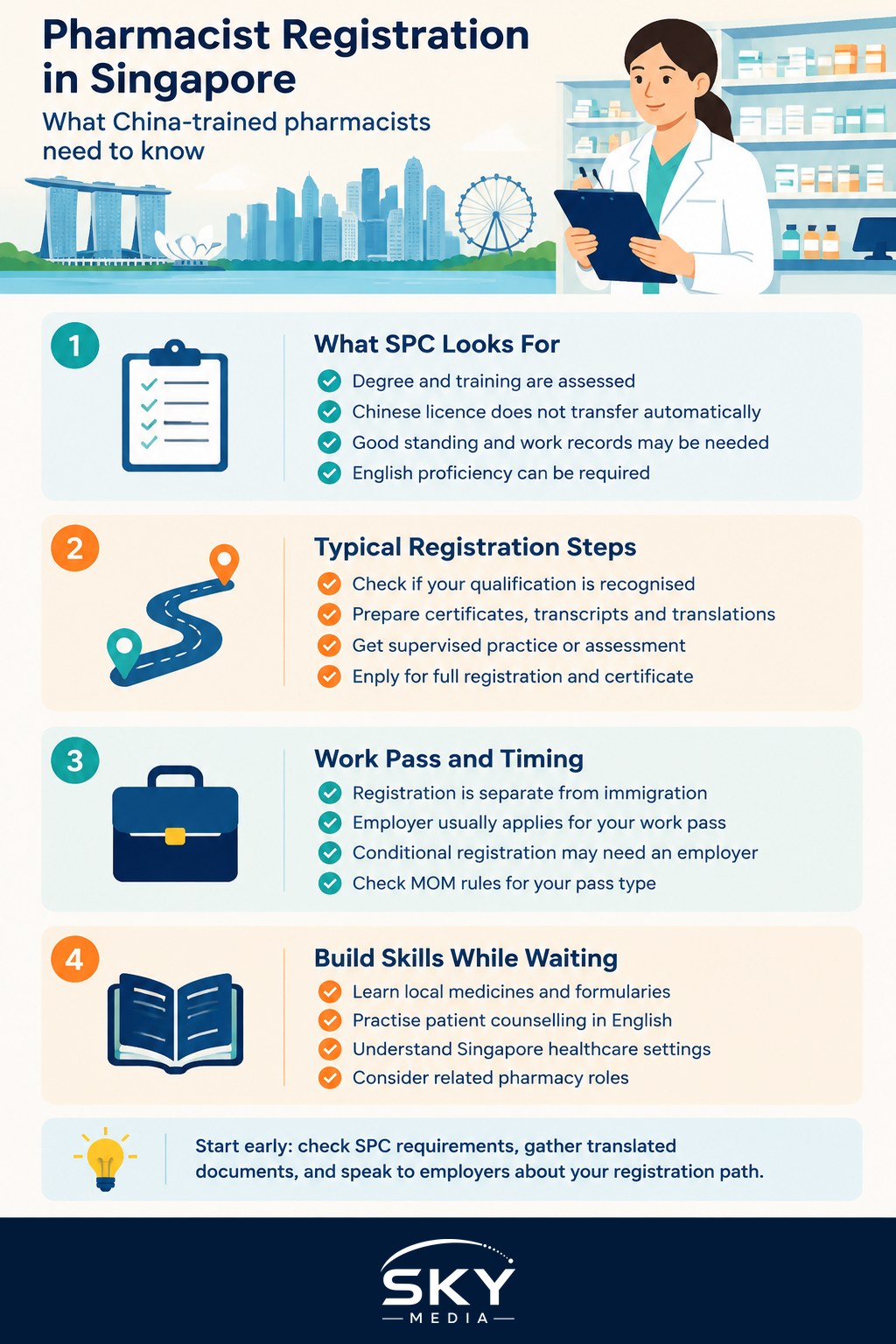
In China, you may be familiar with the national licensed pharmacist qualification (执业药师) and provincial registration. In Singapore, the structure is simpler but stricter in one way: there is one statutory body, the Singapore Pharmacy Council, which registers pharmacists under the Pharmacists Registration Act. Your Chinese licence does not transfer automatically. The SPC looks at your degree, your training and your competence against Singapore’s standards.
Some other points that often surprise newcomers:
- Registration and practising are separate. Being registered is one step. You also need a valid practising certificate, which is renewed periodically and is linked to continuing professional education (CPE).
- Supervised practice is common. Many foreign-trained pharmacists start under conditional registration, working under supervision before full registration.
- Singapore law is tested. Pharmacists here must understand local laws on medicines, poisons and controlled drugs. Expect some form of assessment on this.
- Traditional Chinese medicine is separate. If your training is in TCM pharmacy, the relevant body is the TCM Practitioners Board, not the SPC, and the rules are different.
| Area | Typical experience in China | What to expect in Singapore |
|---|---|---|
| Licensing body | National qualification exam plus provincial registration | Singapore Pharmacy Council under the Pharmacists Registration Act |
| Recognition of degree | Domestic degrees accepted | Foreign degrees assessed; recognition depends on the school and programme |
| Starting status | Licensed after passing the exam | Often conditional registration with supervised practice first |
| Local law knowledge | Chinese drug administration law | Assessment on Singapore pharmacy law and practice |
| Ongoing requirements | Continuing education | Practising certificate renewal tied to CPE |
The General Registration Path for China-Trained Pharmacists
The exact route depends on your qualification, so treat the steps below as a broad map, then confirm the current process with the SPC.
- Check your degree against SPC requirements. The SPC publishes information on which qualifications are recognised and what applies to graduates from other schools. Many Chinese pharmacy degrees are not on any automatic recognition list, so expect an individual assessment.
- Prepare your documents. Usually this means degree certificates, academic transcripts, proof of registration and good standing in China, and records of work experience. Documents not in English need certified translations. Start early, because getting transcripts from Chinese universities can take time.
- Show English proficiency. Pharmacy in Singapore is practised in English, from prescriptions to patient counselling. The SPC may require evidence such as a recognised English test result. Check which tests and scores it currently accepts.
- Secure a job offer with a suitable employer. Conditional registration is typically tied to an approved employer and supervisor. Public healthcare institutions and larger retail or hospital pharmacies are common routes.
- Complete any required training or assessments. This may include a period of supervised practice and examinations on local pharmacy law and practice.
- Apply for full registration. Once you meet the conditions, you can apply to move to full registration and obtain your practising certificate.
Processing times and fees are set by the SPC and can change. Do not rely on figures from forums or old posts.
Work Passes and Timing
Registration and immigration are two separate systems. The SPC handles your professional registration. The Ministry of Manpower (MOM) handles your work pass, which your employer normally applies for. Most pharmacists come in on an Employment Pass, but the right pass depends on MOM’s current criteria, and your employer will advise.
In practice, the sequence matters. Employers often want to know your registration route is realistic before they commit, and the SPC may need employer details for conditional registration. Talk openly with prospective employers about where you are in the process.
If you are a dependant or on a Long-Term Visit Pass, whether you can work and on what basis depends on MOM’s rules for that pass. Check with MOM before accepting any role.
Building Your Career While You Register
Registration can take months. Use that time well.
- Learn local brand names and formularies. Many medicines are sold under different names here. Hospital and retail pharmacies use their own formularies.
- Practise patient counselling in English. Singapore patients expect clear explanations of dosage, side effects and interactions. If you also speak Mandarin, that is a real asset in many neighbourhoods, and some pharmacies serve patients in Malay or Tamil too.
- Study Singapore’s healthcare system. Understand polyclinics, public hospitals, MediSave, CHAS (the Community Health Assist Scheme that subsidises care at participating GP and dental clinics) and how prescriptions flow between them.
- Consider related roles. If full registration takes longer, some people work in regulatory affairs, pharmaceutical sales, clinical research or as pharmacy technicians. These roles have their own requirements, so check them carefully, and remember that you must not perform restricted pharmacist duties until registered.
- Join professional networks. The Pharmaceutical Society of Singapore runs events and courses that help you understand local practice and meet employers.
Common Pitfalls to Avoid
China-trained pharmacists sometimes lose months to avoidable problems.
- Arriving without documents. Bring original transcripts, certificates and good-standing letters, or arrange for them to be sent officially before you leave China.
- Assuming a Chinese licence is enough. It is helpful evidence, but it is not a Singapore registration.
- Accepting a role that requires registration before you have it. Practising without proper registration is a serious offence.
- Ignoring CPE once registered. Practising certificate renewal depends on keeping up with CPE requirements.
- Relying on outdated advice. Rules change. Always check the SPC website and ask the Council directly if something is unclear.
Where to Get Official Information
The Singapore Pharmacy Council website sets out current registration routes, required documents, assessments and fees. MOM covers work passes, and the Health Sciences Authority (HSA) regulates medicines and pharmacy licensing. If you have dependants or need to sort out other admin, our guide to the NRIC and national registration explains how identity documents work here once you become a resident.
Frequently Asked Questions
Can I work as a pharmacy technician while waiting for registration? Some people take related roles such as pharmacy technician, regulatory affairs, pharmaceutical sales or clinical research. Each has its own requirements, so check them carefully. You must not perform restricted pharmacist duties until you are registered, as practising without registration is a serious offence.
Does my TCM pharmacy training count with the Singapore Pharmacy Council? No, TCM is separate. If your training is in TCM pharmacy, the relevant body is the TCM Practitioners Board rather than the SPC, and the rules are different. Check with the Board about your qualification.
What documents should I bring from China before moving? Bring original degree certificates, transcripts and good-standing letters, or arrange for them to be sent officially before you leave. Documents not in English need certified translations. Transcripts from Chinese universities can take time, so start early.
How can I get ready for Singapore patients while registration is pending? Learn local brand names and formularies, practise patient counselling in English, and study how polyclinics, public hospitals, MediSave and CHAS work. Mandarin is a real asset in many neighbourhoods, and some pharmacies also serve patients in Malay or Tamil.
What happens after I become registered as a pharmacist? You also need a valid practising certificate, which is renewed periodically and tied to continuing professional education. Keep up with CPE requirements, and check the SPC website for current renewal conditions.
Official sources: Ministry of Health (MOH)
Further reading: Working as a Physiotherapist in Singapore With an Overseas Degree