

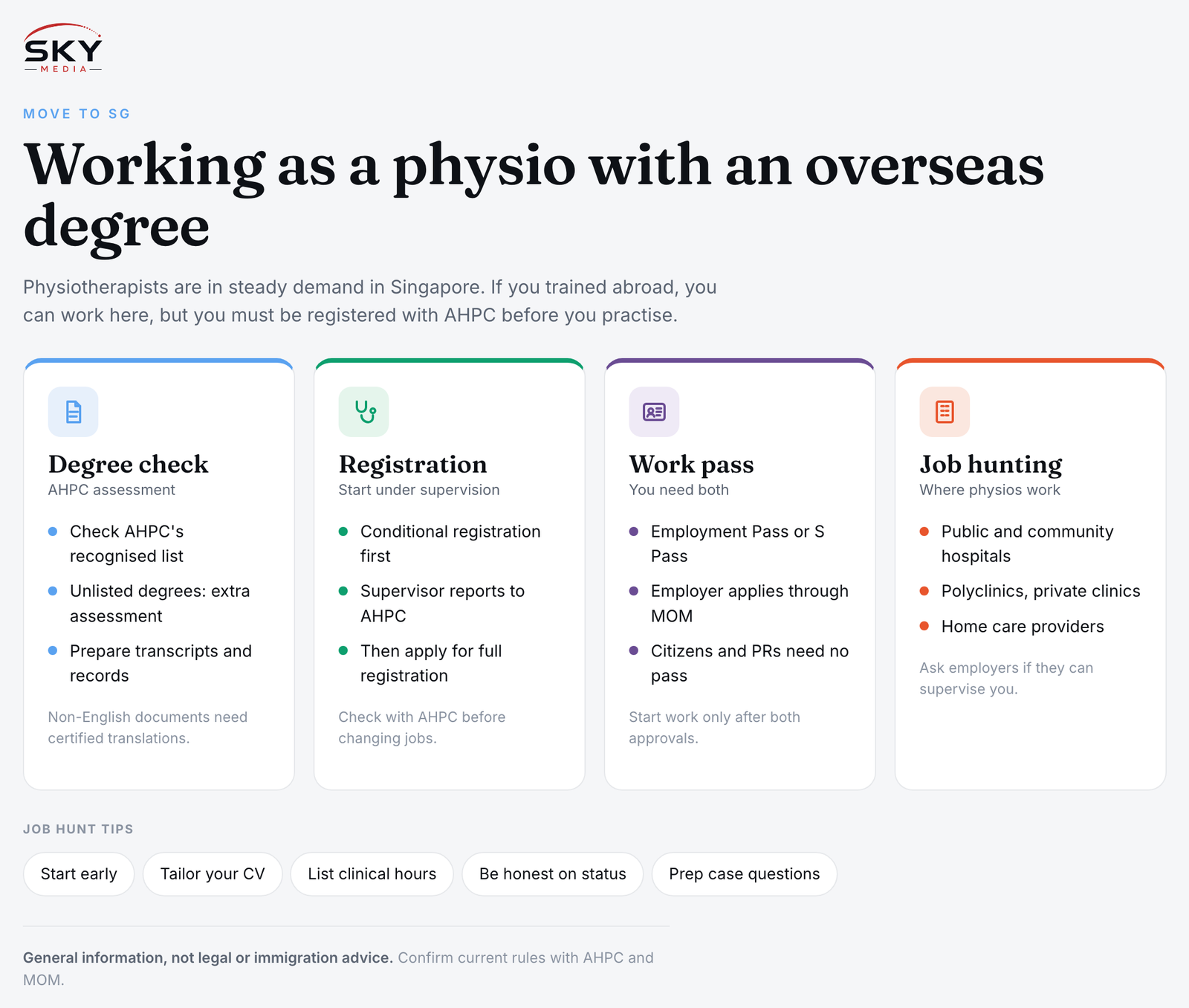
Singapore’s ageing population and busy sports and rehabilitation scene keep physiotherapists in steady demand. If you trained abroad, you can work here, but you must be registered before you practise. Understanding physiotherapist registration in Singapore for overseas graduates early will save you months of frustration, and help you approach employers with realistic expectations.
This guide explains how the Allied Health Professions Council (AHPC) registration works, what supervised practice involves, and how to job hunt. It is general information, not legal or immigration advice. Requirements change, so always confirm current rules with AHPC and the Ministry of Manpower (MOM).
Who Regulates Physiotherapists in Singapore
Physiotherapy is a regulated allied health profession. The Allied Health Professions Council (AHPC), set up under the Ministry of Health (MOH), registers physiotherapists, occupational therapists, speech therapists and several other professions under the Allied Health Professions Act.
In practice this means:
- You cannot practise or call yourself a physiotherapist in Singapore without valid AHPC registration and a current practising certificate.
- Registration is tied to your qualifications, and AHPC decides whether your degree meets its standards.
- Registered professionals must meet ongoing requirements, such as continuing professional education, to renew their practising certificate.
AHPC’s website is the authoritative source for application forms, document lists, fees and timelines. Anything you hear from agents or forums should be checked against it.
How Your Overseas Degree Is Assessed
AHPC maintains a list of physiotherapy qualifications it recognises. Where your degree sits on that list shapes your route.
- Recognised qualifications. Graduates from listed programmes can typically apply for registration directly, though usually under conditions at first.
- Qualifications not on the list. You may still be able to apply, but AHPC may require further assessment, such as a review of your curriculum and clinical hours, or an examination. Outcomes are decided case by case.
Prepare a solid document pack in advance. Commonly requested items include degree certificates, academic transcripts, details of clinical placements, proof of registration or good standing from your home country’s regulator, and identity documents. Documents not in English typically need certified translations. Follow AHPC’s current checklist exactly rather than relying on this list.
English Language
If your degree was not taught in English, you may need to demonstrate English proficiency. Check AHPC’s current requirements, including which tests and scores it accepts.
Registration Types and Supervised Practice
Overseas-trained physiotherapists commonly start on conditional registration, which means practising under supervision before moving to full registration. The general picture looks like this:
| Registration stage | What it generally means | What you should check |
|---|---|---|
| Conditional registration | You practise under supervision at an approved employer | Supervision period, reporting, scope of practice |
| Full registration | You practise independently after meeting conditions | Eligibility criteria and application process |
| Temporary registration | Short-term practice for specific purposes, such as teaching or training | Whether it applies to your situation |
| Practising certificate renewal | Needed to keep practising | Continuing education requirements and renewal cycle |
What Supervised Practice Involves
Under conditional registration, an experienced registered physiotherapist at your workplace acts as your supervisor. Expect:
- Regular supervision sessions and case discussions.
- Periodic reports from your supervisor to AHPC on your clinical performance.
- Possible limits on where you work, since conditions are usually tied to an approved employer.
Because conditional registration depends on a supervising employer, your job and your registration are closely linked. Changing jobs during this period generally requires checking with AHPC first. The length of supervised practice and the requirements to move to full registration are set by AHPC, so confirm them for your case.
Work Passes for Foreign Physiotherapists
Registration lets you practise. A work pass lets you work. You need both.
Most foreign physiotherapists are employed on an Employment Pass or S Pass, which the employer applies for through MOM. Eligibility depends on MOM’s current criteria, including salary and, for the Employment Pass, its assessment framework. Do not start work until both your registration and work pass are approved.
If you are in Singapore on a Dependant’s Pass, whether you can work and how depends on MOM rules for that pass at the time. Check MOM’s website before accepting any role.
If you are a Singapore Citizen or PR with a foreign degree, you still need AHPC registration but not a work pass.
Finding a Physiotherapy Job
Physiotherapists work across a wide range of settings in Singapore:
- Public hospitals in the three public healthcare clusters, covering acute care, ICU, orthopaedics, neurology and cardiopulmonary rehabilitation.
- Community hospitals and nursing homes, with a strong focus on older adults and rehabilitation after strokes and falls.
- Polyclinics and day rehabilitation centres.
- Private clinics, including sports, musculoskeletal and women’s health practices.
- Home care providers, visiting patients in their homes.
Tips for the job hunt:
- Start conversations early. Many employers recruit overseas physiotherapists and understand conditional registration. Ask whether they can provide supervision.
- Search official and cluster career portals, as well as MOH Holdings, which handles some public healthcare recruitment.
- Tailor your CV to Singapore’s settings. Highlight geriatric, neurological, cardiopulmonary or sports experience, and list your clinical hours clearly.
- Be honest about your registration status, whether it is pending, conditional or not yet started.
- Prepare for clinical interviews. Many employers include case-based questions.
Adapting to Practice in Singapore
Clinical skills transfer well, but some things differ. You will treat a multilingual, multicultural population, so basic phrases in Mandarin, Malay or local dialects can help with older patients. Learn how subsidies, MediSave and insurance affect what patients choose, and how referrals flow between hospitals, polyclinics and community care. Our guide on how to choose a physiotherapist in Singapore shows how local patients think about the decision.
A Practical Checklist
- Check whether your degree is on AHPC’s list of recognised qualifications.
- Gather degree certificates, transcripts, clinical records and good standing letters.
- Confirm English language requirements if relevant.
- Look for employers that can offer supervision.
- Apply for AHPC registration, following its current process.
- Let your employer apply for your work pass through MOM.
- Start work only after both approvals, then meet your supervision and continuing education requirements.
Other professions follow similar but distinct routes. Compare with our guides to practising dentistry in Singapore with an overseas degree and working as a pharmacist in Singapore with a China degree if you are weighing options within healthcare.
Frequently Asked Questions
How long does AHPC registration take for overseas physiotherapists? Timelines depend on how complete your documents are and whether AHPC needs extra assessment of your degree. Check AHPC’s website for current processing information, and start collecting transcripts, clinical records and good standing letters early, since certified translations can take time.
Can I bring my family if I work as a physiotherapist on an Employment Pass? Eligibility for a Dependant’s Pass is set by MOM and depends on your pass type and salary at the time. Check MOM’s website for the current criteria before relocating your family. Whether a spouse can work depends on the pass they hold.
Can an overseas-trained physiotherapist open a private practice? Conditional registration ties you to an approved employer under supervision, so independent practice generally comes after full registration. Setting up a clinic also involves other healthcare licensing rules, so check with AHPC and MOH before planning.
What can I do while waiting for my AHPC registration? You cannot practise or call yourself a physiotherapist until you are registered, and you must not start work before your work pass is approved. Use the time to look for employers who can offer supervision, polish your CV and prepare for clinical interviews.
Do I need to speak Mandarin or Malay to work as a physiotherapist here? Not strictly, since English is widely used in healthcare. But basic phrases in Mandarin, Malay or dialects help you communicate with older patients and build rapport. Employers may value this, especially in community hospitals and home care.
Further reading: Working as an Architect in Singapore With Overseas Qualifications