
If you trained and practised architecture abroad, Singapore can look like a natural next step: dense, design-led, and full of public and private building work. But the path for a foreign architect in Singapore has one big fork in the road. You can work in an architecture firm fairly quickly, yet calling yourself an “architect” and signing off on building plans is a separate, regulated step. This guide explains how the two fit together, what you can do while you are not yet registered, and how to plan the move without surprises.
This is general information, not legal or immigration advice. Rules, recognised qualifications and requirements are set by the official bodies named below and can change, so always confirm the current position on their websites before you make decisions.
Why “Architect” Is a Protected Title in Singapore
In Singapore, architecture is a regulated profession under the Architects Act. The body that administers it is the Board of Architects (BOA), a statutory board. Two things flow from this:
- The title is protected. Only a person registered with the BOA, and holding a valid practising certificate, may practise as or call themselves an architect in Singapore. That includes business cards, LinkedIn headlines, email signatures and firm websites.
- Plan submission is restricted. Building plans submitted to the authorities, such as the Building and Construction Authority (BCA) and the Urban Redevelopment Authority (URA), need to be signed off by a “qualified person” (QP). For architectural work, that is a registered architect with a practising certificate.
So the gap between “works in architecture” and “registered architect” is real, and it shapes your job title, your responsibilities and, often, your pay.
What You Can Do Before You Register
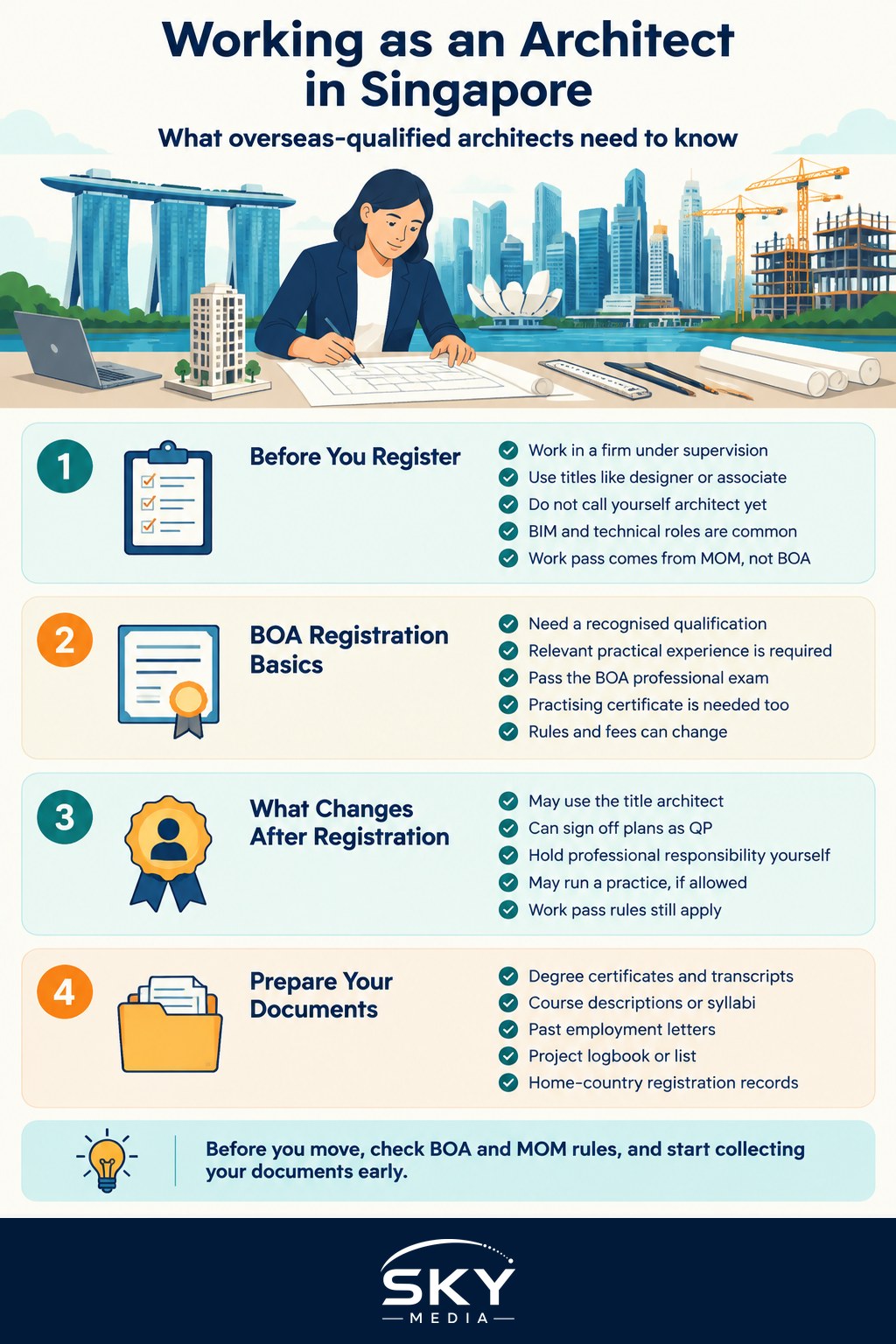
Many overseas-trained architects start in Singapore without BOA registration. This is common and legitimate, as long as you stay within the boundaries. Typical roles include:
- Architectural designer or design architect (title wording aside). You develop concepts, produce drawings and models, and coordinate with consultants, under the supervision of a registered architect who takes professional responsibility.
- Project or design manager. You manage timelines, consultants and clients on the design side, again with a registered architect signing off.
- BIM or technical roles. Building Information Modelling (BIM) coordination and technical documentation are in demand, and your overseas experience counts.
- Developer, consultancy or in-house roles. Some property developers and large organisations hire design professionals who never need to submit plans themselves.
Two practical cautions. First, be careful with job titles: firms often use “designer” or “associate” for unregistered staff, and you should not describe yourself as an architect in Singapore until you are registered. Second, your right to work comes from your work pass, not from the BOA. Most foreign professionals come in on an Employment Pass (EP), or an S Pass for some mid-level roles, applied for by the employer through the Ministry of Manpower (MOM). Eligibility criteria, salary benchmarks and the points-based assessment are set by MOM and change from time to time, so check the current rules on the MOM website.
How Board of Architects Registration Works
The BOA publishes the full requirements, and you should read them directly. In broad terms, registration usually rests on three pillars:
- A recognised qualification. The BOA maintains a list of architecture qualifications it recognises. Some overseas degrees are on it; others are not. If yours is not listed, the BOA may have a route for assessing it, so ask them rather than assuming you are excluded.
- Practical experience. Registration requires a period of relevant practical training, and the BOA sets how much of it must be gained in Singapore and under what supervision. Overseas experience may or may not count fully, depending on the rules in force.
- The Professional Practice Examination. Candidates generally need to pass the BOA’s professional examination, which tests knowledge of Singapore practice: local legislation, building control, contracts and professional ethics.
After registration, you also need a practising certificate, which is renewed periodically and comes with continuing professional development requirements. Fees, timelines and exam schedules are set by the BOA and can change, so do not rely on figures from forums or old articles.
Registered vs Unregistered: What Changes
| Area | Working before registration | After BOA registration with a practising certificate |
|---|---|---|
| Job title | “Architectural designer”, “associate” or similar; not “architect” | May use the title “architect” in Singapore |
| Plan submissions to BCA and URA | Prepares drawings; a registered architect signs off as QP | Can act as the qualified person and sign off |
| Professional responsibility | Supervising registered architect holds it | You hold it personally, with professional indemnity considerations |
| Running your own practice | Not possible as an architectural practice | Possible, subject to BOA and business registration rules |
| Right to work | Depends on your MOM work pass | Still depends on your work pass unless you are a citizen or PR |
The last row trips people up. BOA registration is a professional licence. It does not give you the right to live or work in Singapore. If you hold a work pass, any plan to start your own firm needs to be checked against MOM’s rules for your pass type, and against ACRA (the Accounting and Corporate Regulatory Authority, which handles business registration) and BOA rules for architectural practices.
Getting Your Paperwork in Order Early
Much of the stress of registration comes from chasing documents from overseas. Before you move, or as soon as you arrive, gather:
- Degree certificates and full transcripts, ideally certified, plus official English translations if they are in another language.
- Course descriptions or syllabi, especially for studio, technology and professional practice modules, in case the BOA needs to assess equivalence.
- Employment letters from past architecture firms stating your role, dates, project types and the name and registration of your supervisor.
- A logbook or project list with your responsibilities on each project. This is useful for both the BOA and your Singapore employer.
- Any professional registration from your home country, with a letter of good standing if available.
If your qualifications are from mainland China, you may also need them verified. Our guides on verifying Chinese qualifications in Singapore and getting your China qualifications recognised explain how verification works for employers and pass applications.
Practical Tips for Your First Years
- Choose an employer who supports registration. Ask at interview whether the firm has supervised candidates through BOA registration, whether a registered architect will mentor you, and whether they give time off for the professional exam.
- Log your Singapore experience from day one. Keep a running record of projects, stages, tasks and supervisors. Reconstructing this later is painful.
- Learn local codes early. Singapore practice leans heavily on building control, fire safety, accessibility and planning guidelines. BCA, URA and the Singapore Civil Defence Force (SCDF) publish codes and guides online, and reading them early will make you more useful at work and better prepared for the exam.
- Understand the project culture. Public housing, private condominiums, industrial and institutional projects each have their own pace and procedures. Expect more documentation and authority liaison than in some countries.
Comparing Notes With Other Regulated Professions
Architecture is not the only field where overseas professionals need a local licence. Accountants, dentists and pharmacists face similar “work first, register later” choices with their own boards. If you are weighing options or moving as a couple, see how working as an accountant with China qualifications and practising dentistry with an overseas degree compare.
Key Takeaways
- A foreign architect in Singapore can usually work in a firm on a valid work pass before registering, under a registered architect’s supervision.
- Using the title “architect” and signing off plans requires BOA registration and a practising certificate.
- Registration generally involves a recognised qualification, practical experience and a professional examination; check the BOA website for current details.
- BOA registration and your work pass are separate. Check MOM rules before planning to start your own practice.
Frequently Asked Questions
Can I use the title architect on LinkedIn before BOA registration? No. The title is protected, and only a person registered with the Board of Architects with a valid practising certificate may call themselves an architect in Singapore, which includes LinkedIn headlines, email signatures and firm websites. Use wording such as architectural designer instead.
Does my overseas architecture degree count for BOA registration? The BOA keeps a list of recognised qualifications, and some overseas degrees are on it while others are not. If yours is not listed, the BOA may have an assessment route, so ask them directly instead of assuming you are excluded.
Which work pass does a foreign architect usually need? Most foreign professionals come in on an Employment Pass, or an S Pass for some mid-level roles, applied for by the employer through MOM. Criteria and salary benchmarks change from time to time, so check the current rules on the MOM website.
Can I start my own architecture practice on a work pass? BOA registration does not give you the right to live or work in Singapore. If you hold a work pass, check MOM’s rules for your pass type, and ACRA and BOA requirements for architectural practices, before planning your own firm.
What documents should I prepare before moving to Singapore as an architect? Gather certified degree certificates and transcripts with English translations, course syllabi, employment letters with role and dates, a project logbook, and any home-country registration with a letter of good standing. These help both the BOA and your employer.
Further reading: Practising Law in Singapore With an Overseas Law Degree