

A pop up store Singapore shoppers walk past in a mall atrium or a kiosk near the escalators can be one of the cheapest ways to test a product, launch a brand or clear seasonal stock. You get footfall without signing a multi-year lease, renovating a unit or hiring a full team. But short-term retail has its own rules, costs and paperwork, and malls are selective about who they let in.
This guide covers how short-term mall spaces work, how to approach a mall, what to budget for, the licences and permissions to think about, and how to set up and run the space. It focuses on stays of days to a few months. If you are ready for a permanent shop, a long-term lease is a different process.
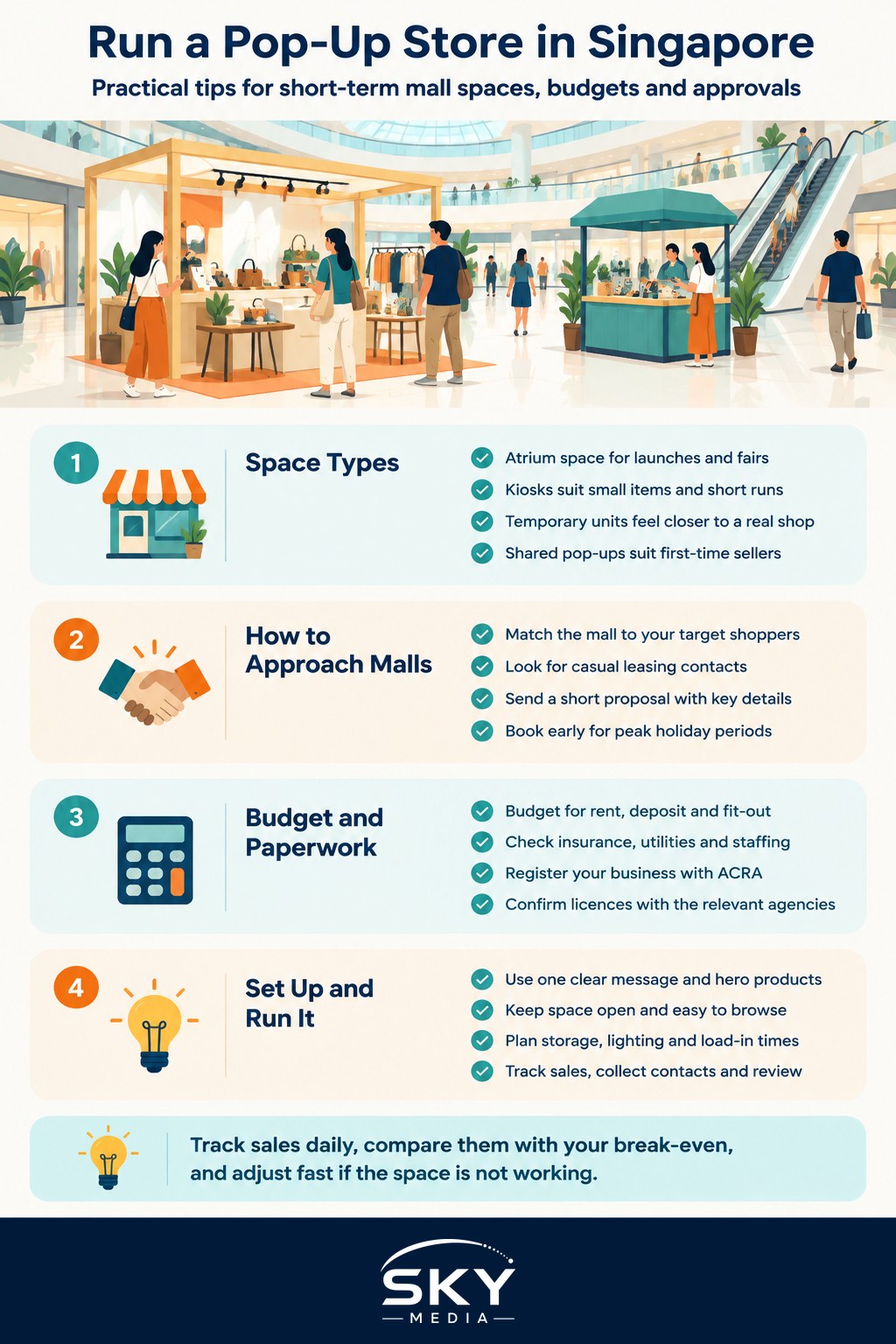
Types of Short-Term Retail Space
Most malls in Singapore have a casual leasing or “specialty leasing” team that manages temporary spaces separately from the main tenancy department. The options usually fall into a few types:
| Space type | Typical duration | Best for | Trade-offs |
|---|---|---|---|
| Atrium event space | A few days to a few weeks | Brand launches, themed fairs, seasonal sales | High visibility, usually the most expensive, often booked around festive periods |
| Kiosk or push cart | Weeks to months | Accessories, gadgets, snacks, small-ticket items | Small footprint, limited stock and display |
| Temporary shop unit | One to several months | Fuller retail experience, testing a location | Closer to a real shop, more fit-out and staffing |
| Shared or curated pop-up | Days to weeks | First-time sellers, small makers | Lower commitment, less control over branding |
Outside malls, you can also look at weekend markets, office lobby events, community centre fairs and festival bazaars. If you sell food, our guide to running a pop-up food stall at a festival or weekend market covers the food-specific steps.
How to Approach a Mall
Malls want pop-ups that suit their shoppers and do not clash with existing tenants. A clear, professional pitch helps.
- Shortlist malls by audience. A heartland mall near HDB estates draws families and regulars. A city or tourist mall draws office workers and visitors. Walk the mall at the times you would trade and watch who shops there.
- Find the right contact. Look for “casual leasing”, “atrium booking” or “advertising and promotions” on the mall’s website, or ask the customer service counter.
- Prepare a short proposal. Include your business details, product photos, price range, proposed dates, space size and a sketch or mock-up of your booth.
- Expect questions about exclusivity. If a tenant in the mall sells something similar, the mall may decline or ask you to adjust your range.
- Book early for peak periods. School holidays, Mid-Autumn, Christmas and Chinese New Year are popular, and the best spots go well ahead.
What to Budget For
Prices vary widely by mall, location within the mall, season and duration, so get written quotes and compare them. Rather than relying on a headline rental figure, list every cost line:
- Rental: usually quoted per day, per week or per month. Some malls may use a base rent plus a percentage of sales, so read the terms.
- Security deposit: often required, refundable after you hand back the space in good condition.
- Booth or kiosk build: buying, renting or custom-building fixtures, signage and lighting. Malls often have design guidelines and need to approve your drawings.
- Utilities and services: power points, cleaning and after-hours charges may be extra.
- Insurance: many malls require public liability insurance naming them as an interested party. Ask an insurer for a short-term policy.
- Staffing: wages for the full mall opening hours, including breaks and backup cover.
- Payment and stock: card and PayNow terminals, packaging, and inventory you may not sell.
Work out your break-even: the sales you need per day to cover all these costs. If the number looks unrealistic for the footfall you observed, try a smaller space or shorter run first.
Registration, Licences and Permissions
This section is general information, not legal advice. Requirements depend on what you sell and how you set up, so confirm with each official body.
- Business registration. Selling as a business generally means registering with ACRA (the Accounting and Corporate Regulatory Authority) through Bizfile, either as a sole proprietorship, partnership or company. Malls usually ask for your registration details.
- GST. If your business is or must be GST-registered with IRAS, your pricing and receipts need to reflect that. Check the IRAS rules on registration.
- Food and drinks. Selling food, including packaged snacks or drinks, may need a licence or permit from SFA (the Singapore Food Agency). Do not assume a mall’s approval covers this.
- Regulated products. Items such as health products, cosmetics with certain ingredients, electrical goods and children’s products can have their own rules. Check with the relevant agency, for example HSA or the Consumer Product Safety Office under Enterprise Singapore.
- Fire safety and structures. Larger booths, temporary structures and anything using power go through the mall’s own fit-out and fire safety checks. Follow their instructions on materials and exits.
- Promotions and lucky draws. Some promotions are regulated. If you plan a lucky draw or contest, check the current rules before announcing it.
- Staff. Anyone you hire must be legally allowed to work in Singapore. Check MOM (Ministry of Manpower) rules for part-timers and for any pass holders.
If you hold a work pass yourself, whether you can run or work in your own pop-up depends on MOM rules for your pass type. Check before you start.
Setting Up a Booth That Sells
Mall shoppers decide in seconds whether to stop. A few principles help:
- One clear message. A big, readable sign saying what you sell and why it is different works better than a crowded display.
- Hero products at eye level. Put your bestsellers or new launch where people can see and touch them.
- Space to step in. Leave room so shoppers can browse without blocking the walkway, which malls monitor closely.
- Good lighting. Atrium light can be uneven, so add your own lighting if permitted.
- Secure storage. Plan where extra stock, bags and cash go, and how you will lock up at closing.
- Load-in and load-out. Malls usually set timings for moving goods through loading bays and service lifts, often outside opening hours. Confirm these in writing.
Running the Pop-Up Day to Day
Treat each day as data. Track sales by hour and by product, note which displays get attention, and ask customers how they heard about you. Collect emails or social follows with a simple sign-up offer so the pop-up keeps paying off after it ends.
Promote before and during the run on your social channels, with the mall’s location and dates clearly stated. Some malls will share your event in their own promotions if you ask.
When the run ends, compare actual sales against your break-even, review which products moved, and decide whether to repeat, move to a different mall or scale up. Many brands do several pop-ups before committing to a permanent lease. Families are a big part of weekend mall traffic, so think about how your booth suits shoppers who come for indoor holiday activities for kids in Singapore malls during school breaks.
Frequently Asked Questions
Why might a mall turn down my pop-up application? Common reasons are that your products overlap with an existing tenant, your range does not suit the mall’s shoppers, or the proposal is thin. Malls may also have no space on your dates. Include photos, price range, dates, space size and a booth sketch, and be ready to adjust your range.
Can one person run a mall kiosk alone? It is possible for a small kiosk, but you must cover the mall’s full opening hours, including meal breaks and toilet trips, and keep stock and cash secure. Plan backup cover for those gaps. A second person also makes busy periods easier to handle.
Is a kiosk or a shared pop-up better for a first-time seller? A shared or curated pop-up has lower commitment and suits first-time sellers, though you get less control over branding. A kiosk gives you your own space for weeks to months, with limited display room. Choose by how much risk and brand control you want.
How long should my first pop-up run for? Keep the first one short, as days to a few weeks lets you test demand without carrying big costs. Compare actual sales against your break-even afterwards. Many brands run several pop-ups before committing to a permanent lease.
What if pop-up sales are slower than my break-even figure? Review what is happening by hour and by product, then adjust displays, hero products or promotion. If the numbers still look unrealistic for the footfall, a smaller space or shorter run is safer next time. Use the data to decide whether to repeat, move or stop.