
Food festivals, weekend markets and community carnivals give small food businesses a low-commitment way to test recipes, build a following and earn extra income without signing a long shop lease. Running a pop-up food stall Singapore style, though, involves more than turning up with a gas stove. You need the right licence, trained food handlers, a booth that passes safety checks and prices that still make sense after fees. This guide is written for vendors, from home bakers to hawkers trying a new concept, who are planning their first or next pop-up.
This is general information, not legal advice. Licensing rules and fees change, so always confirm current requirements with the Singapore Food Agency (SFA) and the GoBusiness Licensing portal before you commit.
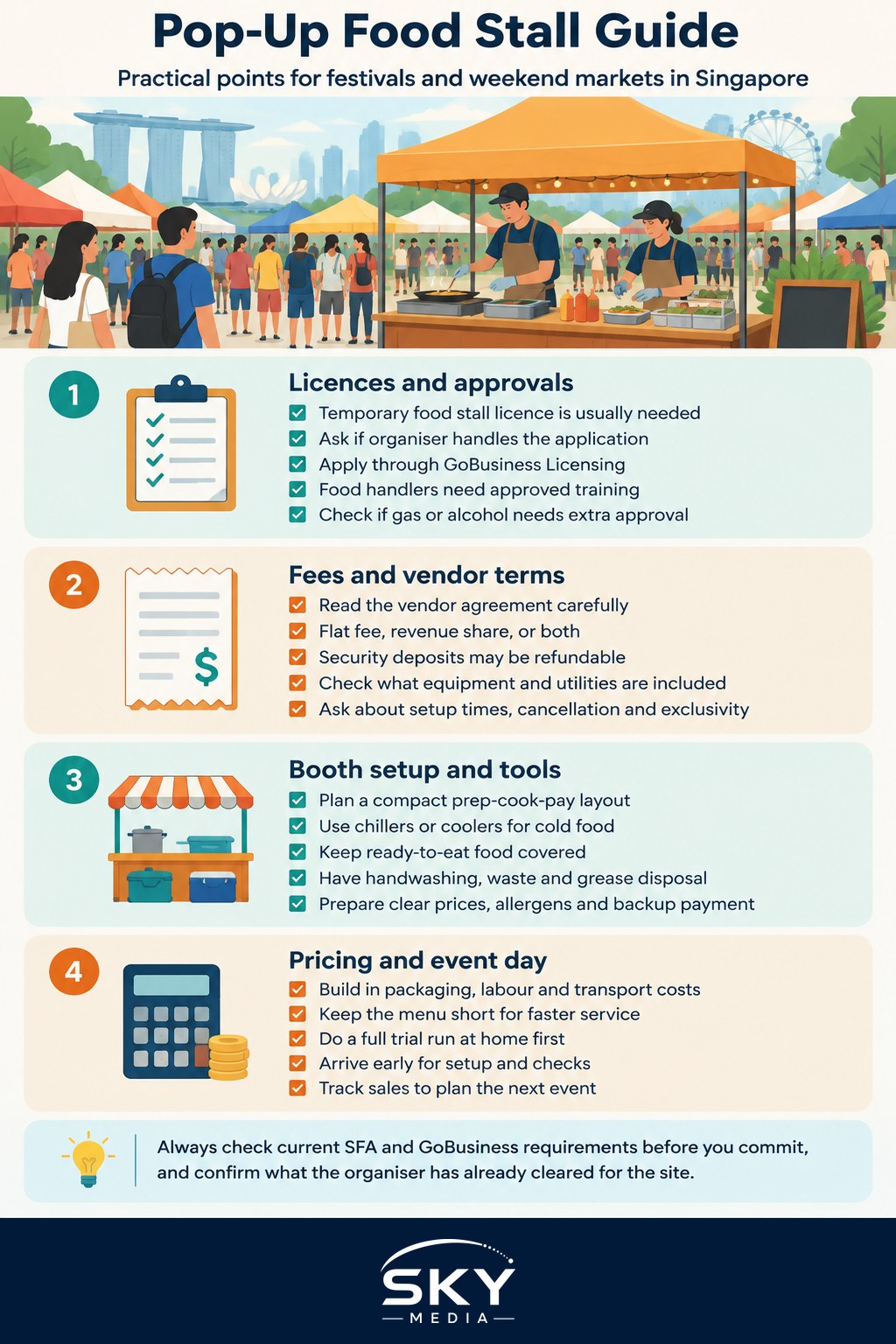
Licensing: The Temporary Food Stall Route
In Singapore, selling food to the public generally requires a licence from the SFA, the agency that regulates food safety. For short-term events such as fairs and markets, SFA has a category for temporary food stalls, which is separate from the licence a permanent restaurant or hawker stall holds.
How it typically works in practice:
- The organiser often leads. For many established festivals and markets, the event organiser coordinates with SFA and other agencies, and tells stallholders exactly what documents to submit and by when. Ask the organiser early whether they handle the application or whether you apply individually.
- Applications go through GoBusiness Licensing. This is the government’s one-stop portal for business licences. You will usually need your business details (for example, your ACRA registration if you have one; ACRA is the Accounting and Corporate Regulatory Authority, which handles business registration), event details and the food you plan to sell.
- Apply well ahead. Do not leave it to the final week. Processing times vary, and some events set their own earlier deadlines.
- Food handlers need training. People who prepare or handle food are generally required to complete the Food Safety Course Level 1 (formerly known as the Basic Food Hygiene Course) from an approved training provider. Check SFA’s site for the current requirement and how long the certificate stays valid.
If you are a home-based food business, remember that home-based rules are designed for selling from home. Selling at a public event is a different activity and usually needs the event licensing above.
Other agencies can be involved depending on your setup. Cooking with LPG gas cylinders or open flames at an event brings fire safety considerations, which the organiser and the Singapore Civil Defence Force (SCDF) rules govern. Selling alcohol needs separate approval. Ask the organiser what has been cleared for the site.
Understanding Booth Fees and Vendor Terms
Every organiser structures fees differently, and the cheapest booth is not always the most profitable. Read the vendor agreement carefully.
| Fee model | How it works | Suits | Watch out for |
|---|---|---|---|
| Flat booth fee | One fixed payment for the slot | Vendors confident of high volume | Losing money on a rainy or quiet day |
| Revenue share | Organiser takes a percentage of sales | First-timers testing demand | Mandatory use of the organiser’s payment system |
| Flat fee plus revenue share | A smaller fixed fee plus a percentage | Large curated festivals | Total cost adding up on a busy day |
| Security deposit | Refundable sum held against damage or no-shows | Most events | Conditions for getting it back |
Questions to ask before signing:
- What is included: tent, table, lighting, power points, water access, waste disposal?
- How much electrical load is allowed, and are your appliances within it?
- What are the setup and teardown times, and is there a penalty for leaving early?
- What is the cancellation policy if the event is postponed for weather or other reasons?
- Is there exclusivity, or will three other stalls sell the same item?
Equipment and Booth Setup
A pop-up kitchen needs to be compact, safe and fast. Plan your layout as a production line: ingredients, prep, cooking, assembly, payment.
Core equipment to consider
– Cooking equipment suited to your menu and the power or gas allowed on site.
– Insulated cooler boxes and ice packs, or a portable chiller, to keep chilled food at a safe temperature. Bring a food thermometer.
– Covered containers for all ready-to-eat food, plus sneeze guards or covers for any display.
– A handwashing setup if the site does not provide one close by, along with soap, paper towels and gloves.
– Separate boards and utensils for raw and cooked food.
– Rubbish bags, a bin with a lid and grease containers. Never pour oil into drains.
– A fire extinguisher or fire blanket if required by the organiser, and a basic first-aid kit.
Front of house
– Clear signage with prices and allergens (nuts, shellfish, dairy, gluten, egg) visible at a glance.
– Cashless payment with a backup: many customers expect to pay by QR code or card, but a mobile signal can drop in crowded venues.
– A queue plan, so customers know where to line up and you do not block neighbouring stalls.
Do a full trial run at home. Time how long each order takes from start to handover, because that number decides how many customers you can serve per hour.
Pricing a Pop-Up Menu That Still Makes Money
Festival customers expect to pay a little more than hawker prices, but they also compare stalls side by side. Work out your numbers before setting a price.
- Food cost per portion. Include packaging, utensils, napkins and garnishes.
- Share of fixed costs. Divide your booth fee, licence costs, equipment hire, transport and helpers’ pay across a realistic (not hopeful) number of portions.
- Wastage buffer. Assume some unsold food, spillage and tasting portions.
- Payment and platform fees. Card and QR payment providers, and some organisers, charge per transaction.
- GST. If your business is GST-registered, prices displayed to consumers must include GST. Check IRAS guidance if you are unsure whether you need to register.
Keep the menu short. Three to five items done quickly and well usually outsell a long menu with slow service. Consider one signature item, one easier best-seller and one drink or add-on that lifts the average spend.
On the Day: Running the Stall Smoothly
- Arrive early for setup and any inspection or briefing by the organiser.
- Keep your licence and food handlers’ certificates on hand, as officers or organisers may ask to see them.
- Label food prepared in advance with the time it was made, and discard anything kept out of temperature control too long.
- Stay hydrated and rotate breaks. Outdoor events in Singapore’s heat are physically tough.
- Track sales by hour and by item. This data helps you plan stock for the next event.
Using Pop-Ups to Grow a Food Business
Many vendors treat festival stalls as market research. Collect social media follows or email sign-ups, note which items sell out first and ask regulars what they would buy again. If your pop-up does well, you might move towards a permanent setup; our practical guide to starting a hawker stall in Singapore explains what that step involves.
Big seasonal events are where the crowds are. To understand the calendar and the kind of audience each draws, read our Singapore Food Festival guide and the overview of food festivals and restaurant week.
Frequently Asked Questions
Do I apply for the temporary food stall licence myself or through the organiser? It depends on the event. For many established festivals and markets, the organiser coordinates with SFA and tells stallholders which documents to submit and by when. Ask early whether they handle the application or whether you apply individually through GoBusiness Licensing.
Which fee model suits a first-time pop-up vendor best? A revenue share often suits first-timers testing demand, since you do not pay a large fixed sum for a quiet day. Check for conditions such as mandatory use of the organiser’s payment system, and read the vendor agreement carefully.
How many items should a festival stall put on its menu? Keep it short. Three to five items done quickly and well usually outsell a long menu with slow service. Consider one signature item, one easier best-seller and one drink or add-on that lifts average spend.
Can I sell alcohol or cook with gas at my pop-up stall? Both need extra clearance. Cooking with LPG cylinders or open flames brings fire safety considerations governed by the organiser and SCDF rules, and selling alcohol needs separate approval. Ask the organiser what has been cleared for the site.
How do I work out my pop-up prices so I still make money? Add up food cost per portion, a share of fixed costs spread over a realistic number of portions, a wastage buffer and payment fees. If your business is GST-registered, displayed prices must include GST. Check IRAS if unsure about registering.
Official sources: Singapore Food Agency (SFA)
Further reading: How to Run a Pop-Up Store or Mall Kiosk in Singapore