

When you sell one home and buy another, your existing mortgage does not automatically travel with you. Some borrowers hope to carry their current loan and its terms across to the new property, an idea often called porting. Porting your home loan in Singapore is not as common or as simple as it is in some other countries, so it pays to understand what is really on offer before you plan a move around it. This guide explains the concept, the realities of the local market, and the alternatives worth discussing with your bank. It is general information, not financial advice.
What porting a home loan means
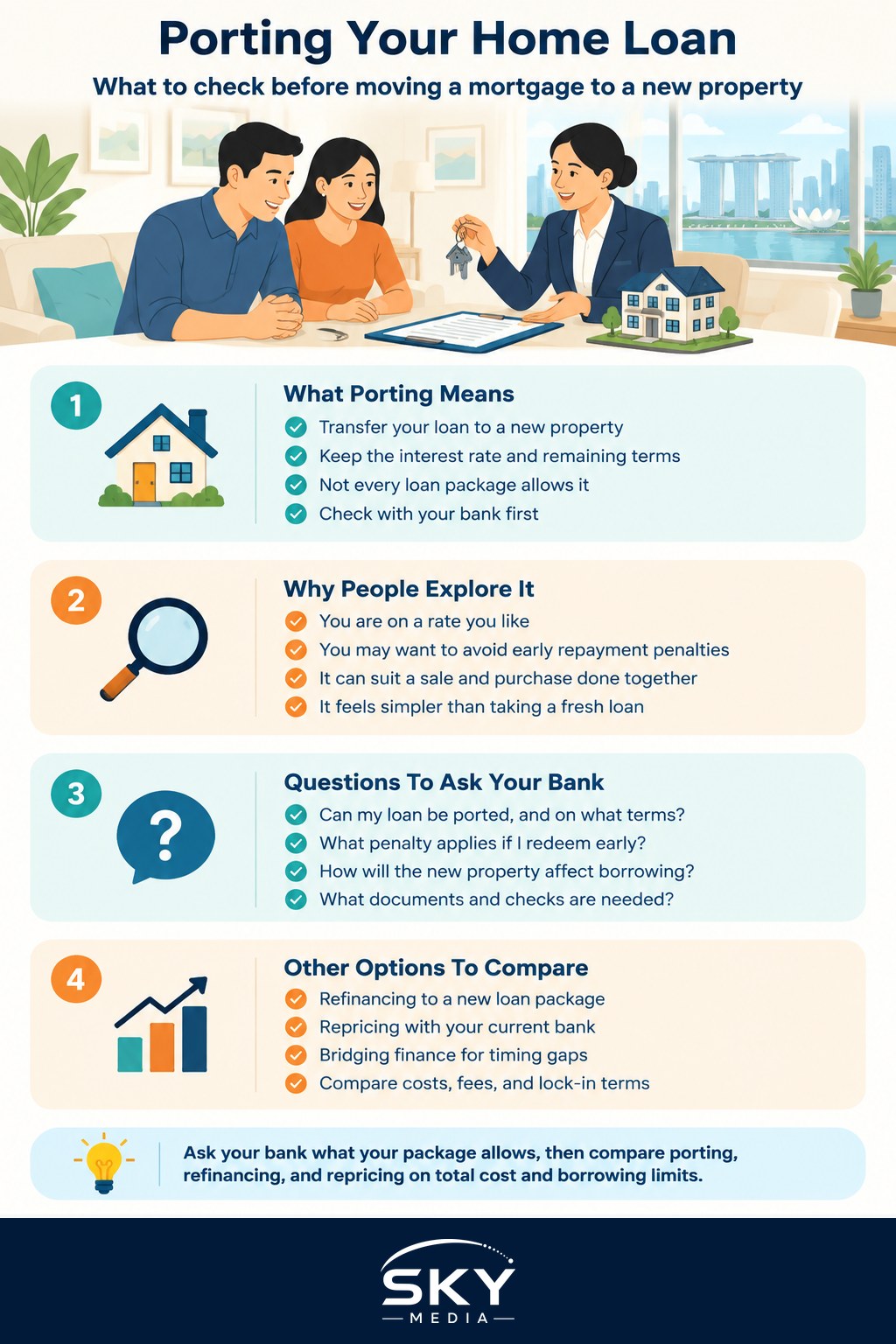
Porting, in principle, means transferring your existing loan, including its interest rate and remaining terms, from the property you are selling to the one you are buying. The appeal is obvious. If you are locked into an attractive rate, keeping it when you move sounds like a neat way to avoid taking a fresh loan at whatever rates prevail at the time.
In practice, whether and how this can be done depends entirely on your bank and the specific terms of your loan package. Local mortgage packages are not always built with straightforward portability in mind, and features vary between lenders and change over time. So the honest starting point is that you should not assume your loan can be ported. Ask your bank directly what your package allows.
Why people consider it
There are a few situations where the idea is especially tempting.
- You are on a rate you like. If your current package is favourable compared with what is available now, carrying it over feels valuable.
- You want to avoid penalties. Redeeming a loan early can trigger charges within a lock-in period, and porting is sometimes floated as a way around that. Our guide to early home loan repayment explains how those penalties generally work.
- You are timing a sale and a purchase together. Moving in one smooth step is appealing, and keeping the same loan seems to reduce friction.
These are all reasonable motivations. The catch is that the mechanics may not support them, so treat porting as one option to explore rather than the plan.
The realities to check with your bank
Because so much depends on the fine print, a conversation with your lender is essential before you commit to anything. Sensible questions to raise include the following.
- Does my current package actually allow the loan to be ported, and under what conditions?
- If I redeem early instead, what penalty applies, and is my lock-in period still running?
- How would the loan amount change if the new property has a different value, and what rules apply to the fresh borrowing?
- What documents and reassessment would the bank require, and how long would it take?
Keep in mind that borrowing limits such as the loan-to-value ratio and the total debt servicing ratio are set by MAS and are reassessed when you take on financing for a new property. These rules and thresholds change over time, so the amount you can borrow on the new home is not guaranteed to mirror your old loan. Check the current position with your bank rather than assuming continuity.
Alternatives worth weighing
If porting is not available or not worthwhile, you have other routes to a good outcome, and one of them may suit you better anyway.
- Refinancing to a new package. When you buy the new home, you take a fresh loan, and shopping around may land you a competitive rate. A mortgage broker can compare packages across lenders for you.
- Repricing with your current bank. Sometimes staying put and adjusting your existing terms makes sense. Our guide to repricing your home loan explains that path.
- Bridging finance for timing gaps. If your sale and purchase do not line up, a short-term facility can cover the gap. See bridging loans explained for how these work in general.
Each of these has its own costs and trade-offs, and the right choice depends on your rate, your timing, and your finances. There is no one-size-fits-all answer.
Making the decision
Porting is best treated as a question to ask, not an assumption to build on. Start by asking your bank exactly what your current loan permits, then compare that against refinancing and repricing on a like-for-like basis, including any penalties, fees, and the fresh borrowing limits that apply to your new property. Line up the total cost of each route over the years you expect to hold the new home, not just the headline rate.
Because this is a financial decision with real money at stake, get advice tailored to your numbers. Speak to your bank about what your specific package allows, and consider a qualified financial adviser or a mortgage broker to compare your options across lenders. Remember that loan rules, rates, and penalties all change over time, so confirm the current position rather than relying on general articles like this one, which is general information and not financial advice.
Further reading: Applying for a Home Loan Jointly or Alone