
Preparing a Singapore permanent residence application is largely a documentation exercise, and a well-organised pr documents checklist is the single biggest thing you can do to make the process smoother. The Immigration and Checkpoints Authority (ICA) assesses your application on the strength and clarity of the papers you submit, so missing, unclear or poorly scanned files are a common cause of delay. This guide walks through the categories of documents most applicants need, how to prepare them, and how to keep the whole set tidy.
This is general guidance to help you get organised, not personalised immigration advice. The exact document list, formats and any fees are set by ICA and can change, so always confirm the current requirements on the official ICA e-PR system before you submit.
Start With Identity and Travel Documents
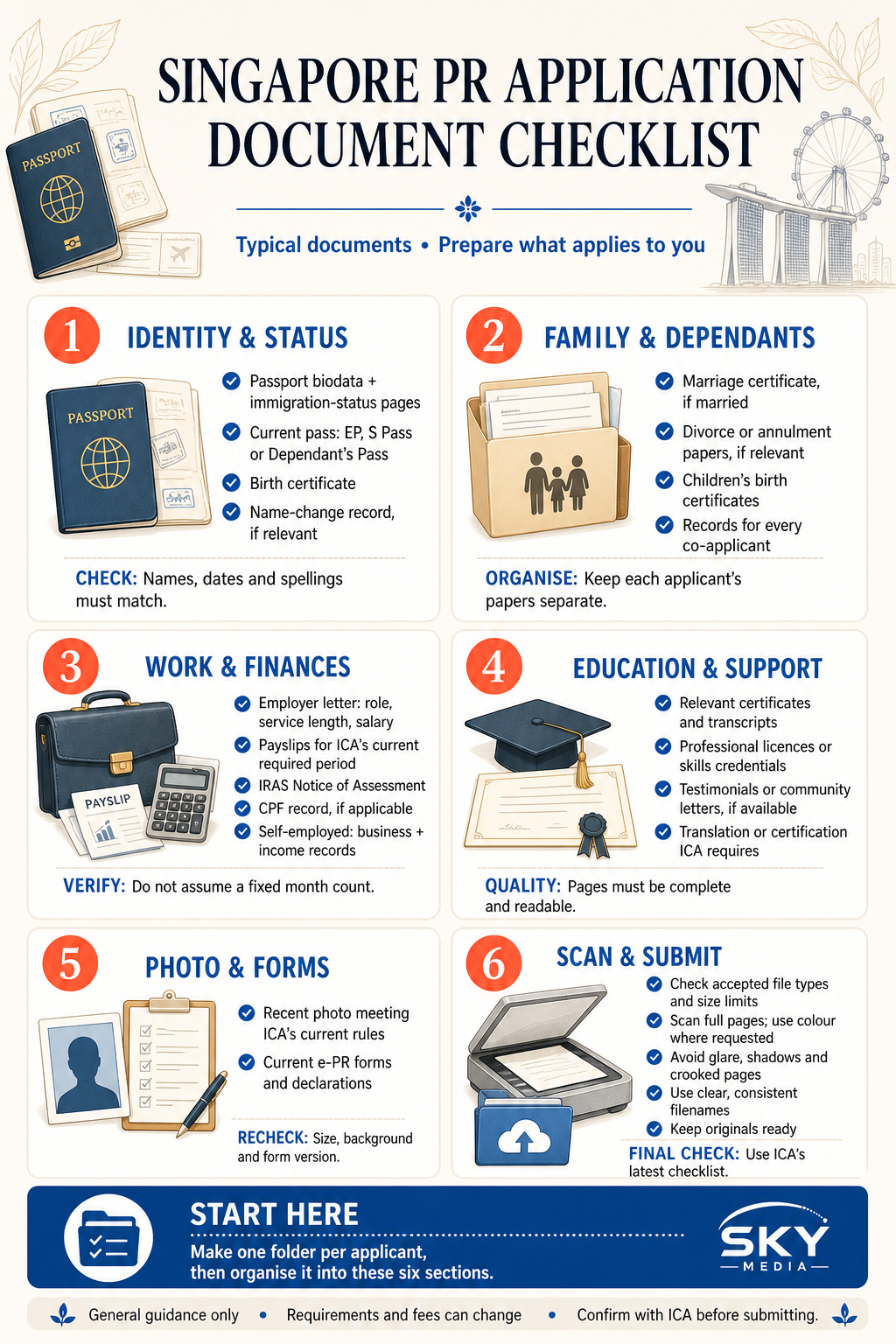
The foundation of any application is proving who you are and your legal status in Singapore. These are the documents ICA uses to establish your identity, nationality and current pass.
Typical items in this group include:
- Your passport, including the personal-details page and any pages showing your current immigration status.
- Your current pass, such as an Employment Pass, S Pass, Dependant’s Pass or the pass under which you reside here.
- Your birth certificate, which establishes your name, date of birth and parentage.
- Any official name-change document if your name differs across records.
Because these underpin everything else, make sure names, dates and spellings match across all files. Inconsistencies, even small ones, invite follow-up questions.
Family and Relationship Documents
ICA looks at your family circumstances, both to assess ties to Singapore and to process any family members you are including in the same application. Even if you are applying alone, relationship documents help paint a full picture.
Prepare, as relevant to your situation:
- Marriage certificate, and divorce or annulment papers if a previous marriage applies.
- Birth certificates for any children, showing the parents’ names.
- Documents for family members you are applying for at the same time, such as a spouse or children.
- Death certificate of a spouse where relevant to your family status.
If you are applying together with dependants, keep each person’s set clearly separated so nothing is attributed to the wrong applicant.
Employment, Income and Financial Standing
Your economic contribution and stability weigh heavily in the assessment, so income and employment documents deserve careful attention. This is often where applicants have the most to gather.
Common documents include:
- A letter from your employer stating your position, length of service and salary.
- Recent payslips covering the period ICA specifies.
- Your income tax documents, such as the Notice of Assessment from the Inland Revenue Authority of Singapore (IRAS).
- CPF contribution history, where applicable, which reflects your working record in Singapore.
- For the self-employed or business owners, records that show your business activity and income.
Do not guess at figures or timeframes. The number of months of payslips or tax statements required is defined by ICA, so verify the current requirement rather than assuming a fixed period.
Education, Skills and Supporting Papers
Beyond income, ICA considers your qualifications and how you have integrated into life here. Educational and supporting documents round out your profile.
Consider including:
- Educational certificates and transcripts, from your highest qualification and others that are relevant.
- Professional licences, membership certificates or skills accreditation tied to your work.
- Testimonials or letters that speak to your contribution or community involvement, where you have them.
Quality matters here. Certificates in another language usually need an official translation, and every scan should be complete, in focus and legible.
How the Document Categories Fit Together
It helps to see the whole picture before you start scanning. The table below groups the main categories, what they establish, and a quick preparation tip. Treat it as a planning aid and confirm the definitive list with ICA.
| Category | What it establishes | Preparation tip |
|---|---|---|
| Identity and travel | Who you are and your current status | Match names and dates across every file |
| Family and relationship | Your ties and any dependants | Separate each applicant’s documents clearly |
| Employment and income | Economic contribution and stability | Use the exact period ICA specifies |
| Education and skills | Qualifications and integration | Translate and certify non-English papers |
| Photograph and forms | Formal application requirements | Follow ICA’s size and format rules exactly |
The e-PR system also requires a recent photograph that meets specific dimensions and background rules, so prepare that to ICA’s stated specification rather than reusing an old photo.
Scanning, Formatting and Submitting Cleanly
Even a complete set of documents can stall if the files are hard to read or wrongly formatted. A few disciplines pay off:
- Follow the file rules. ICA specifies accepted file types and size limits in the e-PR system. Check and match them before uploading.
- Scan in full and in colour where asked. Capture the entire page, keep it straight, and avoid glare or shadows.
- Name files clearly. A simple, consistent naming scheme helps you check nothing is missing and makes re-uploads painless.
- Keep originals ready. You may be asked to present originals for sighting, so keep them accessible even after you submit.
- Do a final cross-check. Read your own checklist against ICA’s current list one last time before you press submit.
Give yourself time. Requesting a Notice of Assessment, an employer letter or an official translation can take days or weeks, so start early. A calm, complete submission reflects well and reduces the chance of a request for further documents later.
Explore more
Once your documents are in order, see what happens next in our Singapore PR application timeline, and read the fuller Singapore PR application guide for context on eligibility and assessment. If a decision does not go your way, our guide on appealing a rejected PR application explains the options.