

The first year in a new country arrives all at once. There is a pass to activate, a bank account to open, a home to set up, a workplace to understand, and a hundred small unfamiliar tasks in between. This settling in checklist singapore newcomers from mainland China can lean on turns that rush into a calmer, phase-by-phase roadmap. Instead of trying to do everything on day one, you move through the year in stages, arrival, first months, settling, and approaching year one, ticking off what belongs to each. Think of it as a reassuring map rather than a test. Everyone finds their feet at their own pace, and the point is simply to make sure nothing important slips through.
Throughout, remember that specifics such as pass rules, subsidies, and PR criteria are set by official bodies and change over time, so treat this as a general guide and confirm the current details with the relevant agency.
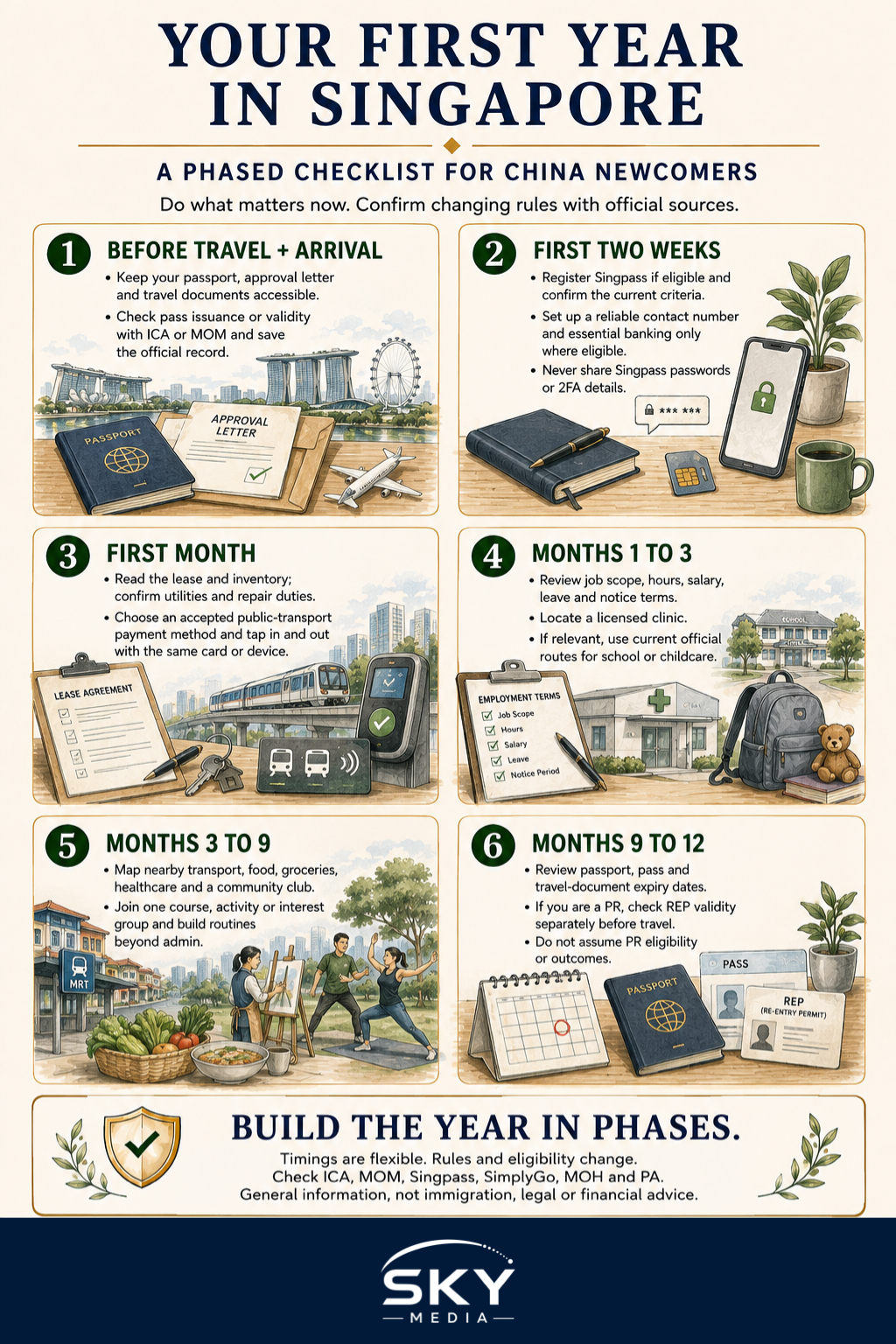
Phase One: Arrival Essentials in Your First Weeks
The opening weeks are about switching on the basics that everything else depends on. You do not need to do them in a single day, but this handful comes first.
Start with your pass and identity. Make sure your pass, issued through ICA or the Ministry of Manpower, is properly in order, then set up Singpass, the digital key to almost every government and many private services in Singapore. With that in hand, life becomes far smoother.
Next, sort the practical foundations:
- Open a bank account so your salary and payments have a home, and set up PayNow, the local instant-transfer system that will feel familiar if you used WeChat Pay or Alipay, though it works through your bank.
- Get a local SIM or mobile plan, since a Singapore number is needed for verifications, deliveries, and daily contact.
- Settle your home, whether rented or otherwise, and register the essentials so you have a stable base.
These arrival essentials are the scaffolding. Once your pass, Singpass, bank account, phone, and home are in place, the rest of the year has something solid to build on.
Phase Two: The First Few Months of Daily Life
With the basics live, the next months are about turning a place you sleep into a life you live. This is where routines form.
Sort your utilities and connectivity so the home runs, arranging electricity, water, and gas through the proper providers, and a home internet plan. Learn the transport system early, because it changes everything: get an EZ-Link or SimplyGo setup for the MRT and buses, and let public transport, which is extensive here, replace the instinct to solve every trip another way.
Then attend to health and family. Find out where your nearest clinics are and how to see a GP, so that a fever or minor illness does not become a scramble. If you have children, this is the window to sort schooling or childcare and help them settle. And at work, take the time to understand your workplace, your contract, your leave, and the local norms, which may differ from what you knew at home. If anything about employment terms is unclear, the Ministry of Manpower and your contract are the references to check.
By the end of this phase, the ordinary machinery of life, getting around, staying well, working, and caring for family, is running without constant thought.
Phase Three: Putting Down Roots
Around the middle of the year, once survival mode fades, a gentler and in many ways more important phase begins: actually feeling at home. This is easy to postpone and worth prioritising.
Start building a social life beyond the practical. Making friends, including beyond the Chinese community, and joining a group or activity turns a city you function in into one you belong to. Community centres run by the People’s Association are an easy, welcoming entry point. At the same time, deepen your grasp of everyday finances, understanding local budgeting, and beginning to build a credit record here, since your record from China does not carry over.
This is also the season to explore and absorb the culture. Try the food beyond what is familiar, visit different neighbourhoods, and pick up the local rhythms, from hawker-centre etiquette to festival customs. None of this is on a deadline, but the newcomers who settle best tend to be the ones who lean into local life rather than waiting for it to come to them.
Phase Four: Approaching Your First Year
As the twelve-month mark nears, the task shifts from setting up to reviewing and thinking ahead. A short stocktake now prevents surprises.
First, check your documents and permits. Confirm that your pass, your Chinese passport, and, if you are a Permanent Resident, your Re-Entry Permit all remain valid and are not about to expire together, renewing through the right body in good time. Then, if longer-term residence is your goal, learn how Permanent Residence works and what it involves, always confirming current eligibility and process with ICA rather than assuming. Finally, reflect on integration itself: your language, your community, your sense of home, and where you would like the next year to take you.
The first year is less a checklist to race through than a foundation to lay well, and reaching its end usually means the hardest part is behind you.
| Settling-in phase | Key tasks |
|---|---|
| Arrival (first weeks) | Pass in order, Singpass, bank account and PayNow, SIM, home |
| First few months | Utilities, transport card, GP and clinics, kids’ school, workplace |
| Putting down roots | Friends and community, budgeting and credit, exploring, culture |
| Approaching one year | Review passes and documents, consider PR, deepen integration |
Treat the table as a flexible guide rather than a strict timetable, since everyone’s pace and circumstances differ. For anything involving official rules, passes, PR, or subsidies, verify the current position with the relevant Singapore body.
Keeping It Manageable
The single most useful mindset for year one is that you do not have to do it all now. Break the list into the phase you are actually in, finish what belongs there, and let the next phase wait until you reach it. Keep a simple running note of what is done and what is pending, and lean on official channels, ICA, the Ministry of Manpower, HealthHub, and your community centre, whenever you need the authoritative answer. Ask for help freely, since every established resident here was once new too. A year from now, the tasks that feel daunting today will simply be part of a life you have built.
Explore More
Paperwork threads through the whole year, so keep Keeping Your China and Singapore Documents in Order close by for the passport, pass, and certification side of settling in. And when you reach the roots-and-community phase, Joining Interest Groups and Clubs in Singapore is a warm, practical next step toward feeling truly at home.