
For many mainland-Chinese families who have settled here, the PR vs citizen Singapore question surfaces once permanent residence starts to feel secure. Both statuses let you live and work in Singapore for the long term, yet they carry different rights, costs and duties. This guide compares the two across housing, CPF, National Service, voting and travel, so you can weigh the trade-offs calmly rather than in a rush. Rules, fees and eligibility change often, so treat this as a starting map and confirm the current position with the Immigration and Checkpoints Authority (ICA) before you decide.
What Permanent Residence and Citizenship Really Mean
A Singapore permanent resident (PR) keeps their original nationality, so a mainland-Chinese PR continues to hold a Chinese passport. To leave and re-enter Singapore, a PR needs a valid Re-Entry Permit (REP), which is issued for a fixed period and has to be renewed. Let it lapse while you are overseas and your PR status can be lost, so PRs learn to watch that expiry date closely.
A Singapore citizen holds a Singapore passport and full civic membership. Because both China and Singapore bar dual citizenship, becoming a Singaporean means giving up your Chinese nationality. Under China’s Nationality Law, acquiring a foreign nationality of your own free will leads to loss of Chinese citizenship, and you would also deregister your household registration, or hukou, back home. That is a one-way door for most people, which is why the comparison below matters so much.
Housing and Property
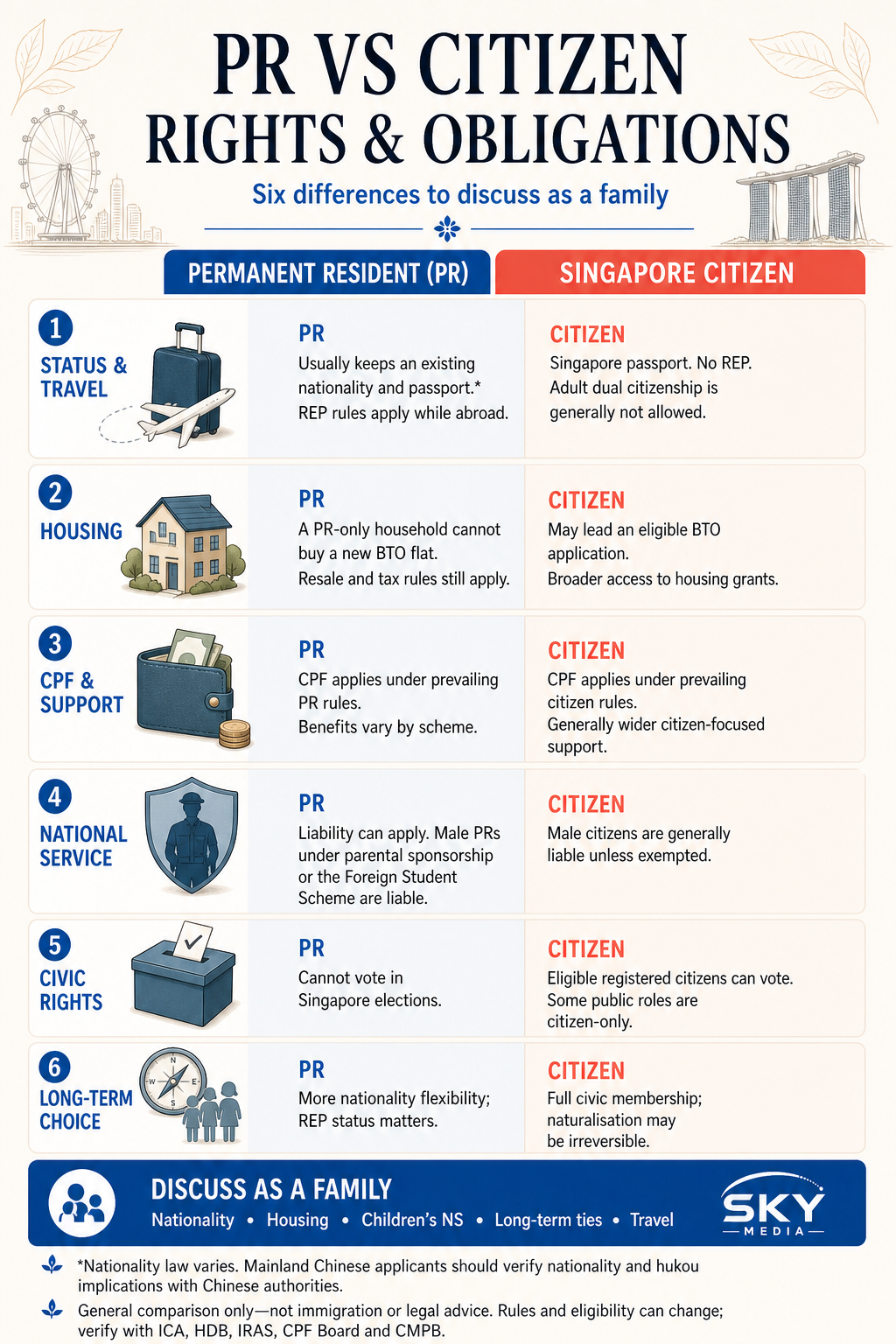
Housing is often the biggest practical difference. Citizens can apply for new Build-To-Order (BTO) flats from HDB and are eligible for the widest range of housing grants. PRs generally cannot buy new flats and must meet a waiting period before buying a resale HDB flat, and a purely PR household faces tighter rules than a citizen household. For private property, the Additional Buyer’s Stamp Duty (ABSD) that applies to citizens and PRs is not the same, and the rates are reviewed from time to time.
Because these figures move, do not rely on any number you read casually. Confirm current flat eligibility and grants with HDB, and check stamp-duty treatment with IRAS, before you commit to a purchase or sign an option.
CPF, Subsidies and Everyday Costs
PRs and citizens both contribute to the Central Provident Fund (CPF) through work, so both build retirement, housing and MediSave savings. Where they part ways is in government subsidies. As a broad principle, citizens receive the highest tier of support, PRs a middle tier, and foreigners the least, across areas such as healthcare at public hospitals and polyclinics, school fees and various schemes.
Newborn benefits, education top-ups and cost-of-living rebates are frequently citizen-only or more generous for citizens. None of these amounts are worth memorising here because they are revised regularly. For anything touching CPF or MediShield Life as a PR, defer to the CPF Board and MOH; for school fees, defer to MOE.
National Service, Voting and Civic Duties
National Service (NS) is a duty that many families weigh heavily. Male citizens are liable for NS, and so are male PRs of the second generation, meaning sons who obtain PR status through their parents. A first-generation man who becomes a PR as an adult is generally not called up himself, but his sons who are PRs or citizens usually are. This has real consequences for a boy’s schooling, travel and career timing, so read MINDEF and CMPB guidance carefully rather than assuming.
Voting and standing for election are citizen-only rights. PRs cannot vote in Singapore’s general or presidential elections. Citizens also gain access to certain roles, scholarships and public appointments that are closed to PRs. In short, citizenship brings a fuller civic voice, while both statuses share the everyday duty to obey the law and pay taxes.
Travel, Passports and Consular Help
On travel, a PR juggles two documents: a Chinese passport for identity and a Singapore REP for re-entry, and visa access still follows the Chinese passport. A citizen travels on the Singapore passport, which enjoys wide visa-free or visa-on-arrival access, and can seek Singapore consular assistance abroad. The trade-off is that gaining that passport means renouncing Chinese citizenship and deregistering your hukou, and returning to China afterwards would be as a foreign national needing a visa.
PR vs Citizen at a Glance
| Area | Permanent Resident | Singapore Citizen |
|---|---|---|
| Nationality and passport | Keeps Chinese passport, holds a Re-Entry Permit | Holds Singapore passport, gives up Chinese citizenship |
| New HDB (BTO) flats | Generally not eligible; resale only after a wait | Eligible, with the widest grant support |
| Government subsidies | Middle tier for healthcare, schooling and schemes | Highest tier of subsidies and benefits |
| National Service | Second-generation males (sons) are liable | Males are liable |
| Voting and elected office | Not eligible | Eligible to vote and stand |
Making the Choice, and Where to Verify
The right answer is personal. Weigh how much you value keeping your Chinese citizenship, any property or business ties in China, your children’s education and NS timing, and how often you travel back. Some families stay PR indefinitely because it preserves flexibility; others convert to citizenship for stability, subsidies and belonging. There is no universally correct path.
Before you act, verify the current rules with the official bodies rather than online rumour. Speak to ICA about status, REP and citizenship; to HDB and IRAS about property; to the CPF Board and MOH about CPF and healthcare; and to the Chinese Embassy about renunciation and hukou matters. Getting the sequence right protects your family from costly missteps.
Explore more
If citizenship is on your mind, read our guide on renouncing Chinese citizenship to become a Singapore citizen and the practical steps for deregistering your China hukou when emigrating. Families still on the PR track may also find our walkthrough on including your spouse and children in your PR application helpful.