

If you are an international student offered a place at a Singapore university or polytechnic, you will probably see two fee figures: a much higher one, and a lower “subsidised” one. The difference is the MOE Tuition Grant. For many an MOE Tuition Grant international student, it makes a Singapore degree affordable. But the grant is not free money. It comes with a service obligation, often called a bond, that commits you to working in Singapore after you graduate.
This guide explains what the Tuition Grant covers, how the work obligation works in broad terms, what happens if you cannot or do not want to fulfil it, and the questions to ask before you sign. It is general information. The Ministry of Education (MOE) sets the rules, which can change, so always check the latest terms on MOE’s Tuition Grant website and with your institution.
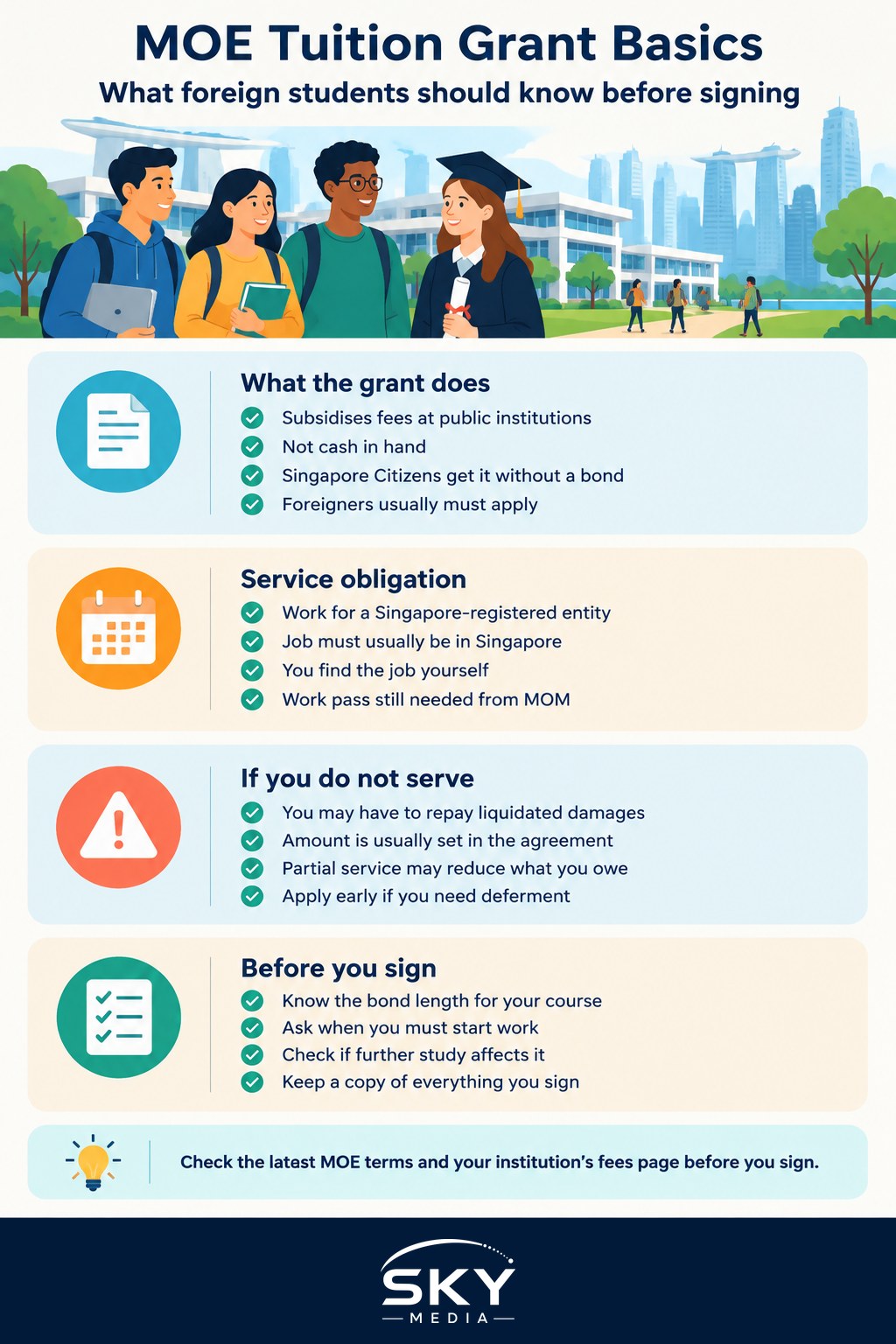
What the Tuition Grant Is
The Tuition Grant Scheme is a subsidy from the Singapore government that reduces the tuition fees students pay at publicly funded institutions. These typically include the autonomous universities, the polytechnics and some arts institutions. Singapore Citizens receive the grant without a bond. Permanent Residents and international students can usually apply for it too, but they must sign a Tuition Grant agreement that includes a service obligation.
A few practical points:
- It is not automatic for foreigners. International students generally need to apply, typically through MOE’s online Tuition Grant system, within the window their institution gives.
- Not every course is eligible. Some programmes may not offer the grant to international students, or may have different terms. Check your specific course.
- The subsidy is applied to your fees, so you pay the subsidised fee directly to your institution. You do not receive the money in cash.
- Fees still rise each year in some cases, and subsidised fees for international students are higher than those for citizens and PRs. See our explainer on MOE school fees for PR and foreign students for the general fee tiers.
How the Service Obligation Works
When you accept the grant, you agree to work for a Singapore-registered entity for a set period after you graduate. For many degree and diploma courses, this has been three years, but the length can depend on the course and may change. Your agreement states the exact period and conditions.
The obligation generally works like this:
- You must find the job yourself. MOE does not assign you to an employer. You apply for jobs like any graduate.
- The employer must be a Singapore-registered entity, and the work is generally done in Singapore. Some arrangements for work overseas with a Singapore entity may be possible; ask MOE.
- You need a valid work pass. As a foreigner, you will need a work pass from the Ministry of Manpower (MOM), such as an Employment Pass or S Pass. MOM decides pass eligibility separately; the bond does not guarantee you a pass.
- You must start within a set time after graduating. The agreement allows a period to find work. If you need more time, or want to study further first, you may be able to apply for a deferment.
- Your service is tracked. You may need to report your employment to MOE through its system.
Taking the Grant vs Paying Full Fees
Some international students choose not to take the grant so they are free to leave Singapore after graduating. Here is how the two paths compare.
| Factor | With Tuition Grant | Without Tuition Grant |
|---|---|---|
| Fees you pay | Subsidised fee, much lower | Full, unsubsidised fee |
| After graduation | Must work in Singapore for the bond period | Free to work anywhere |
| Work pass | Still needed from MOM, not guaranteed | Needed only if you choose to work here |
| Changing your mind later | Breaking the bond means paying back a set sum | No obligation to repay |
| Best for | Students who want a Singapore career start | Students with firm plans to return home or go elsewhere |
There is no single right answer. If you already plan to build a career in Singapore, the grant can save a large amount. If you are certain you will go home, the bond may be a burden.
What If You Cannot Fulfil the Bond?
Life changes. Family needs, a job offer at home, or difficulty getting a work pass can all get in the way. The agreement usually covers these situations:
- Breaking the bond. If you do not serve your obligation, you will generally have to pay MOE liquidated damages, a sum set out in the agreement. This can include the grant amount and interest, and it is often a large sum. Read the agreement carefully.
- Partial service. If you serve part of the period, the amount owed may be reduced in proportion. Check how your agreement treats this.
- Deferment. Further studies or other circumstances may allow you to postpone the obligation. You usually need to apply and get approval first, not after the fact.
- Not finding a job. If you genuinely cannot find work or get a pass, talk to MOE early. Keep records of your job applications.
Do not simply leave Singapore and hope the bond is forgotten. Unresolved obligations can follow you, and contacting MOE early usually gives you more options.
Questions to Ask Before You Sign
Before you sign the Tuition Grant agreement, find out:
- How long is the service obligation for my course?
- How long after graduation must I start work?
- Does internship or part-time work count?
- What happens if I do a master’s degree straight after?
- How are liquidated damages calculated if I break the bond?
- Do I need a guarantor or any other documents?
Your university’s admissions or financial aid office can explain the process, but MOE’s official terms are what bind you. Save a copy of everything you sign.
Planning Your Life Around the Bond
If you take the grant, treat the bond as part of your career plan rather than a trap:
- Build your network early. Internships during your studies help you find bond-eligible work.
- Understand work passes. Learn how the Employment Pass and S Pass work so you are not caught out after graduation.
- Think about longer term status. Some graduates later apply for Permanent Residence. Read up on PR versus citizen rights and obligations to understand what that means.
- Keep records of your employment and pass dates.
The MOE Tuition Grant can be a great deal for international students who want to start their careers in Singapore. Read the terms carefully, ask your questions early, and make sure the service obligation fits your plans before you sign. For the latest rules, go to MOE’s Tuition Grant website and your institution’s fees page.
Official sources: Ministry of Education (MOE)
Further reading: Applying to a Singapore Polytechnic as an International Student · The ASEAN Scholarship for Secondary and JC Students Explained · MOE Tuition Fee Loan and Study Loans for University in Singapore