
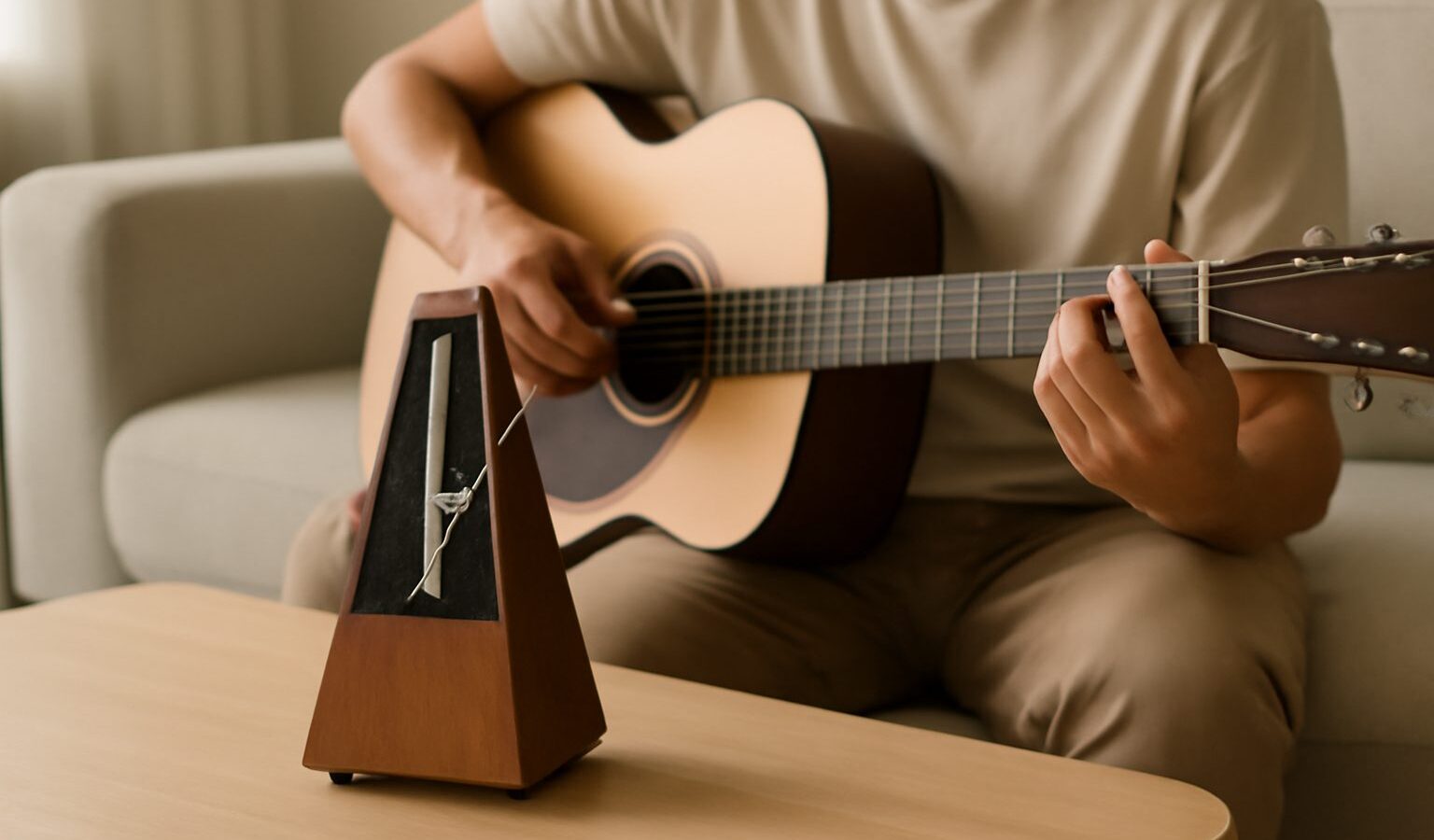
Practising with a metronome is the single most reliable way to fix shaky timing, and yet it is the tool most learners quietly avoid. A metronome is simply a device that clicks a steady pulse at a chosen speed, measured in beats per minute, or BPM. Set it to 60 and it clicks once a second. Set it to 120 and it clicks twice a second. Your job is to play in time with those clicks. Simple to describe, humbling to do, and genuinely transformative once you stick with it.
Most players think their timing is better than it is. Record yourself against a click for two minutes and the truth comes out: rushing the easy bits, dragging the hard bits, and speeding up whenever the music gets exciting. None of that is a character flaw. It is just untrained timing, and the metronome is the gym where you train it.
Why a steady pulse matters so much
Music is organised in time. A wobbly tempo makes even correct notes sound uncertain, while rock-solid time makes a simple piece sound professional. If you ever want to play with other people, in a band, a choir, a church group or the local music scene, keeping a shared pulse is the difference between locking together and falling apart. When you record, you may well play to a click track, a metronome running in your headphones, so a drummer’s fills and a singer’s phrasing all line up. Getting comfortable with a click now pays off everywhere later.
There is a deeper benefit too. Practising with a metronome exposes exactly where your technique breaks down. If you can play a run cleanly at 70 BPM but it collapses at 90, that gap tells you precisely what to work on. The click is an honest coach that never flatters you.
Setting up: tempo, beat and subdivision
You need three decisions before you start: how fast, what counts as a beat, and whether you subdivide.
- Tempo: start slower than feels natural. If the marked speed is 120, begin at a pace where you make zero mistakes, even if that is 60 or 70.
- The beat: decide what each click represents. In common time (four beats to a bar) the click usually lands on each quarter note beat.
- Subdivision: this means dividing the beat into smaller equal parts, such as playing two or four even notes per click. Subdividing keeps you honest between the beats, where most rushing happens.
Many metronomes let you accent the first click of each bar, which helps you feel the bar rather than a blur of ticks. If yours does, use it. Feeling beat one gives your playing shape.
A step by step practice routine
Here is a routine that works for almost any instrument or voice.
- Pick one short passage, not a whole piece. A bar or two is plenty.
- Set the metronome slow enough to play it perfectly. Perfect is the target, not fast.
- Play it four times in a row with no mistakes and no tension.
- Nudge the tempo up by a small step, often two to four BPM.
- Repeat. If you slip, drop back down and rebuild.
- Stop while it still feels good, and return to it the next day.
The magic is in the small steps. Jumping the tempo up by twenty at a time just teaches your hands to panic. Creeping up by two or three trains them to stay relaxed, and relaxed is fast. This slow climb is also the safest way to memorise, which is why our guide to memorising music leans on the same idea.
Clicks, subdivisions and where to place them
As you improve, you can make the click work harder by placing it in less obvious spots. This forces you to hold the pulse internally rather than leaning on constant reassurance.
| Metronome setting | What it trains | Best for |
|---|---|---|
| Click on every beat | Basic steady time | Beginners and new pieces |
| Click with subdivisions | Even notes between beats | Fast runs and rushing fixes |
| Click on beats 2 and 4 | Feeling the backbeat | Pop, funk and band playing |
| Click once per bar only | Holding time internally | Advanced timing and groove |
Do not rush to the harder settings. Spend real time on the basics first. The advanced placements are a test of timing you already have, not a shortcut to getting it.
Staying musical, not robotic
The most common worry is that a metronome will make your playing stiff and mechanical. It will not, if you use it as a tool rather than a cage. The click builds a reliable internal clock. Once that clock is steady, you can push and pull the tempo deliberately for expression, which is a world away from drifting by accident. Great players have superb time precisely because they trained it, and then they bend it on purpose.
So switch the metronome off regularly and play the same passage without it, listening to whether your new steadiness has stuck. Then check yourself against the click again. This back and forth, on and off, is how internal time gets built. Record both versions on your phone and compare. Your ear will tell you more than any device, which is one more reason to keep developing it alongside your timing, as our ear training for musicians guide explains.
Making it work in a flat
Timing practice does not have to be loud. A visual metronome that flashes, or a click in your headphones, lets you drill quietly late in the evening without disturbing neighbours through thin HDB or condo walls. If you practise an acoustic instrument, a practice mute or a lower dynamic keeps the peace while you focus purely on the timing. Being considerate about hours and volume matters as much as the music itself.
Finally, be patient. Timing improves slowly and invisibly, then one day you play with others and simply lock in. If your progress feels stuck despite regular clicking, it may be a routine problem rather than a timing one, and our guide to getting past a practice plateau can help. There are also plenty of apps to learn music that include a metronome, so you always have one in your pocket.
Stick with it for a few weeks and you will feel the difference. The clicks stop being a nag and start being a friend, and your playing gains a steadiness that makes everything else sound better.