

Your manager has just told you that you are joining a client visit in Jakarta, a conference in Shanghai or a regional meeting in Bangkok. It is exciting, and slightly nerve-racking, because a work trip is not a holiday. Someone else is paying, your behaviour reflects on the company, and there is admin waiting for you when you get back. These first business trip tips cover the parts nobody explains properly: claims, allowances, insurance, etiquette and how to actually get work done while you are away.
Read Your Company’s Travel Policy First
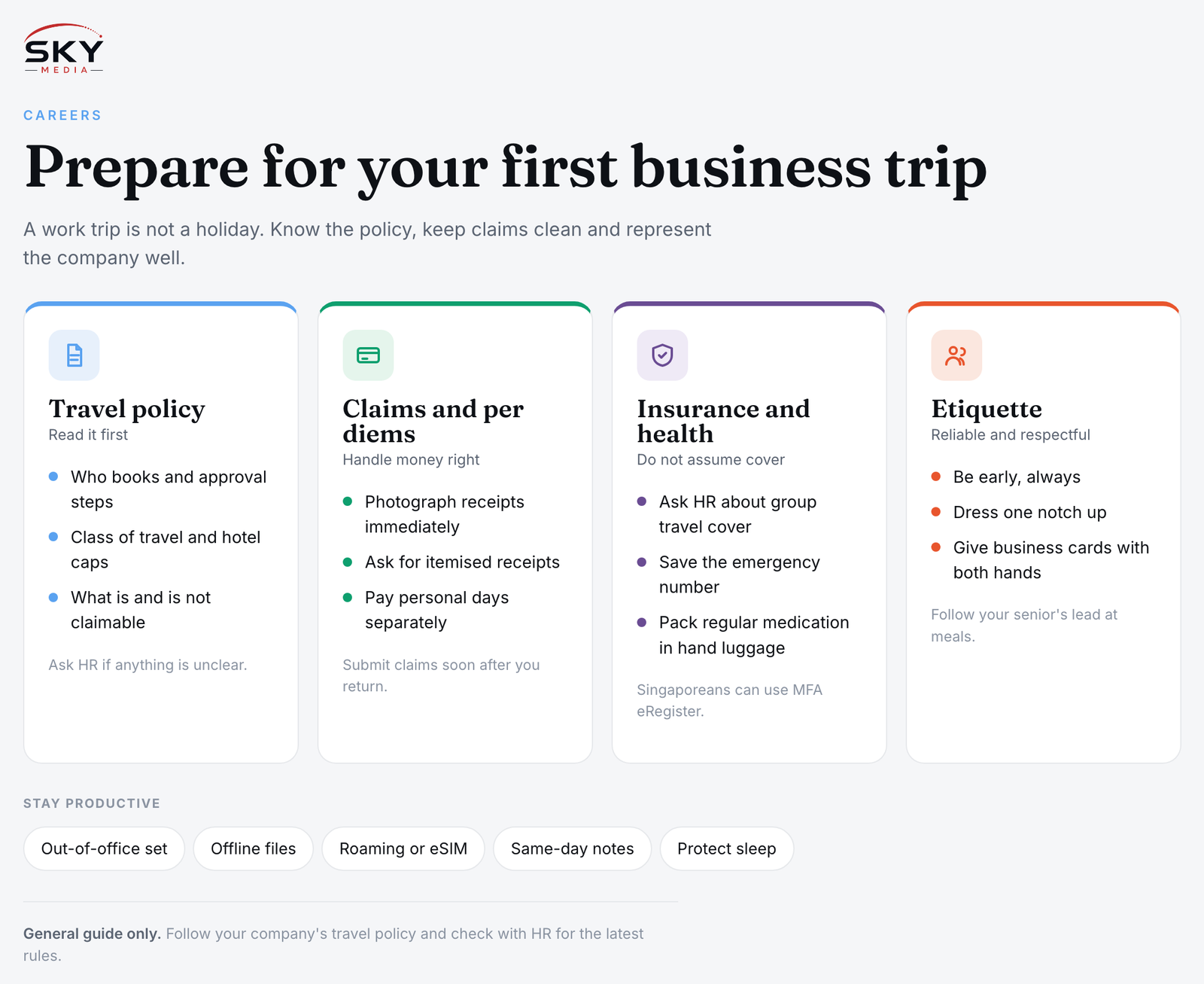
Almost every company that sends staff overseas has a travel policy, usually in the employee handbook or on the HR portal. Read it before you book anything, because it answers questions that are awkward to ask later.
Look for:
- Who books travel. Some firms use a travel agency or an online booking tool; others let you book and claim back.
- Class of travel and hotel limits. Policies often set economy class for short flights and a nightly hotel cap that varies by city.
- Approval steps. You may need written approval from your manager before booking.
- What is claimable. Meals, airport transfers, local transport, data roaming, laundry on longer trips and visa fees are commonly covered, but not always.
- What is not claimable. Alcohol, minibar items, in-flight entertainment, upgrades and personal side trips are often excluded.
- Submission deadlines. Claims usually have to be filed within a set period after you return.
If the policy is unclear on anything, ask HR or your manager before you go. “Can I check what the meal limit is for this trip?” is a perfectly professional question.
Expense Claims vs Per Diems
Companies usually reimburse trip spending in one of two ways, and some use a mix. Knowing which applies to you changes how you handle money on the road.
| Approach | How it works | What you need to do |
|---|---|---|
| Actual expense claims | You pay, keep receipts, and claim back what you spent within policy limits | Keep every itemised receipt and note the purpose of each expense |
| Per diem allowance | You get a fixed daily amount for meals and incidentals, regardless of actual spend | Track travel days accurately; receipts may not be needed for covered items |
| Corporate card | Expenses are charged to a company card and reconciled later | Match each card transaction with a receipt and business reason |
A few habits make claims painless:
- Photograph receipts immediately. Thermal paper fades and small slips get lost. Many expense apps let you snap and upload on the spot.
- Ask for itemised receipts. A credit card slip showing only the total may not be accepted.
- Note the exchange rate. Your company may use the rate on your card statement or a standard rate. Keep your card statements handy.
- Separate personal spending. If you extend the trip for a weekend of your own, pay for those days separately so your claim stays clean.
How allowances and reimbursements are treated for income tax is set out by IRAS, and your employer’s payroll team handles the reporting. If you are unsure, ask HR rather than guessing.
Travel Insurance and Health Basics
Many employers have a corporate travel insurance policy that covers staff on business trips. Do not assume you are covered. Ask HR:
- Whether a group travel policy applies to this trip and destination.
- How to get the policy details or emergency assistance number.
- Whether personal days added to the trip are also covered.
- What to do if you need medical treatment overseas.
Save the emergency contact number in your phone and keep a printed copy in your bag. If you are not covered, or you are extending the trip privately, consider buying your own travel insurance.
On health, check whether your destination has any recommended vaccinations or entry health requirements, and pack enough of any regular medication in your hand luggage. A travel clinic or your GP can advise. Singaporeans travelling abroad can also register their trip with the Ministry of Foreign Affairs (MFA) eRegister service so they can be contacted in an emergency.
Business Travel Etiquette That Matters
Etiquette on a work trip is mostly about reliability and respect.
- Be early, always. Arrive at meetings and airport check-in with time to spare. Being late on someone else’s turf looks worse than at home.
- Dress one notch up. Pack for the most formal meeting on your schedule. In many Asian business settings, people dress more formally than in a typical Singapore office.
- Handle business cards properly. In much of East Asia, offer and receive cards with both hands, read the card briefly and place it on the table rather than pocketing it straight away.
- Follow your senior’s lead at meals. Let the host or most senior person order and start. If alcohol is served, it is fine to drink lightly or decline politely.
- Mind your social media. Posting hotel pool photos during a work trip can send the wrong message to colleagues and clients.
- Respect local customs. A little research into greetings, gift-giving norms and topics to avoid goes a long way. If you are visiting China, our city guides to Shenzhen and Guangzhou are a good starting point for food and getting around.
Staying Productive on the Road
Travel days eat time. A little planning keeps your normal workload from piling up.
- Set an out-of-office message explaining when you will reply and who to contact for urgent matters.
- Download files for offline use before flying, and charge a power bank.
- Sort out connectivity. Check whether your company provides a roaming plan or an eSIM. Some destinations restrict certain apps and websites, so ask IT about access to work tools and use the approved VPN if required.
- Block thinking time. Use the flight for focused tasks like drafting a report rather than email.
- Write notes the same day. Summarise each meeting while it is fresh, including action items, and send a short recap to your manager.
- Protect your sleep. Jet lag is mild on most regional trips, but late dinners and early meetings add up. Hydrate and avoid overloading the evenings.
Your Pre-Departure Checklist
Use this list in the days before you fly.
- Passport valid for the destination’s entry requirements, plus any visa or entry approval. Check with the destination country’s official immigration site or embassy.
- Flight, hotel and ground transport confirmations saved offline.
- Meeting agenda, client names and addresses.
- Business cards, laptop, chargers and a universal adaptor.
- Corporate card or enough cash and a backup card.
- Insurance details and emergency contacts.
- Clothes for the most formal meeting, plus one spare shirt or blouse. Our guide to packing tips for tropical and cold trips helps if the weather differs from Singapore.
After You Get Back
Submit your expense claim within the first few days while receipts are still in order. Send thank-you emails to the people you met, share your meeting notes, and tell your manager what went well and what you would do differently. That last step quietly signals you are ready for the next trip.
Frequently Asked Questions
Do I need my manager’s approval before booking a business trip? Often yes. Many policies require written approval from your manager before you book, and some firms use a travel agency or online booking tool instead. Check the employee handbook or HR portal first, and ask HR if anything is unclear.
What expenses are usually not claimable on a business trip? Alcohol, minibar items, in-flight entertainment, upgrades and personal side trips are commonly excluded. Policies differ, so confirm what your company covers, and pay separately for any days you add for yourself.
Should I buy my own travel insurance for a work trip? Do not assume you are covered. Ask HR whether a group travel policy applies to the trip and destination, and whether added personal days are included. If not, or if you extend the trip privately, consider your own cover.
How do I get my receipts and claims in order after a business trip? Photograph receipts immediately, since thermal paper fades, and ask for itemised ones. Submit the claim within the first few days of returning, because policies set a filing deadline, and match any card transactions to a business reason.
How should I handle business cards and meals with overseas hosts? In much of East Asia, offer and receive cards with both hands and place them on the table instead of pocketing them. At meals, follow the host or most senior person, and it is fine to drink lightly or decline alcohol politely.