

You have shortlisted a few centres, checked the distance from home and read the reviews. Now comes the part that tells you the most: walking through the door. The typical preschool tour Singapore centres offer lasts 30 to 60 minutes, and it is easy to come away remembering only the bright murals and the friendly principal. This checklist helps you use that time well, so you leave with real answers you can compare across centres.
If you are still deciding what type of centre suits your family, start with our guide to choosing a preschool or childcare in Singapore. This article assumes you already have a shortlist and want to judge each one on site.
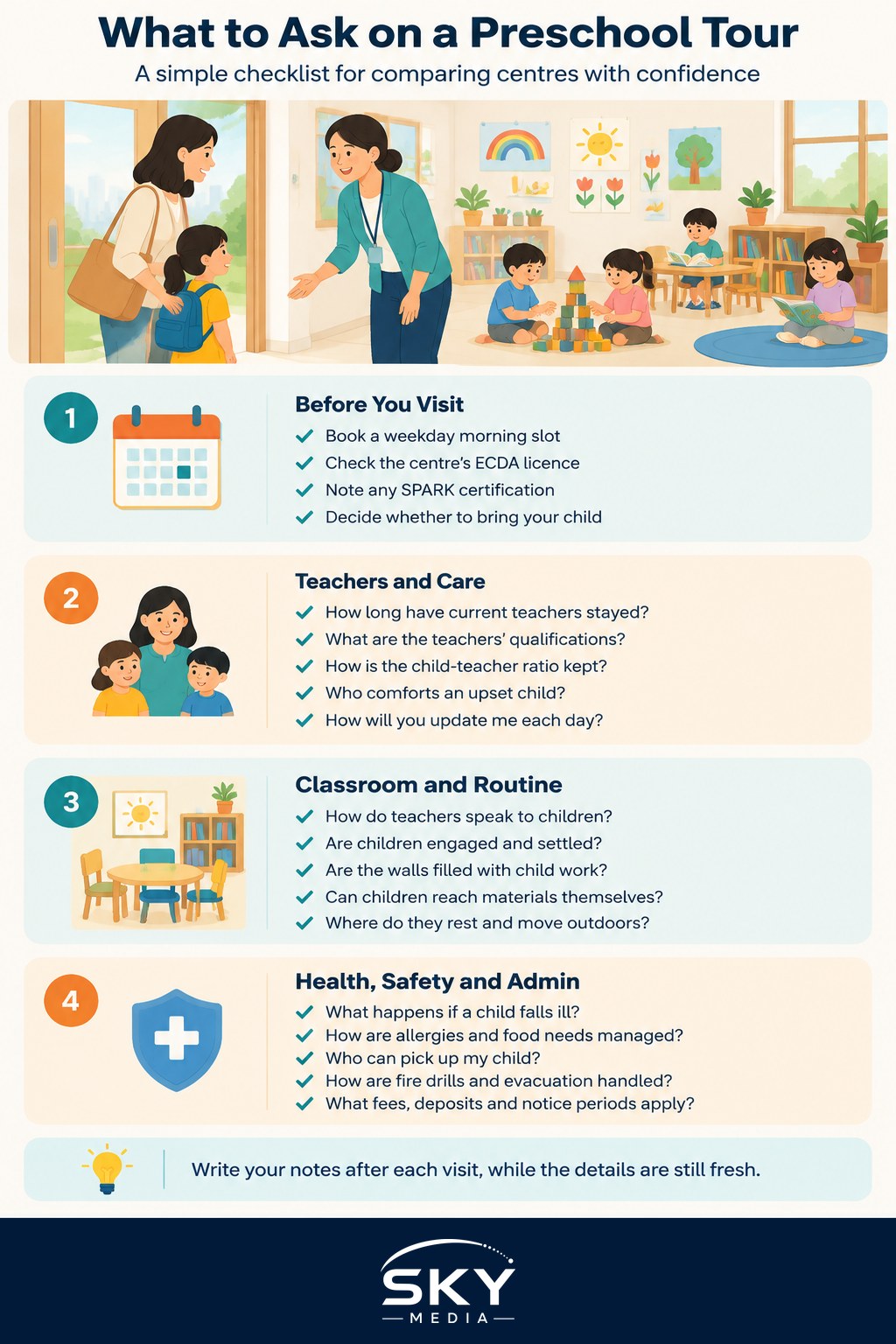
Before You Go: Set Up the Visit Properly
A good tour starts before you arrive. A few small steps make the visit far more useful.
- Ask for a weekday morning slot. Many centres hold Saturday open houses, which are helpful for an overview, but the classrooms are empty. A weekday morning lets you see children and teachers in their normal routine.
- Check the licence first. Every preschool in Singapore must be licensed by ECDA (the Early Childhood Development Agency). You can look up a centre on ECDA’s official listing before you visit and note its licence details.
- Note any SPARK certification. SPARK (Singapore Preschool Accreditation Framework) is a voluntary quality framework. Not having it does not mean a centre is poor, but having it tells you the centre has gone through an external quality assessment.
- Bring your child, or not, on purpose. Bringing your child shows you how staff greet a new face. Going alone lets you ask harder questions without distraction. Some parents do both across two visits.
- Write your questions down. Print or save the list below on your phone and tick items off as you go.
Questions About Teachers and Care
Teachers shape your child’s day far more than the curriculum brochure does. Ask about the people first.
- How long have the current teachers in my child’s class been at the centre? High turnover is worth probing gently.
- What are the qualifications of the lead teacher and the assistant, and how does the centre support ongoing training?
- What is the teacher to child ratio in this age group, and how is it kept when staff are on leave or sick? ECDA sets requirements by age, so ask how the centre meets them in practice.
- Who will my child go to when they are upset, and how do teachers comfort a crying child during settling in?
- How do teachers handle biting, hitting or other difficult behaviour? Listen for words like redirecting and talking it through, rather than punishment.
- How will you tell me about my child’s day? Many centres use a parent app, a communication book or a short chat at pick up.
What to Observe in the Classroom
Answers from the principal matter, but what you see matters more. Spend a few quiet minutes simply watching.
- Teacher tone. Do teachers kneel to the child’s eye level and speak calmly? Do they know the children’s names?
- Children’s mood. Are children busy and engaged, or wandering and bored? A little noise is healthy; constant chaos or eerie silence both deserve a question.
- Work on the walls. Is the artwork clearly made by children, with different results, or does every piece look identical and teacher made?
- Access to materials. Can children reach books, blocks and art supplies themselves, or is everything locked away?
- Outdoor and movement time. Where do children play outdoors or move about? In a hot, wet climate, ask what happens on rainy or hazy days.
- Rest area. For full-day programmes, look at where children nap, how mats or beds are stored and how the room is ventilated.
The table below helps you sort what you notice into what is reassuring and what is worth a follow-up question.
| Area | Encouraging sign | Worth asking about |
|---|---|---|
| Greeting | Staff welcome you and your child warmly by name | No one acknowledges you or the children |
| Classroom | Children engaged in varied activities | Long periods of waiting or screen time |
| Hygiene | Handwashing routines, clean toilets and kitchen | Strong odours or visibly dirty areas |
| Safety | Gate controls, sign-in for visitors, covered sockets | Open gates or unsupervised doors |
| Communication | Clear answers and written policies | Vague replies or reluctance to show areas |
Questions About Health, Safety and Food
These questions are practical but important, especially for infants and toddlers.
- What is the procedure if my child falls sick or gets injured during the day? Who calls me, and how quickly?
- What is your policy on sending children home with fever, and when can they return? Your child’s doctor or polyclinic remains the right source for medical advice; the centre’s policy just tells you what to expect.
- How are allergies and dietary needs managed? If your family eats halal, vegetarian or has a specific allergy, ask how food is prepared and labelled.
- Can I see a sample weekly menu? Is food cooked on site or catered?
- Who can pick up my child, and how is identity checked for someone new?
- How often do you run fire drills, and what is the plan for evacuation?
- How is screen time, if any, used during the day?
Questions About Curriculum, Language and Transition to Primary 1
Every centre describes its programme slightly differently. Ask for specifics rather than labels. If a centre says it follows Montessori, Reggio Emilia or play-based learning, our explainer on Montessori and other preschool approaches will help you test whether the claim matches what you see.
- What does a typical day look like, hour by hour?
- How much time is spent on free play, outdoor time, structured lessons and rest?
- How is Mother Tongue (Chinese, Malay or Tamil) taught, and how many hours a week? For families new to Singapore, ask how the centre supports children who speak little English or little Mother Tongue at home.
- How do you prepare K2 children for Primary 1? Look for an emphasis on independence, social skills and confidence, not just worksheets.
- How do you support children who may need extra help with speech, behaviour or development? Ask whether the centre works with early intervention professionals.
Money, Admin and the Fine Print
Fees and terms are easy to forget during a friendly tour. Ask for everything in writing.
- What is the monthly fee, and what is included? Ask separately about registration fees, deposits, uniforms, books, excursions and enrichment classes.
- Which government subsidies apply, and does the centre help with the application? Subsidy rules and amounts are set by ECDA and can change, so confirm current details on ECDA’s website or the LifeSG app.
- What is the notice period for withdrawal, and is the deposit refundable?
- How long is the waitlist, and what do I need to do to hold a place?
- What are the operating hours and closure days, and is there a charge for late pick up?
After the Tour: Comparing Your Shortlist
Write notes the same day, while impressions are fresh. A simple scoring sheet with five headings works well: teachers, environment, safety, programme and practicality (cost, distance, hours). Score each centre out of five under each heading.
Then trust your gut a little too. If you could picture your child happily running in each morning, that matters. If something felt off but you cannot name it, a second visit at a different time of day often clarifies things. For a wider look at the kinds of centres available, see our guide to preschools and kindergartens in Singapore.
A preschool tour is not an exam for the centre or for you. It is a chance to ask, observe and decide with clear eyes. With the questions above, you can turn a pleasant walkabout into a fair comparison and choose a place where your child will feel safe, known and curious.
Official sources: Early Childhood Development Agency (ECDA)