

Sending staff on a course is good for your business, but every hour they spend in class is an hour you still pay them while they are not doing their usual work. Absentee payroll funding is designed to soften that cost. Administered by the Skills and Workforce Development Agency (SWDA, formed in 2026 from Workforce Singapore and SkillsFuture Singapore), it lets eligible employers claim part of the salary paid to employees while they attend approved training during working hours.
This guide explains how absentee payroll (often shortened to AP) works, who qualifies, how the funding is calculated in general terms, and how to make a claim without missing deadlines. It is general information, not financial advice. SWDA revises rates, caps and processes from time to time, so check the current details on the SWDA and SkillsFuture for Business websites before planning your budget.
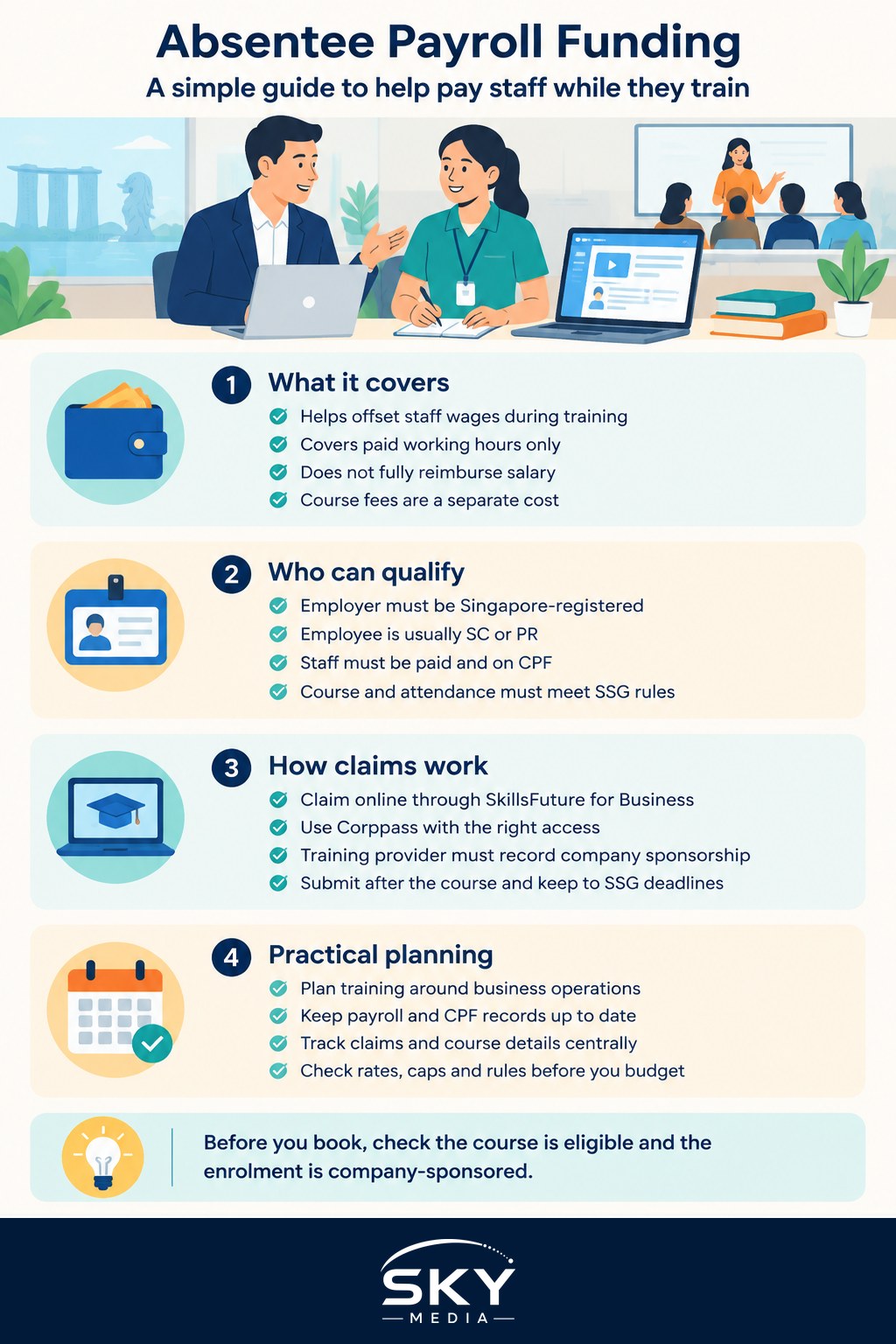
What Absentee Payroll Funding Covers
There are two separate costs when you send someone for training:
- Course fees, which may be reduced by SWDA course fee subsidies paid to the training provider.
- Manpower cost, meaning the salary you pay while the employee is away from work.
Absentee payroll funding targets the second cost. It is calculated on the training hours your employee attends, at an hourly rate set by SWDA, and is generally subject to an annual cap per enterprise. It does not reimburse the full salary. Think of it as a partial offset that makes releasing staff for training more affordable.
Who Is Eligible
Eligibility rules cover the employer, the employee and the course. Common conditions include:
Employer
– Registered or incorporated in Singapore, typically with a valid UEN (Unique Entity Number, the business identifier issued through ACRA or other registering agencies).
– Sponsoring the employee for the course, meaning the company is sending them, not the employee choosing to go on their own.
– Paying the employee’s salary during the training period and making the required CPF contributions for that employee.
Employee
– Usually a Singapore Citizen or Permanent Resident. Foreign employees are generally not eligible for AP funding.
– On the company’s payroll, as confirmed by CPF contribution records.
– Attending training during normal working hours, not on their own time.
Course and attendance
– The course must be one that SWDA supports for funding and is eligible for absentee payroll.
– The employee must meet the minimum attendance requirement and, where applicable, pass the required assessments.
– The same training generally cannot be claimed under more than one government funding source.
Precise criteria vary by course and programme, so check each course’s funding details and SWDA’s eligibility pages.
How the Funding Is Calculated
The general formula is straightforward: eligible training hours multiplied by the applicable hourly AP rate, subject to any cap. Points to keep in mind:
- Hourly rate. SWDA sets a standard rate, and some programmes or initiatives may have enhanced rates. Do not assume the rate you used years ago still applies.
- Annual cap. There is typically a maximum amount each enterprise can receive per calendar year. Large training programmes can hit it.
- Hours counted. Only actual training hours attended during working time count, based on attendance records from the training provider.
- Salary relationship. AP funding should not exceed what you actually paid the employee for those hours.
| Training scenario | Likely AP outcome | What to check |
|---|---|---|
| SC/PR employee on SWDA-funded course during work hours, full attendance | Generally eligible | Claim window and course eligibility |
| Employee attends the same course on weekends, unpaid time | Usually not eligible | AP covers paid working hours only |
| Foreign employee on Employment Pass attends the course | Usually not eligible | Check whether any other scheme applies |
| Employee falls short of minimum attendance or fails assessment | Claim may be rejected | Attendance records and assessment results |
| Self-sponsored employee taking leave to attend | Not an employer claim | Employee may use their own SkillsFuture Credit instead |
How to Make a Claim
Claims are made online through SWDA’s employer portal, SkillsFuture for Business (the Enterprise Portal for Jobs and Skills). You will need your company’s Corppass access set up with the right roles. A typical flow:
- Register the employee for the course as a company-sponsored trainee. Make sure the training provider records the enrolment under your company’s UEN, not as a self-sponsored individual. This step is easy to get wrong and is a frequent reason claims fail.
- Let the employee attend and complete assessments. The training provider submits attendance and results to SWDA.
- Submit the AP claim through the portal after the course ends. Check the course record, training hours and employee details.
- Respond to any queries. SWDA may ask for documents such as payslips or CPF records.
- Receive payment to your company’s registered bank account, usually via the payment method linked in the portal.
Claims must be submitted within the time window SWDA specifies after the course ends. Late claims may be rejected, so add a calendar reminder for each course.
Practical Tips for Small Business Owners
- Plan training around operations. AP covers part of the wages, but you still need cover for the absent employee. Spread course dates across staff.
- Keep clean payroll records. Accurate payslips and timely CPF contributions make verification smoother. Our guide to setting up payroll for your business covers the basics.
- Stack support where allowed. Course fee subsidies, absentee payroll and the SkillsFuture Enterprise Credit, where available and eligible, can work together to reduce your out-of-pocket cost. See our overview of funding and subsidies for training in Singapore for how the wider landscape fits together.
- Track claims centrally. Keep a simple log of employee, course, dates, hours, enrolment type and claim status.
- Check before you commit. Before booking expensive programmes, confirm with the training provider that the course is eligible and that the enrolment will be company-sponsored.
Common Mistakes to Avoid
- Enrolling the employee as self-sponsored when the company is paying.
- Sending foreign staff and expecting AP funding to apply.
- Scheduling training outside working hours and then claiming AP.
- Missing the submission window after the course ends.
- Not checking CPF contributions are up to date for the employee.
Making Training Pay Off
Absentee payroll funding will not cover every dollar, but used consistently, it makes regular upskilling far more affordable for SMEs. The businesses that benefit most treat it as part of an annual training plan: identifying skills gaps, choosing eligible courses, enrolling correctly, and filing claims promptly. Combine it with a clear plan for how new skills will be used on the job, and the time your staff spend in class becomes a genuine investment rather than a cost.
For the latest rates, caps and claim rules, refer to SWDA and the SkillsFuture for Business portal, or speak to your training provider’s funding team.
Official sources: SkillsFuture (SWDA)