

Receiving notice that a current or former employee has filed a salary claim can be unsettling, especially for a small business owner who has never dealt with one. In Singapore, most salary-related disputes start at the Tripartite Alliance for Dispute Management (TADM), which offers mediation before a case can go further. Handling a TADM claim as an employer well means responding promptly, preparing your records and approaching mediation with an open mind.
This guide explains what typically happens after an employee files, what documents to gather and how to make the most of mediation. It is written from the employer’s side. If you want to understand the employee’s process, see Filing a Claim With the Employment Claims Tribunal. This article is general information, not legal advice.
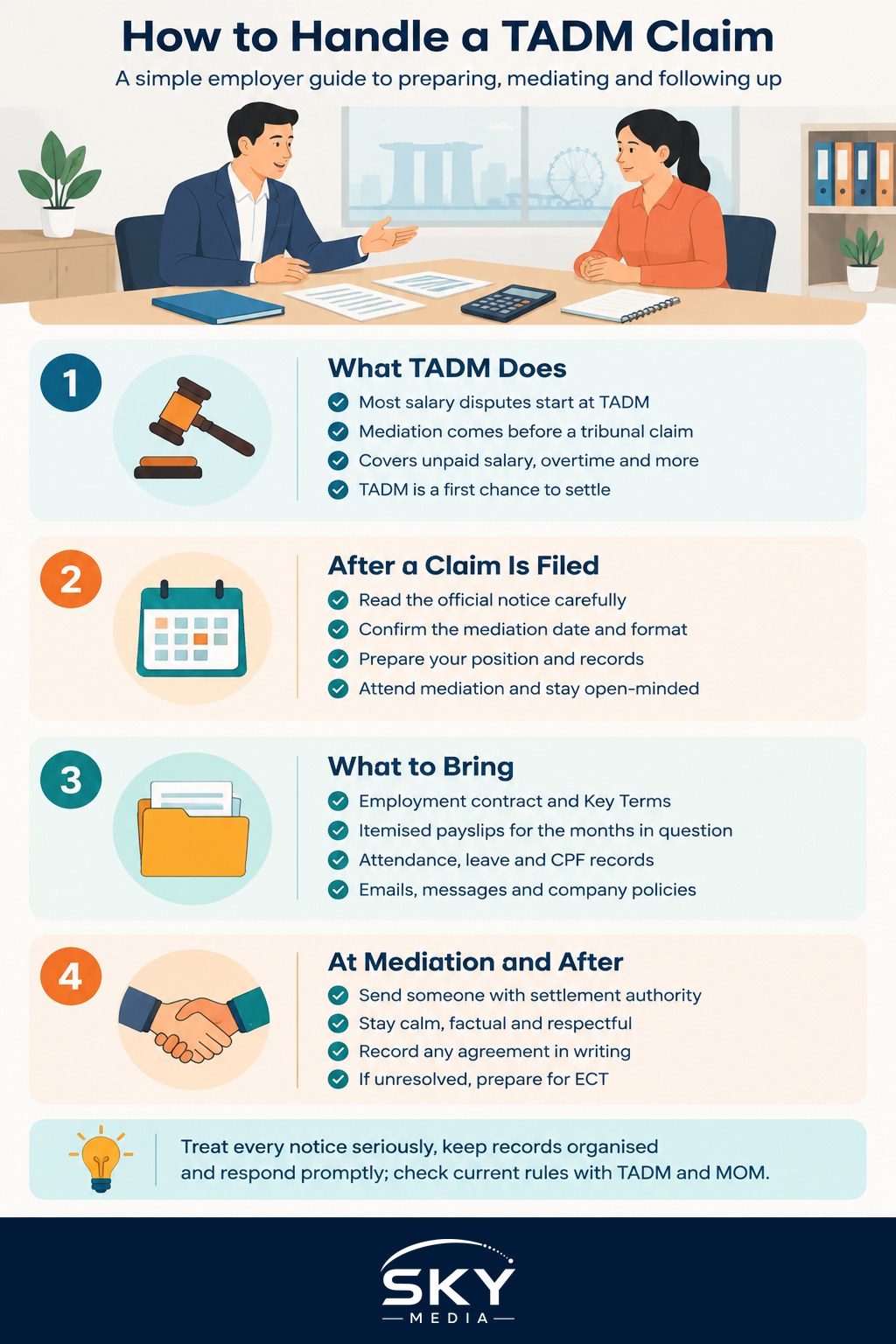
What TADM Is and Why You Are Involved
TADM is a tripartite organisation set up by the Ministry of Manpower (MOM), the National Trades Union Congress (NTUC) and the Singapore National Employers Federation (SNEF). It helps employers and employees resolve employment disputes, including salary-related claims such as unpaid salary, overtime, allowances or notice pay, and certain wrongful dismissal claims.
Under Singapore’s framework, an employee with a salary-related claim generally has to go through mediation at TADM first. If mediation does not resolve the matter, the employee may then be able to take the claim to the Employment Claims Tribunal (ECT), which sits within the State Courts. For employers, this means TADM is usually your first, and often your best, opportunity to settle a dispute quickly and at lower cost.
Eligibility rules, claim limits and filing deadlines are set by law and can change, so check the current details on the TADM and MOM websites.
What Happens After an Employee Files
The exact steps can vary, but the process commonly looks like this:
| Stage | What happens | What the employer should do |
|---|---|---|
| Claim filed | Employee submits a claim with TADM | Watch for official notification and read it carefully |
| Notice of mediation | TADM informs you of the claim and the mediation arrangements | Confirm attendance and note the date, time and format |
| Preparation | Both sides prepare their position | Gather records, calculate amounts and decide your settlement range |
| Mediation session | A TADM mediator helps both sides discuss and try to reach agreement | Attend, explain your position calmly and consider reasonable offers |
| Outcome | Either a settlement is reached, or mediation ends without one | Honour any agreement; if unresolved, prepare for a possible ECT claim |
Treat every TADM notice seriously. Ignoring it does not make the claim go away and can count against you if the matter proceeds. If you genuinely cannot attend on the date given, contact TADM promptly to ask about your options rather than simply not showing up.
Preparing Your Records
Good records are the strongest thing an employer can bring to mediation. Under the Employment Act, employers have obligations to issue Key Employment Terms (KETs) and itemised payslips and to keep employment records. Gather everything relevant to the claim, such as:
- Employment contract and KETs, including salary, allowances, working hours and notice period.
- Itemised payslips for the months in question.
- Time and attendance records, especially if overtime or rest day pay is disputed.
- Leave records, including annual, sick and any unpaid leave.
- Bank transfer records showing what was actually paid and when.
- CPF contribution records, where relevant.
- Correspondence such as emails, messages and letters about pay, performance, resignation or termination.
- Company policies or handbooks that the employee acknowledged.
Then do the maths yourself. Work out what you believe was owed and paid, and compare it with what the employee is claiming. Sometimes this reveals a genuine error, such as a miscalculated overtime rate or a missed allowance. Spotting it yourself and offering to correct it can resolve the claim quickly and reflects well on your business.
If you have employer insurance or are claiming government-paid leave reimbursements, keep those records separate and clear so they do not confuse the salary calculation. Our guide to claiming government-paid leave reimbursements as an employer explains how those schemes usually work.
Attending Mediation: What to Expect and How to Behave
Mediation is not a trial. The mediator is neutral and does not decide who is right. Their role is to help both sides understand each other and find a workable settlement. A few practical tips:
- Send the right person. Attend yourself or send someone who knows the facts and has authority to agree a settlement. Check TADM’s rules on who may represent the employer.
- Bring organised documents. A short, clearly labelled bundle with a summary of the amounts is far more useful than a stack of loose papers.
- Stay calm and factual. Disputes can be emotional, particularly after a difficult resignation or dismissal. Keep to the facts and avoid personal comments about the employee.
- Listen to the other side. You may learn what the employee really wants, which is sometimes acknowledgement, a correct reference letter or a quick payment rather than the full amount claimed.
- Know your settlement range. Decide in advance what you are prepared to pay, weighing the cost of time, management attention and a possible tribunal hearing.
- Get the agreement in writing. If you settle, make sure the terms, amounts and payment dates are clearly recorded in the settlement agreement.
Once signed, a mediated settlement is binding. If either party does not comply, the other may be able to take enforcement steps through the ECT, so pay on time and keep proof of payment.
If Mediation Does Not Resolve the Claim
If no agreement is reached, the employee may proceed to the Employment Claims Tribunal. At that point:
- Continue to keep all documents organised, as the tribunal will want evidence.
- Expect the tribunal process to involve further consultations and possibly a hearing.
- Consider whether you still want to settle. Settlement remains possible at later stages.
- If the claim is complex or involves significant amounts, consider getting legal advice.
Preventing Future Claims
Most salary disputes come down to unclear terms or poor records. A few habits reduce your risk:
- Issue KETs and itemised payslips as required, and keep copies.
- Use a reliable payroll system and double-check overtime and allowance calculations.
- Keep attendance and leave records accurate and up to date.
- Put salary changes, deductions and termination details in writing.
- Pay final salary and other amounts due on time when someone leaves.
- If you employ foreign workers, make sure you meet MOM’s requirements, including qualifying salary rules where they apply. Our guide to Local Qualifying Salary for Singapore employers covers one related area.
A TADM claim is not the end of the world. Many are resolved at mediation, and an employer who responds promptly, prepares well and negotiates in good faith is in the best position for a fair outcome. Check current procedures, deadlines and forms directly with TADM and MOM, as these can change.
Official sources: Ministry of Manpower (MOM)
Further reading: How to File a Salary Claim With TADM as an Employee