

Once the Notice of Assessment (NOA) arrives, many households face the same question: pay the whole tax bill at once, or spread it out? For retirees drawing down savings, people on part-time or contract work, and anyone who prefers a steady monthly budget, an IRAS GIRO instalment plan is often the simplest answer. It turns one lump sum into regular deductions from your bank account, so the bill fits around your cash flow rather than the other way round.
This guide explains how instalments work, who they suit, how to set one up, and the mistakes that can cancel a plan. It is general information, not financial advice. The Inland Revenue Authority of Singapore (IRAS) sets the terms, which can change, so confirm the current details on the IRAS website before you apply.
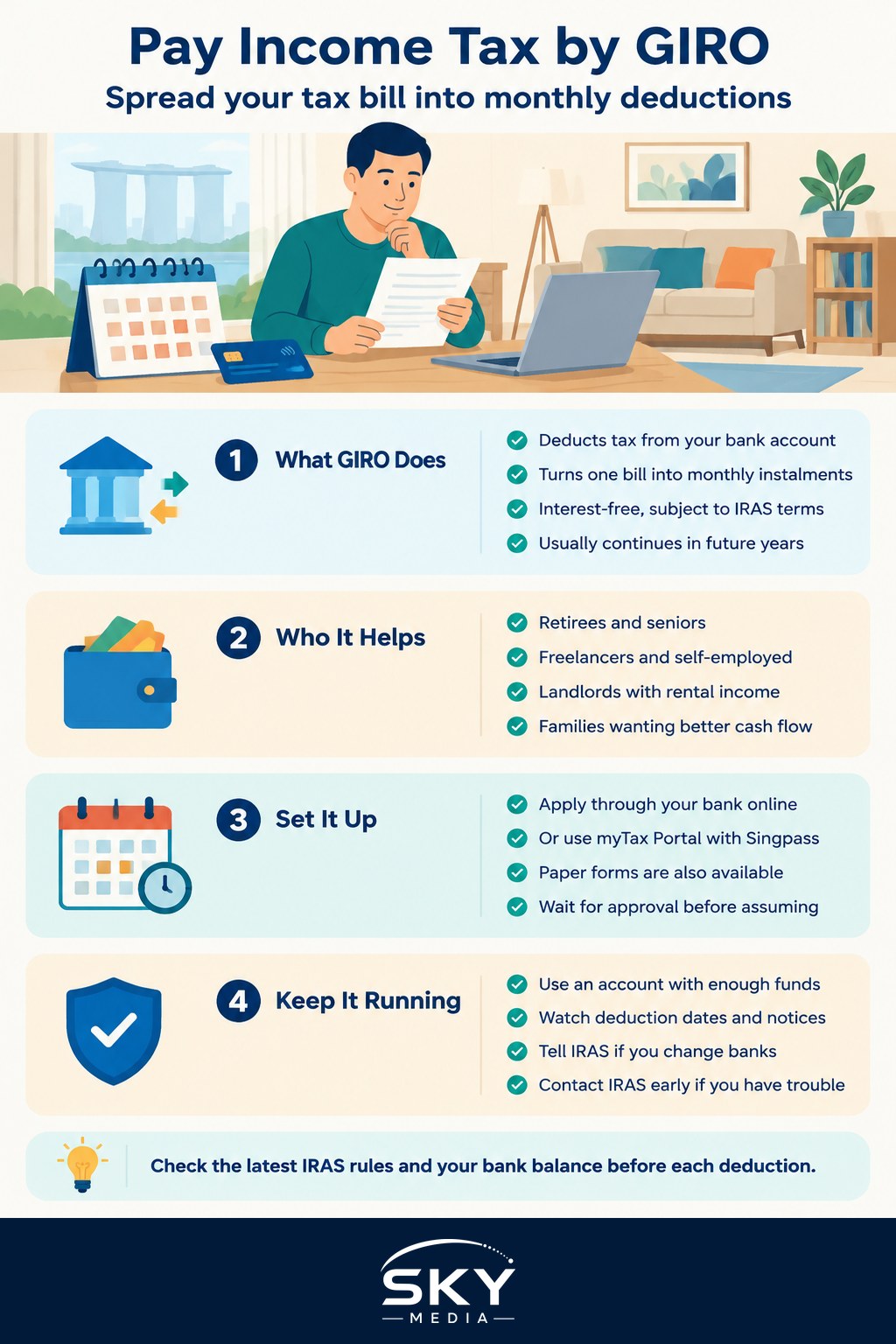
What GIRO Instalments Are
GIRO (General Interbank Recurring Order) is Singapore’s standard direct debit arrangement. You authorise an organisation to deduct money from your bank account on a schedule, much like a recurring bill payment you never have to remember.
For income tax, IRAS allows individuals paying by GIRO to spread their tax over monthly instalments instead of paying the full amount within the usual one month of the NOA. IRAS has long offered these instalments interest free, with the number of instalments available depending on when you sign up and when your assessment is issued. Check the IRAS website for the current maximum and how it is worked out for your year of assessment.
A few points to understand from the start:
- The plan changes how you pay, not how much you owe.
- Once set up, GIRO for income tax usually continues from year to year, so future bills are also deducted automatically unless you cancel.
- Deductions come from the bank account you nominate, so that account needs enough funds on each deduction date.
Who Benefits Most From Instalments
Almost anyone can use GIRO, but it is especially helpful for:
- Retirees and seniors who live on CPF payouts, annuities, rental income or savings withdrawals, and prefer predictable monthly outgoings.
- Freelancers and the self-employed, whose income is uneven and who do not have tax deducted at source. Our guide on reporting freelance income to IRAS covers the filing side.
- Landlords whose rental income pushes up their tax bill. See declaring rental income for how that income is assessed.
- Families who want to keep a cash buffer for school fees, medical costs or emergencies rather than draining it in one payment.
If you are helping an elderly parent with their finances, a GIRO plan can also reduce the risk of a missed payment if they find letters and deadlines hard to track.
One Lump Sum Versus Monthly Instalments
The table below sets out the practical differences.
| Factor | Pay in full after NOA | GIRO monthly instalments |
|---|---|---|
| Timing | One payment by the due date on the NOA | Spread over a series of monthly deductions |
| Effort each year | You must remember to pay every year | Deductions run automatically once set up |
| Cash flow | Larger one-off outflow | Smaller, regular outflows that are easier to budget |
| Risk to watch | Late payment if you forget | A failed deduction if the account runs short |
| Best for | People with spare cash who want it settled | People who prefer steady monthly budgeting |
How to Set Up a GIRO Plan for Income Tax
IRAS provides several ways to apply, and the options may be updated over time. The common routes are:
- Online via your bank. Many banks in Singapore let you apply for IRAS GIRO through their internet banking, usually under a GIRO or bill payment arrangement section. You select IRAS as the billing organisation and enter your tax reference number, which for most individuals is the NRIC or FIN.
- Through the myTax Portal. IRAS’s online portal, accessed with Singpass, offers a GIRO application option for some banks, which links directly to the bank’s approval page.
- By paper form. IRAS also provides a GIRO application form for those who prefer not to apply online. Check the IRAS website for where to download it and where to send it.
After you apply, IRAS and your bank need time to approve the arrangement. Until you receive confirmation, assume the plan is not yet active and keep an eye on the payment due date on your NOA. If the GIRO is not in place by then, you may need to pay the first amount yourself through another method to avoid a late penalty.
When Deductions Start and How Much They Are
Your GIRO deduction schedule is shown on your NOA or a separate letter from IRAS once the plan is in place. It usually states:
- The amount for each instalment.
- The deduction date each month.
- The number of instalments remaining.
If you apply earlier in the year, you may get more instalments, so each deduction is smaller. If you apply later, the same bill is spread over fewer months, so each deduction is larger. Applying as soon as you receive the NOA, or even before, generally gives you the most flexibility.
If IRAS later issues a revised assessment, for example after you object or claim a missed relief, the remaining instalments are adjusted. You can read about that process in our guide on how income tax works in Singapore.
Avoiding Failed Deductions
The most common way to lose an instalment plan is a deduction that fails because the account has insufficient funds. IRAS may cancel the instalment arrangement if deductions fail, and the remaining tax can then become payable in full, with penalties possible if it is not paid on time. The exact rules are set out on the IRAS website, so read them once rather than relying on memory.
Practical habits that help:
- Use a stable account. Choose the account where your salary, pension or CPF payouts land, not an account you only top up occasionally.
- Set a reminder a few days before the deduction date to confirm the balance is sufficient.
- Watch for joint accounts and dormant accounts. If the account is closed or frozen, deductions will fail.
- Tell IRAS if you change banks. A new GIRO arrangement is usually needed when you switch accounts.
- Open IRAS letters promptly. If a deduction fails, IRAS normally writes to you, and acting quickly gives you the best chance of keeping the plan.
Changing or Cancelling Your Plan
Life changes, and your GIRO plan can change with it.
- To change the bank account, apply for a new GIRO arrangement with the new bank. Keep the old account open with enough funds until the new one is confirmed.
- To cancel, you can usually do so through your bank or by contacting IRAS. Remember that any outstanding tax still has to be paid by other means.
- If you can no longer afford the instalments, contact IRAS early. It is far better to explain your situation before payments fail than after.
For seniors, it is worth reviewing the plan each year alongside other recurring payments such as utilities, insurance premiums and town council charges. A short annual check prevents surprises if income drops after retirement.
A Simple Annual Tax Routine
A GIRO plan works best as part of a yearly habit:
- File your return on time and check the NOA when it arrives.
- Confirm the GIRO schedule and the deduction amount.
- Make sure the nominated account has a buffer for the months ahead.
- Keep receipts and records for next year’s reliefs. Our guide to income tax reliefs explains what to collect.
Spreading your tax bill does not reduce what you owe, but it does make it easier to plan around. For the latest instalment terms, application methods and rules on failed deductions, always check IRAS directly.
Official sources: IRAS