

Not long after opening an account, many newcomers from the mainland hit the same wall: a polite but firm request from the bank to explain where their money comes from. If you are staring at that email wondering why it feels like an interrogation, take a breath. Being asked about your source of wealth Singapore bank side is routine, not an accusation. Every bank here operates under strict rules, and understanding what they need makes the whole process far smoother. This guide explains why banks ask, what usually satisfies them, and how to prepare, while leaving the final judgement where it belongs, with the bank’s own compliance team.
Why Singapore Banks Ask at All
Singapore is a major financial centre, and its reputation rests on being clean and well regulated. Banks are supervised by the Monetary Authority of Singapore (MAS), which requires them to know their customers and to guard against money laundering and the financing of crime. These obligations sit inside a framework often shortened to KYC (Know Your Customer) and AML (Anti Money Laundering).
Two related ideas come up constantly, and it helps to keep them apart:
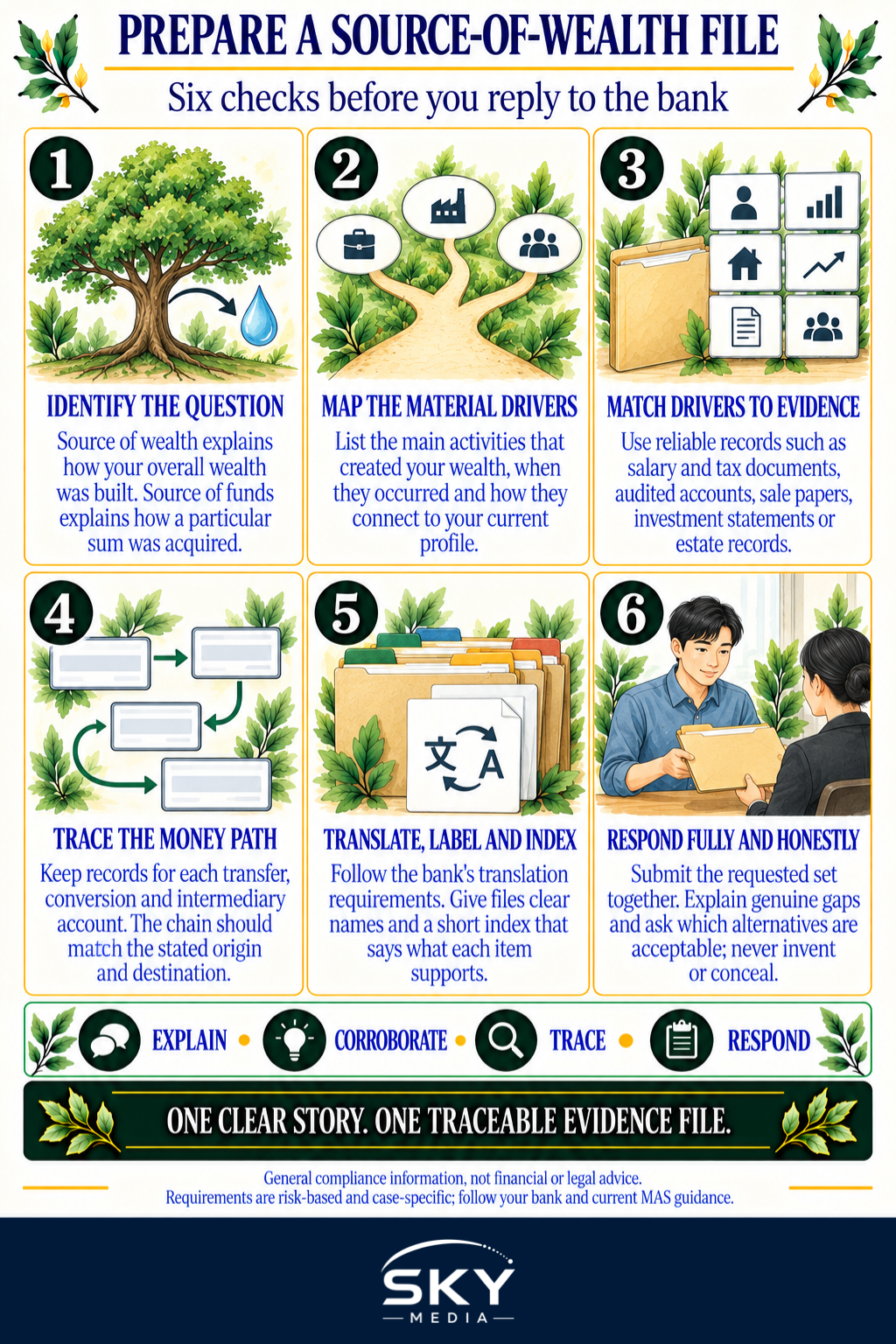
- Source of funds is where a specific sum came from, for example the particular money you are transferring in this month.
- Source of wealth is the bigger picture of how you built your overall net worth over the years, such as a career, a business, investments, or an inheritance.
A bank may ask about either or both, especially when a large sum arrives, when an account behaves differently from before, or during a periodic review. In mainland China these checks exist too, but for cross border newcomers the questions can feel more pointed simply because your financial history sits in another system the bank cannot see directly.
What Counts as Good Evidence
The goal is a clear, consistent story backed by documents. You are helping the bank connect the money in your account to a lawful origin. There is no single magic paper; a combination that fits together is what reassures a reviewer.
Commonly helpful documents include:
- Employment income: pay slips, an employment letter, your labour contract, and annual tax records.
- Business income: company registration, audited financial statements, dividend records, and evidence of your shareholding.
- Property sales: the sale contract, completion statement, and proof the proceeds reached your account.
- Investments: brokerage or fund statements showing holdings, disposals, and gains.
- Inheritance or gifts: a will, a deed of gift, or a lawyer’s letter explaining the transfer.
Documents in Chinese are usually fine, but the bank may ask for a certified English translation of key pages. Keep originals safe and provide clean scans. If a figure in your account does not obviously match your stated income, expect a follow up, so line up the explanation in advance.
| Aspect | Source of funds | Source of wealth |
|---|---|---|
| Question it answers | Where did this transfer come from | How did you build your net worth |
| Typical trigger | A large or unusual incoming payment | Account opening, reviews, private banking |
| Example evidence | Sale contract, salary credit, loan letter | Career history, business ownership, inheritance |
| Time span covered | A specific recent transaction | Many years of accumulation |
| Who assesses it | The bank’s compliance team | The bank’s compliance team |
Preparing as a Newcomer From China
Cross border wealth carries an extra layer of friction, and a little preparation removes most of it. Because your earning years happened under a different tax and banking system, the bank cannot simply pull your history, so you must supply it.
A few habits make a real difference. Keep a tidy folder, digital and physical, of the records above, ideally going back several years. Where money moved through several accounts or across borders before landing in Singapore, be ready to show the chain, because gaps invite questions. If you used a Hong Kong or other intermediary account along the way, keep those statements too, since the bank may want to trace the full path. Remember also that China maintains its own controls on moving money out, and staying on the right side of both systems is part of telling a clean story.
Be honest and consistent above all. Compliance teams are experienced at spotting stories that shift between conversations. If you genuinely do not have a document, say so and offer the next best evidence rather than improvising. And do not take a request personally; the reviewer is following rules, not making an accusation about you.
What to Expect During the Process
Timelines vary. A straightforward query may be resolved with one upload, while a larger or more complex case can involve several rounds and a wait of weeks. During that time a bank may hold a transfer, limit certain activity, or ask you in for a conversation. This is uncomfortable but normal, and cooperating openly is almost always faster than pushing back.
To keep things moving:
- Respond promptly and in full, rather than sending one document at a time.
- Label everything clearly so a reviewer can match each paper to the sum in question.
- Explain the narrative in a short cover note that ties the documents together.
- Ask what specifically is outstanding if you are unsure, so you address the real gap.
- Escalate calmly through the branch or your relationship manager if a case stalls without explanation.
If you ever feel a request is unreasonable, remember the bank must justify its decisions to MAS, and you can ask for the reason in writing. What you should not do is move money around hastily to avoid a question, since that tends to deepen scrutiny rather than end it.
Building a Long Term Relationship
The first review is the hardest because the bank knows nothing about you yet. Once you have established a clean, well documented track record, later transactions usually pass more smoothly. Think of the paperwork as an investment in trust. Keep your records current, tell the bank in advance when a large legitimate sum is coming, and treat compliance staff as partners in a shared goal rather than obstacles.
Handled calmly, source of wealth checks are simply the price of banking in a trusted system, and one that ultimately protects your money too.
This article is general information, not financial or legal advice. Requirements differ between banks and change over time, so follow the specific instructions of your own bank’s compliance team and refer to MAS guidance for the current framework.
Explore more
Getting your money into Singapore cleanly is a connected task. See our guides on cashing out China investments after moving, using a Hong Kong account to bridge China and Singapore, and how CRS cross border account reporting works.
Frequently Asked Questions
What is the difference between source of funds and source of wealth? Source of funds is where a specific sum came from, such as this month’s transfer. Source of wealth is the bigger picture of how you built your net worth over the years through work, a business, investments or inheritance. Banks may ask about either or both.
Do my documents need to be translated into English? Documents in Chinese are usually fine, but the bank may ask for a certified English translation of key pages. Keep originals safe and provide clean scans, and follow your own bank’s compliance instructions.
How long does a source of wealth check take? It varies. A straightforward query may be settled with one upload, while a larger or more complex case can involve several rounds and a wait of weeks. Responding promptly and in full is usually faster than pushing back.
Should I move my money elsewhere while the bank reviews my case? No. Moving money around hastily to avoid a question tends to deepen scrutiny rather than end it. Cooperate openly, label your documents clearly and ask the bank what exactly is still outstanding.
What should I do if I do not have a document the bank asks for? Say so honestly and offer the next best evidence rather than improvising. Compliance teams are experienced at spotting stories that shift. A short cover note tying your documents into one consistent narrative also helps.
Official sources: Monetary Authority of Singapore (MAS)
Further reading: Family Offices in Singapore for Chinese Families