

In Singapore, many families want to live close to their parents or grown-up children. Grandparents help with childcare, adult children keep an eye on ageing parents, and everyone saves time travelling for weekly dinners. The Proximity Housing Grant (PHG) is the HDB grant designed to support exactly that. It gives buyers of resale flats extra money when they choose to live with, or near, their parents or children.
Unlike most housing grants, the proximity housing grant is not limited to first-time buyers. That makes it one of the few grants available to second-timers, such as couples upgrading or right-sizing. This guide focuses only on the PHG. For the full picture of every grant, see our guide to HDB housing grants explained.
Grant amounts and eligibility rules are reviewed by the government from time to time. Treat this as general information and confirm the current rules on the HDB website before you commit to a purchase.
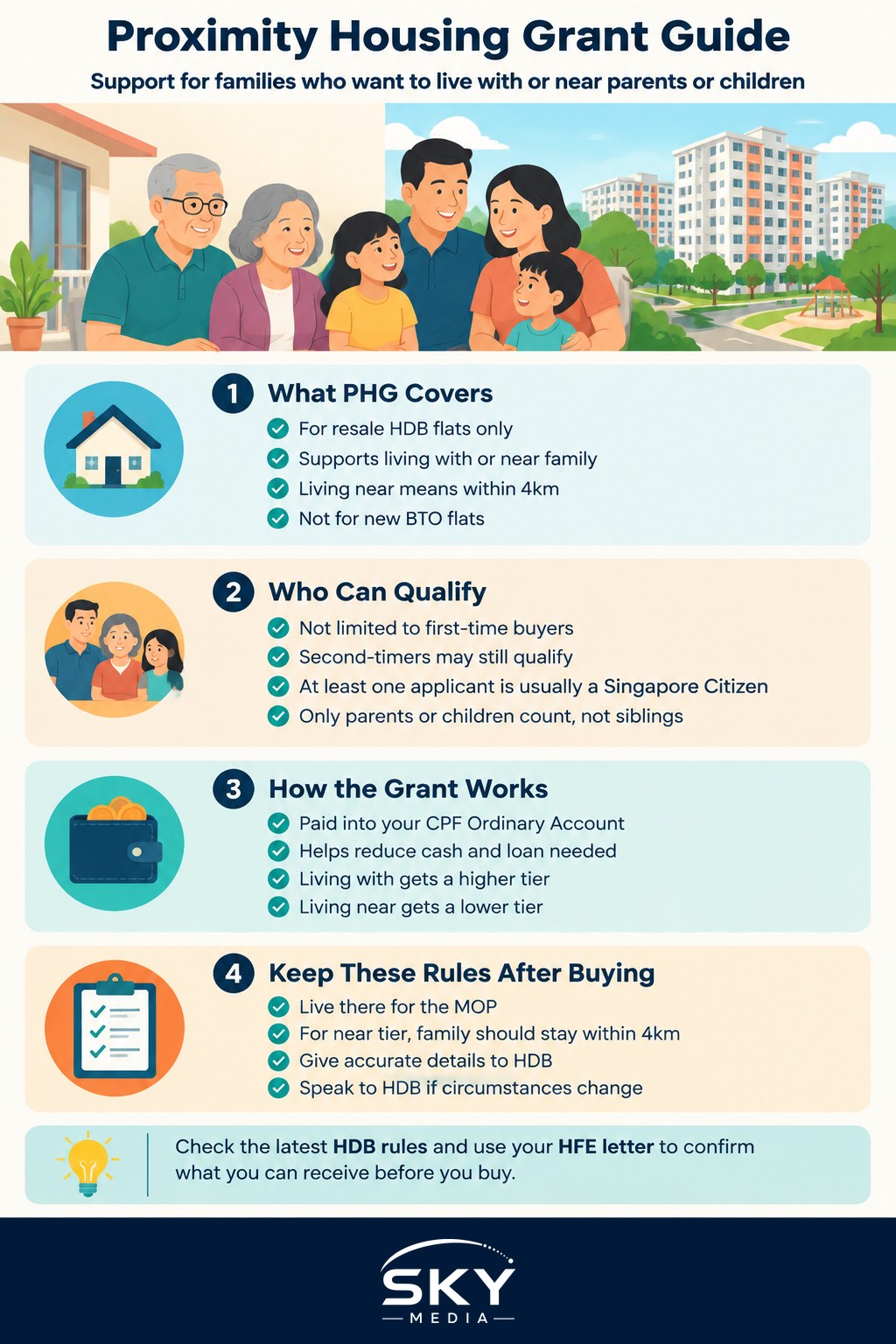
What the PHG Is and How It Is Paid
The PHG applies to resale HDB flats bought on the open market. It is not given for new Build-To-Order (BTO) flats; families who want a new flat near their parents use separate priority schemes, which are explained below.
There are two tiers:
- Living with parents or children. You buy a resale flat and live in the same flat with your parents or your married or adult child.
- Living near parents or children. You buy a resale flat within 4km of where your parents or child live.
At the time of writing, eligible families receive a larger grant for living together, $30,000, and a smaller one for living near, $20,000. Singles who qualify receive lower amounts. Check HDB for the current figures, because they have been revised in the past.
The grant is not handed over in cash. It is credited into your CPF Ordinary Account and used towards the purchase price of the flat, reducing the loan you need or the cash and CPF you must pay upfront. If you sell the flat later, the grant used, plus the accrued interest on it, is refunded to your CPF account under the usual CPF rules.
Living With vs Living Near: The Key Differences
| Feature | Living with parents or child | Living near parents or child |
|---|---|---|
| Where everyone lives | In the same resale flat | In separate homes within 4km of each other |
| Relative grant size | Higher tier | Lower tier |
| Who usually buys | You and your parent or child buy the flat together, or one buys and the other is listed as an occupier, as HDB allows | You buy your own resale flat near the parents’ or child’s existing home |
| Type of other home | Not applicable, everyone shares one flat | Can generally be an HDB flat or private property, as HDB rules allow |
| Typical situation | Multi-generation household under one roof | Young family near grandparents, or adult child near ageing parents |
Who Qualifies, Including Second-Timers
The basic idea is that a family nucleus, or a single, buys a resale flat to live with or near their parents or their child. Broadly, eligibility depends on factors such as:
- Citizenship. At least one applicant typically needs to be a Singapore Citizen, and HDB sets rules on the citizenship or residency of the parents or child whose home you are moving near.
- Relationship. The grant is for living with or near parents or children. Living near siblings, grandparents or in-laws does not count, unless they are the parents of your spouse who is also an applicant.
- Distance. For the “near” tier, the two homes must be within 4km, measured as HDB defines it. HDB’s online tools let you check the distance between two addresses before you buy.
- Previous grants. You can usually only receive the PHG once. If you have received it before, you will normally not qualify again.
- Owning other property. HDB has rules about owning or recently disposing of private property, and these vary by scheme. Check carefully if you or your spouse own private property.
Second-timers can qualify. If you have bought an HDB flat before and taken other housing grants, you may still receive the PHG on your next resale purchase, as long as you meet the PHG’s own conditions. For second-timer families, this can be a meaningful boost when moving from a smaller flat to a bigger one closer to parents. Our broader guide to Singapore housing grants explains how the first-timer grants work alongside it.
There is no income ceiling for the PHG, which is another difference from income-linked grants. However, if you also apply for the Enhanced CPF Housing Grant, that grant has its own income rules. See understanding the Enhanced CPF Housing Grant for details.
Conditions You Must Keep After Buying
Getting the grant comes with ongoing obligations:
- Minimum Occupation Period (MOP). You must live in the flat for the MOP, typically five years for resale flats, before you can sell it or rent out the whole flat.
- Living arrangement during the MOP. For the “with” tier, the family members are expected to live together. For the “near” tier, the parents or child generally need to keep living at their address within 4km. If circumstances change, contact HDB rather than assuming it is fine.
- Accurate declarations. HDB may check your arrangements. Giving false information can lead to the grant being recovered and other penalties.
Life happens. A parent may move into a nursing home or pass away, or a job move may force a relocation. HDB does consider genuine changes in circumstances, so speak to them early.
How to Apply for the PHG
The PHG is not a separate application. You apply for it as part of your resale flat purchase:
- Get an HDB Flat Eligibility (HFE) letter. This tells you which grants and loans you may qualify for before you start house-hunting.
- Check the distance. If you plan to live near your parents or child, verify that shortlisted flats are within 4km of their address using HDB’s tools.
- Agree on terms and grant the Option to Purchase. Follow the usual resale process on the HDB Flat Portal.
- Submit the resale application. Indicate that you are applying for the PHG and provide details of the parents or child you are living with or near.
- HDB assesses your eligibility. If approved, the grant is credited to your CPF account and applied at completion.
Make sure the parents’ or child’s details, such as their address, are correct and up to date, as errors can delay your application.
PHG vs Getting a BTO Near Your Parents
If you prefer a new flat, HDB has separate schemes, such as the Married Child Priority Scheme, which give families better chances in BTO ballots when they apply to live with or near their parents. Those schemes improve your odds in the ballot but do not pay a grant. The PHG, on the other hand, gives you money but only for resale flats.
A few points to weigh:
- Timing. Resale flats can be ready within months, while BTO flats take years to build.
- Location certainty. With resale, you can pick a specific block near your parents. BTO projects near their home may not launch when you need them.
- Cost. Resale prices are often higher, but the PHG, combined with other resale grants you qualify for, can narrow the gap.
Making the Most of Living Close to Family
Before committing, talk openly as a family. Agree on how much help you expect from each other, whether grandparents will look after the children, and how you will handle care if parents need more support later. Living near family works best when expectations are clear from the start.
Rules and grant amounts can change in each Budget, so always confirm the latest details with HDB, and use your HFE letter as the definitive guide to what you can receive.
Official sources: HDB
Further reading: Buying a Home With Your Parents