

Every year, some parents look at their child’s Secondary 1 posting result and feel puzzled. Their child’s PSLE Score matched the school’s cut-off point, yet the child was posted elsewhere. Others discover their child got in “by ballot”. Both outcomes come down to the PSLE tie breaker for Secondary 1 posting: the set of rules the Ministry of Education (MOE) uses when more students share the same score than a school has places left.
This guide focuses only on that tie-break stage. For the full posting exercise, from the option form to results day, see Secondary One Posting Explained for Singapore Parents. Rules can be refined over time, so always confirm the current details on MOE’s website and in the S1 posting booklet your child receives with the results.
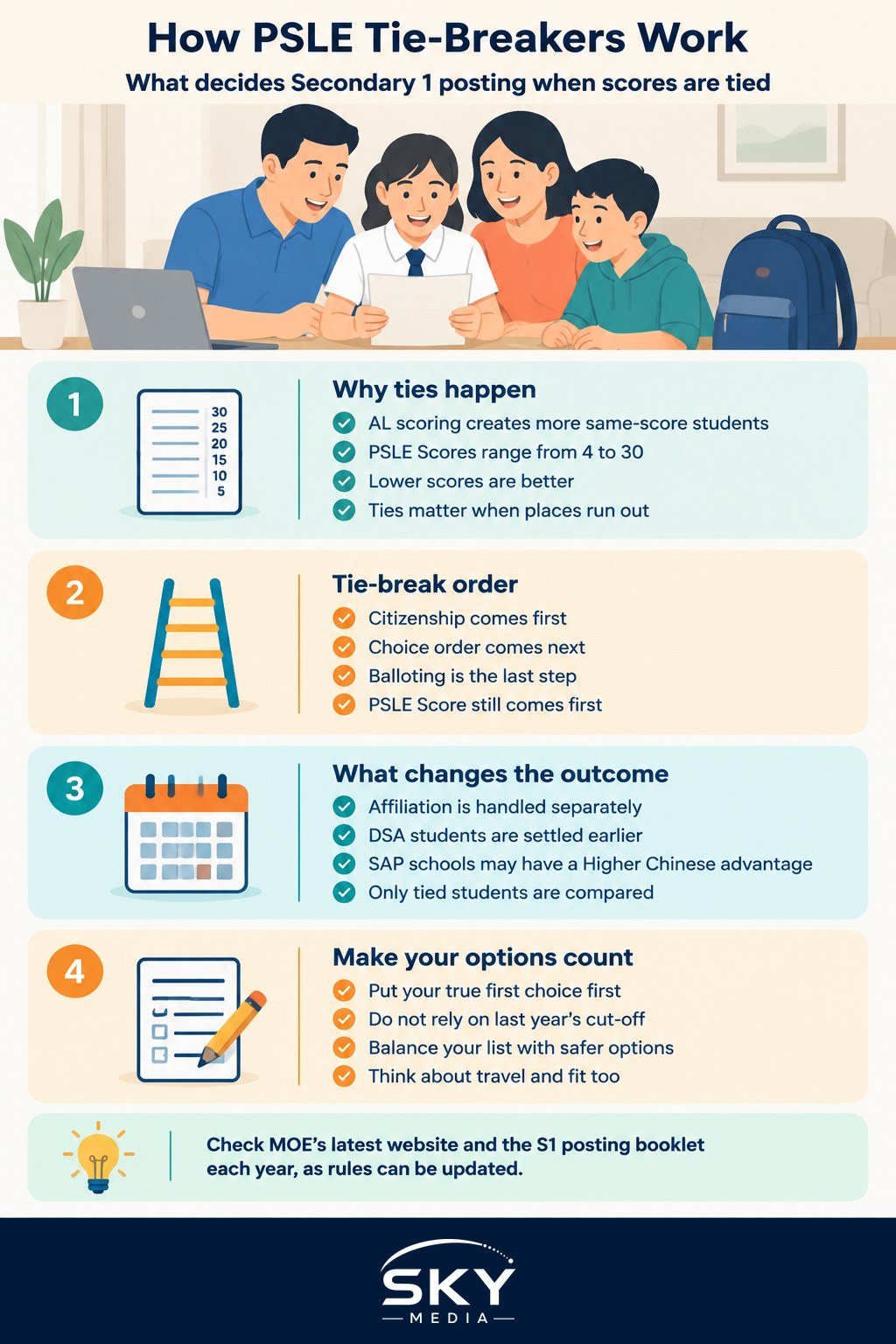
Why Ties Happen Under the PSLE Score System
Since the Achievement Level (AL) system replaced the old T-score, each PSLE subject is graded from AL1 (best) to AL8, and the four subjects add up to a PSLE Score between 4 and 30. A lower score is better.
The old T-score produced finely graded numbers, so exact ties were rare. The AL system is deliberately broader. Thousands of students across Singapore end up with exactly the same PSLE Score. That was intended, to reduce the fine-grained competition over every mark, but it means that at a popular school the last few places are often contested by many students with an identical score.
Posting still runs on merit first. MOE’s system considers students in order of PSLE Score, best first, and places each one in the highest of their chosen schools that still has a vacancy. Ties only matter at the margin: when a school is down to its last places and several applicants share the score being considered. That score becomes the school’s cut-off point (COP) for that year.
The Three Tie-Breakers, In Order
When students with the same PSLE Score compete for the remaining places at a school, MOE applies these tie-breakers one after another until the tie is settled.
- Citizenship. Singapore Citizens are considered first, then Singapore Permanent Residents, then International Students.
- Choice order. Among students of the same citizenship and score, a student who listed the school as a higher choice is placed ahead of one who listed it lower.
- Computerised balloting. If students are still tied after citizenship and choice order, a computerised random ballot decides who gets the remaining places.
A few points that parents often miss:
- Tie-breakers do not override the PSLE Score. A student with a better score is always considered before a student with a worse score. Tie-breakers only sort students who share the same score.
- Affiliation is separate. Students eligible for affiliation priority (where a primary school is affiliated to a secondary school) are handled in their own stage of posting, with their own cut-off. The tie-breakers then apply within that group as needed.
- Direct School Admission (DSA) students are settled before the main posting. Students with a confirmed DSA offer do not take part in the regular competition for that school.
- Some schools have extra considerations. For Special Assistance Plan (SAP) schools, MOE has described a posting advantage linked to Higher Chinese results that applies when students are otherwise tied. Check MOE’s current explanation if a SAP school is on your list.
How Each Tie-Breaker Plays Out
The table below shows a simplified picture of what happens when students share the score at a school’s last places.
| Situation at the cut-off | Tie-breaker used | Who is placed first |
|---|---|---|
| Citizen and PR both scored the cut-off score | Citizenship | The Singapore Citizen |
| Two citizens with the same score, one put the school as 1st choice, the other as 3rd | Choice order | The student who ranked it 1st |
| Several citizens, same score, all ranked the school 1st, too few places | Computerised balloting | Decided at random by the system |
| A student scored one point better than the cut-off | None needed | Placed on score alone |
Choice order is the tie-breaker parents have most control over, and it is also the one most often misunderstood. It only compares how high each tied student ranked that particular school. It does not reward or punish you for the other schools on the list.
What This Means When You Fill In the Option Form
Understanding the tie-breakers changes a few practical decisions on the S1 option form.
Put your genuine first preference first. If your child’s score sits right at a school’s likely cut-off and you really want that school, ranking it lower to “play safe” weakens your position on the choice-order tie-breaker. Ranking it first does not hurt your chances at your other choices, because the system will still try your next choice if the first is full.
Do not treat last year’s cut-off as a guarantee. If your child’s score equals the previous year’s COP, assume a tie-break may be involved. Even with the school ranked first, a ballot could still go either way. Cut-offs move from year to year with the size of the cohort and how many students choose each school, as our overview of secondary school posting in Singapore explains.
Balance the list. MOE’s general advice is to include schools across a range of cut-offs, with some comfortably within reach. If a stretch choice goes to ballot and your child is not drawn, a well-balanced list means they are placed in another school you actually chose, rather than being assigned somewhere you did not consider.
Consider travel and fit, not only scores. A school your child is happy to travel to and attend matters more over four or five years than a one-point difference in cut-off.
For Permanent Resident and International Student Families
The citizenship tie-breaker is the one newcomers ask about most. In plain terms, if a Singapore Citizen and a PR child have exactly the same PSLE Score and are both competing for the last place, the citizen is placed first. This only affects tied cases. A PR or international student with a better score than the cut-off is placed on merit like anyone else.
International students also face separate admission arrangements and fees, so families on passes should check MOE’s pages for international students alongside the posting booklet. Rules for citizenship priority across the education system are set by MOE and can be adjusted, so do not rely on older forum posts.
If Your Child Lost a Ballot
Missing out on a school by ballot is disappointing, especially when the score was “good enough”. A few things can help:
- Talk about it calmly. Explain to your child that the ballot is random and says nothing about their effort or ability.
- Visit the posted school. Orientation often changes how children feel. See How to Prepare for Secondary 1 Orientation in Singapore for ideas.
- Know the appeal route, and its limits. Appeals are made directly to the schools within the window MOE announces, and are considered only if a school has vacancies after posting. Read Appealing a School Posting in Singapore before submitting one.
If your child seems very distressed for a prolonged period, the school counsellor at the new school is a good first contact.
Key Takeaways
- PSLE Score always comes first; tie-breakers only sort students with identical scores.
- The order is citizenship, then choice order, then computerised balloting.
- Rank the school you most want first, especially if your child’s score sits at its likely cut-off.
- Treat last year’s cut-off as a guide, and build a balanced list of six choices.
- Confirm current rules on MOE’s website and in the posting booklet each year.
Official sources: Ministry of Education (MOE)
Further reading: How to Read Secondary School PSLE Cut-Off Scores