
Secondary 1 orientation is the doorway into a very different school life. Your child moves from being one of the oldest pupils in primary school to one of the youngest in a much larger, busier place. There are new subjects, more teachers, longer days, co-curricular activities (CCAs) and a whole new set of classmates. Orientation activities in the first days are designed to help them settle, but families can do a lot to make that transition smoother.
This guide is about the first week itself: what to pack, how to adjust routines at home and how to support the social side of starting secondary school. If you are still weighing up schools, our guide to choosing a secondary school in Singapore covers that earlier stage.
What Secondary 1 Orientation Usually Involves
Orientation formats differ between schools, and they can change from year to year, so treat this as a general picture and follow your school’s own letters and portal messages.
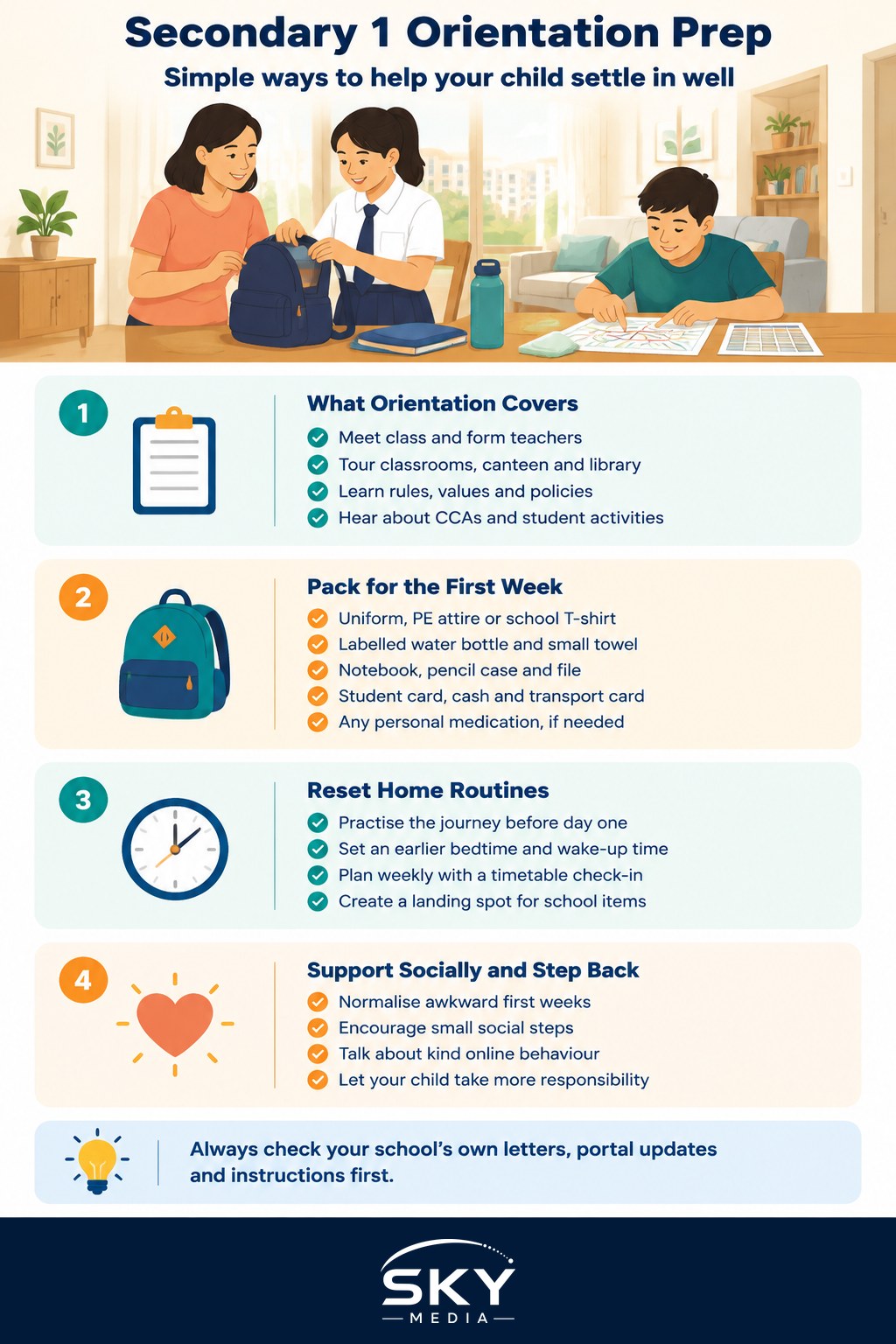
Commonly, orientation includes:
- Getting to know the class and form teachers, often through icebreakers and team games
- A tour of the campus, including classrooms, special rooms, the canteen and the library
- Introductions to school rules and values, such as attendance, uniform and devices policies
- House or group activities run by student leaders, which may be lively and physically active
- Information about CCAs, sometimes with demonstrations or trial sessions
- Administrative tasks, such as collecting books, timetables or student cards
Some activities may run longer than a normal school day or happen outdoors. Check the school’s instructions for attire, timings and what to bring.
What to Pack for the First Week
A Secondary 1 student is more independent, but the first week still catches many teens unprepared. Pack together the night before, then let your child take over packing as the week goes on.
- School uniform and, if required, PE attire or the orientation T-shirt the school issues
- A large, labelled water bottle, especially for outdoor activities
- Sunscreen and a cap if the school allows and activities are outdoors
- A small towel and a change of shirt for active days
- Pencil case, a notebook and a simple file for loose papers
- Student card or any documents the school asked for
- Some cash for the canteen, plus a stored-value card if your child takes public transport
- A light snack if allowed
- Any personal medication, with the school informed where relevant
Secondary schools often hand out a lot of paper in the first week. A single clear file just for forms and letters stops important items getting lost in a crowded bag.
Resetting Routines Before Day One
The secondary school day is usually longer, and many students travel further than they did to primary school. Starting the reset a week or two before school helps.
| Routine area | Primary school habit | What to adjust for Secondary 1 |
|---|---|---|
| Wake-up time | Often a short trip to a nearby school | Allow for a longer commute and possible early assembly |
| Travel | Parent drop-off or school bus | Practise the public transport route together before day one |
| After school | Fixed dismissal time | CCAs and activities may end later on some days |
| Homework | Fewer subjects, closer guidance | More subjects and teachers, so a planner becomes essential |
| Devices | Parent-managed screen time | Agree house rules that suit the school’s device policy |
A few practical habits that help:
- Do a trial run of the commute at the right time of day, including the walk from the bus stop or MRT station.
- Set a consistent bedtime that gives enough sleep for longer days.
- Agree on a weekly planning moment, such as Sunday evening, to look at the timetable and upcoming tasks together at first.
- Create a home landing spot for the bag, uniform and shoes so mornings are less chaotic.
Supporting the Social Side of the Transition
For many teens, the hardest part of Secondary 1 is not the work but the people. Friends from primary school may have gone to different schools, and new friendships take time.
- Normalise the awkwardness. Let your child know it is common to feel like an outsider for the first few weeks.
- Encourage small steps. Saying hello to the person seated nearby or joining a group game during orientation is enough to start.
- Talk about CCAs as a social anchor. A CCA gives students a regular group with shared interests. Encourage them to choose based on genuine interest rather than only following friends.
- Discuss online behaviour. New class chat groups often appear quickly. Talk about kindness, not sharing other people’s photos without consent, and leaving chats that feel unkind.
- Keep listening without fixing everything. Teens often want to be heard more than advised. Ask open questions like “What was the best part of today?”
How Parents Can Help Without Hovering
Secondary 1 is a good time to step back gradually while staying close.
- Shift responsibility in stages. Let your child pack their own bag and check their own timetable by the end of the first week or two.
- Learn the school’s communication channels. Schools typically share updates through letters, an online portal or an app. Check them regularly so you are not caught out by deadlines.
- Know the form teacher’s preferred contact method, and use it for genuine concerns rather than small daily issues.
- Protect rest and downtime. Avoid stacking lots of tuition or new commitments in the first month.
- Watch for signs of stress. Persistent difficulty sleeping, withdrawal, frequent complaints of feeling unwell before school or reluctance to attend are worth a calm conversation. If concerns continue, the form teacher and school counsellor are good first contacts.
Our guide on the transition to secondary school looks at the longer academic and emotional adjustment across the whole first year.
Helping Your Teen Build Good Daily Habits
Orientation week is a good moment to introduce simple systems your teen can own.
- Use a planner or digital calendar for homework, CCA sessions and test dates.
- Break the day into small tasks. Ideas like the 1-3-5 rule for daily tasks can help teens decide what matters most each evening.
- Pack the night before, using the timetable as a checklist.
- Keep a running list of questions to ask teachers, rather than worrying at home.
A First Week Checklist for Families
Before Secondary 1 orientation begins:
- Read every school letter and portal message about orientation timings and attire
- Label uniform, bottle and personal items
- Do a trial run of the journey to school
- Shift bedtime and wake-up time earlier
- Prepare a file for school papers
- Talk openly about feelings, friendships and online behaviour
- Agree how your child will contact you if plans change
Every school runs orientation a little differently, so the school’s own instructions always come first. With good preparation and a calm, supportive home base, your child can walk into Secondary 1 orientation ready to make the most of a new chapter.
Frequently Asked Questions
What does Secondary 1 orientation week usually involve? Orientation commonly includes icebreakers with form teachers, a campus tour, an introduction to school rules and house or group activities run by student leaders. CCA information may also be covered. Formats differ between schools and years, so follow your school’s own letters and portal messages.
How can I help my Secondary 1 child make friends at a new school? Normalise the awkwardness, since feeling like an outsider for the first few weeks is common. Encourage small steps such as greeting the person nearby or joining a game at orientation, and let them choose a CCA by genuine interest rather than only following friends.
How should my child get to school the first week of Secondary 1? Do a trial run of the commute at the right time of day, including the walk from the bus stop or MRT station. Many students travel further than in primary school, so practise the public transport route together and agree how your child will contact you if plans change.
What if my Secondary 1 child seems stressed or does not want to go to school? Have a calm conversation first. Persistent trouble sleeping, withdrawal, frequent complaints of feeling unwell before school or reluctance to attend are worth taking seriously. If concerns continue, the form teacher and school counsellor are good first contacts.
How should I set up house rules for devices at Secondary 1? Agree household rules that suit the school’s own device policy, which you will hear about during orientation. Talk about kindness in new class chat groups, not sharing other people’s photos without consent, and leaving chats that feel unkind.
Official sources: Ministry of Education (MOE)