
Every July, parents ask the same question: where do I find a racial harmony day costume for my child, and how much should I spend on something worn for one morning? Racial Harmony Day falls on 21 July, and most primary schools and many preschools invite children to come in traditional dress from any of Singapore’s communities, not only their own. This guide covers where to buy or rent children’s baju kurung, cheongsam, kurta, saree-style outfits and Eurasian kebaya, how to get the sizing right, and how to keep the budget sensible.
If your child is curious about why the day exists at all, our explainer on Total Defence and Racial Harmony Day is a good place to start the conversation.
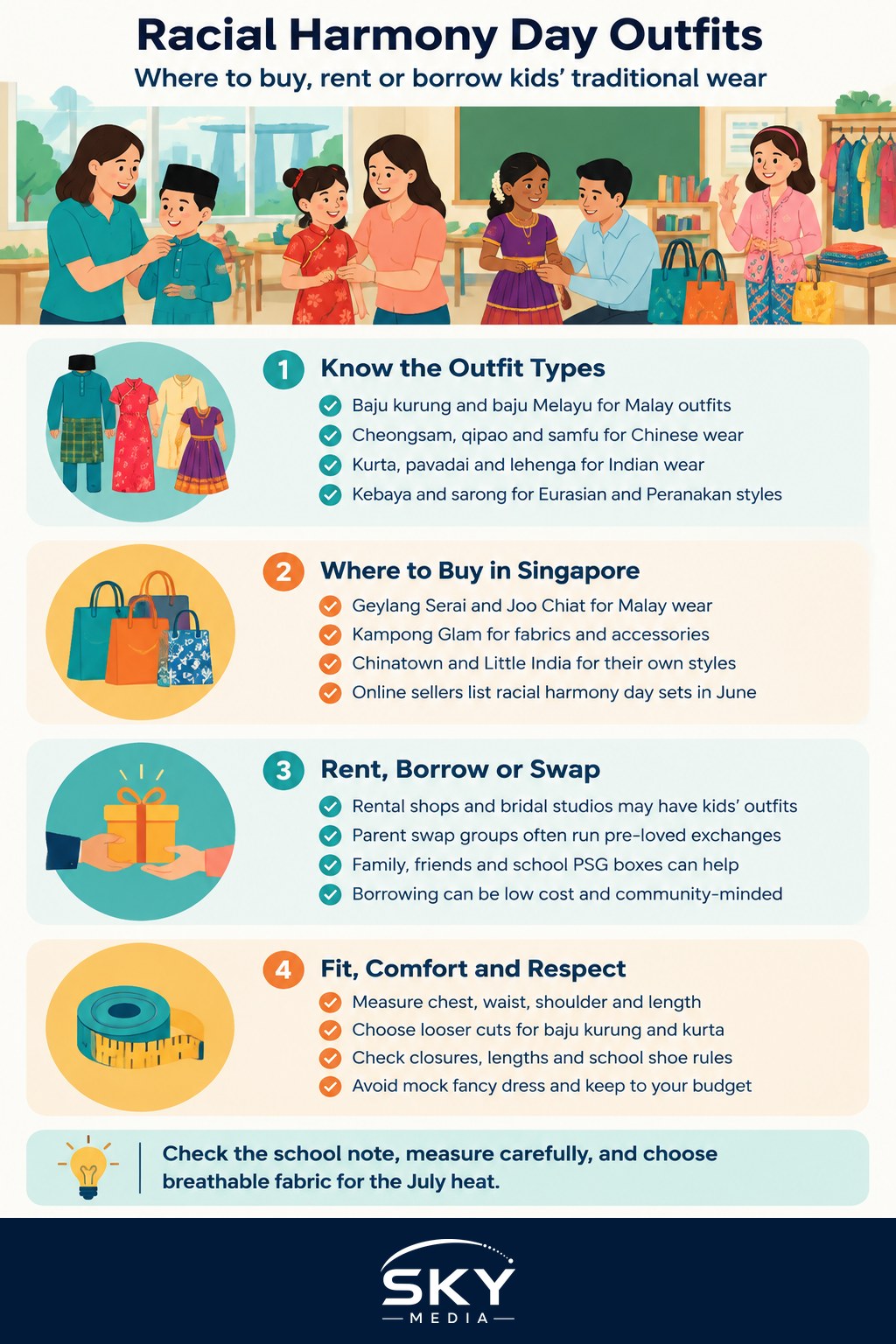
Know the Main Outfit Types Before You Shop
It helps to know what you are looking for, because shop assistants and online listings use the traditional names.
- Baju kurung and baju Melayu (Malay): Girls usually wear a baju kurung, a long, loose tunic over a matching ankle-length skirt. Boys wear a baju Melayu, a loose shirt and trousers, often with a short sarong called a samping wrapped at the waist and a songkok (a black velvet cap).
- Cheongsam, qipao and samfu (Chinese): Girls often wear a cheongsam (also called qipao), a fitted dress with a mandarin collar and frog buttons. Boys usually wear a samfu-style top and trousers or a tangzhuang jacket with knotted buttons.
- Kurta, pavadai and lehenga (Indian): Boys commonly wear a kurta, a long tunic, over loose trousers. For girls, a full saree is tricky for young children, so many families choose a pavadai (a long silk skirt with a blouse, sometimes called pattu pavadai), a lehenga choli or a ready-stitched “saree-style” dress.
- Kebaya and sarong (Eurasian and Peranakan): A kebaya is a fitted, often embroidered blouse worn with a batik sarong. Eurasian families may also dress children in Portuguese-influenced outfits for the occasion, such as a simple blouse and full skirt with a scarf.
Children are welcome to wear any of these, whatever their own background. Trying another community’s dress is very much in the spirit of the day.
Where to Buy Children’s Traditional Wear in Singapore
Heritage districts are the most reliable places to see outfits before buying, and they stock children’s sizes year round.
- Geylang Serai and Joo Chiat: The bazaar area and nearby shops carry children’s baju kurung and baju Melayu, sampin and songkok. Selection peaks before Hari Raya Puasa, but basic sizes are usually available.
- Kampong Glam (Arab Street area): Good for fabrics, kurung sets and accessories like brooches and shawls.
- Chinatown: Shops around the main shopping streets and the Chinatown Complex area sell ready-made children’s cheongsam and samfu, especially in the weeks before Chinese New Year. Polyester satin versions are cheap; cotton or silk blend ones feel better in the heat.
- Little India: Serangoon Road and the surrounding lanes, plus the large shopping complexes there, carry kurtas, pavadai, lehenga sets and stitched saree-style dresses for children. Ask for ready-stitched options so you are not paying for tailoring.
- Peranakan and kebaya specialists: Shops in the Katong and Joo Chiat area are known for kebaya, though handmade embroidered pieces are investment buys. For a school day, a machine-embroidered or printed kebaya top with a batik sarong is plenty.
- Department stores and neighbourhood malls: Some stores run festive racks around Chinese New Year, Hari Raya and Deepavali that include children’s sizes. Watch these sales and buy ahead for July.
- Online marketplaces: Local sellers list “racial harmony day costume” sets every June. Check the size chart in centimetres, read reviews that mention fabric, and order at least two to three weeks early so there is time to exchange.
For a related shopping roundup, our guide to Halloween costumes in Singapore covers how to judge online costume listings and fabric quality, and the same checks apply here.
Renting, Borrowing and Swapping
You do not have to buy. Several cheaper or greener routes are worth trying first.
- Costume and traditional wear rental: Some costume rental shops and bridal or photography studios rent children’s traditional outfits. Ask about the deposit, the cleaning policy, what counts as damage, and the return deadline, because the school day is fixed and you do not want late fees.
- Parent swap groups: School and estate community groups often run pre-loved swaps in June. Children outgrow these outfits long before they wear them out, so many are near new.
- Family and friends: Ask colleagues and relatives from other communities. Many are delighted to lend an outfit and may even help your child put it on correctly, which is a lovely way to learn.
- School PSG or class collections: Some Parent Support Groups keep a box of donated costumes. Ask the form teacher in early July.
Buy, Rent or Borrow: Quick Comparison
| Option | Best for | Watch out for |
|---|---|---|
| Buy new in a heritage district | Trying on, checking fabric, siblings who can reuse it | Peak-season crowds, impulse buys on accessories |
| Buy online | Convenience, wide size range | Inaccurate sizing, slow delivery, synthetic fabric |
| Rent | One-off wear, more formal pieces | Deposits, damage clauses, fixed return dates |
| Borrow or swap | Lowest cost, community spirit | Limited choice, may need small alterations |
Getting the Sizing Right
Children’s traditional wear is often cut differently from everyday clothing, so do not rely on the age label alone.
- Measure, do not guess. Take chest, waist, shoulder width and length from shoulder to ankle, then compare against the seller’s chart. Sizes vary widely between makers.
- Size up slightly for loose styles. Baju kurung, baju Melayu and kurta are meant to be roomy, and a slightly bigger set can last another year.
- Be careful with fitted styles. Cheongsam and kebaya are fitted at the chest. Too tight and a child cannot run or sit cross-legged on the hall floor. Choose a cut with a little ease or a side zip.
- Check the length. Ankle-length skirts and sarongs are a tripping risk on stairs. Hem them or choose a mid-calf length for younger children.
- Think about closures. Can your child go to the toilet alone? Frog buttons and back hooks are hard for small fingers. Elastic waists and front zips are kinder.
Comfort, School Rules and Practical Tips
A school day is long and Singapore in July is hot and humid. Some practical points:
- Choose breathable fabric. Cotton, cotton blends and light rayon beat heavy satin or brocade.
- Pack the PE shirt. Many children change after the morning programme. Check the class note for what to bring.
- Shoes matter. Schools usually expect school shoes or simple sandals. Avoid new slippers that cause blisters.
- Read the school’s note. Some schools ask for traditional costume, others for an outfit in a theme colour, and some preschools prefer simple accessories over a full set. Follow the instructions you are given.
Keeping It Respectful and Within Budget
A costume is a form of respect for another community, so a few small choices go a long way.
- Avoid “fancy dress” versions that exaggerate or mock a culture, and do not add face paint to change a child’s skin tone.
- Teach your child the name of the outfit and where it comes from. Our explainer on racial harmony and the CMIO model gives useful background in simple terms.
- Set a ceiling before you shop and stick to it. Accessories are where budgets creep up.
- Buy neutral colours that a younger sibling can wear later, or that suit Chinese New Year, Hari Raya or Deepavali visits.
- After the day, wash according to the label, store with a silica gel pack to fight humidity, and pass it on if your child has outgrown it.
With a little planning in June, Racial Harmony Day becomes a cheerful morning where children enjoy each other’s cultures, not a last-minute scramble.
Explore more: Racial and Religious Harmony in Singapore
Further reading: Racial Harmony Day Food: Easy Snacks Kids Can Bring to School