
Food is often the highlight of Racial Harmony Day on 21 July. Many primary schools and preschools hold a class sharing session where children bring a snack from one of Singapore’s communities, try each other’s dishes and talk about where they come from. Choosing racial harmony day food for a class is different from cooking for a family gathering, though. It needs to travel well, be easy to eat with small hands, suit classmates with different dietary needs, and pass the teacher’s rules. This guide gives simple Chinese, Malay, Indian and Eurasian ideas, plus the allergy and halal points that matter most in a mixed classroom.
For background on why the day matters, see our explainer on Total Defence and Racial Harmony Day.
Check the School’s Rules First
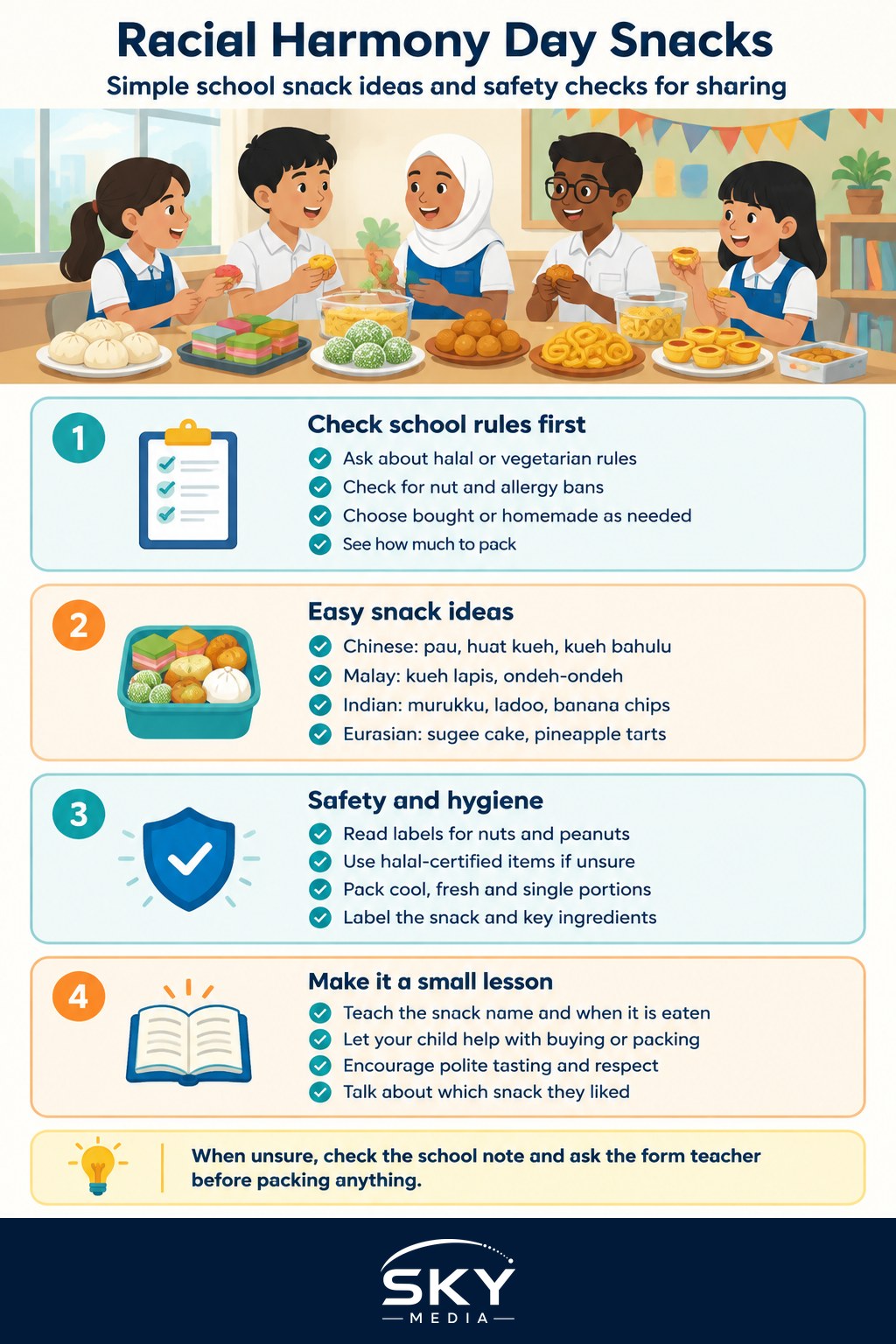
Before you buy or bake, read the note from the school or class teacher carefully. Common instructions include:
- Halal or vegetarian only. Many classes include Muslim children, and teachers often ask for halal-certified bought items or home food that contains no pork, lard or alcohol. Some ask for vegetarian food so everyone can share safely.
- No nuts or specific allergens. Classes with a child who has a serious allergy may ban peanuts, tree nuts, eggs or other ingredients entirely.
- Bought versus homemade. Some schools prefer sealed, store-bought items with an ingredient label, because teachers cannot check home kitchens.
- Portion count. You may be asked to bring enough for the whole class, or only a small contribution to a shared table.
When in doubt, message the form teacher. It is much easier than having your child’s food set aside on the day.
Simple Snack Ideas From Each Community
These are common, kid-friendly choices that most families can find at bakeries, neighbourhood kueh stalls or supermarkets, or make at home. Recipes and ingredients vary by family, so treat this as a starting list.
Chinese
- Steamed buns (pau) with sweet fillings such as red bean or lotus paste. Choose vegetarian or halal-certified versions if the class needs them, since some fillings contain lard.
- Huat kueh or steamed cupcakes, soft and colourful, easy to portion.
- Kueh bahulu, small sponge cakes baked in flower moulds. They keep well in a box.
- Mandarin oranges, simple and symbolic, and need no checking for halal status.
Malay
- Kueh lapis (layered steamed cake) in rainbow colours, which children love peeling apart.
- Ondeh-ondeh, pandan balls filled with gula melaka and rolled in coconut. They can be messy when the sugar bursts, so pack with napkins.
- Kueh dadar, pandan crepes rolled around sweet coconut.
- Curry puffs, if your class allows savoury food and you can keep them in a covered container.
Indian
- Murukku, crunchy spiral snacks. Check the label, as some contain peanuts or are fried in shared oil.
- Ladoo, sweet round balls made from flour or gram flour. Some versions contain cashews, so check for nut rules.
- Banana chips or plain papadum, easy to share and usually vegetarian.
- Mini idli, soft steamed rice cakes, best for classes that allow savoury food.
Eurasian
- Sugee cake, a buttery semolina cake. It traditionally contains ground almonds, so it is not suitable for nut-free classes.
- Pineapple tarts or simple butter biscuits, popular across communities and easy to bring.
- Love letters (kueh belanda), thin rolled wafers enjoyed by Eurasian, Peranakan and Chinese families alike. They are fragile, so pack them in a firm tin.
If your family has its own recipe from any community, that is often the best choice of all, because your child can explain the story behind it.
Allergy, Halal and Hygiene Checklist
A mixed classroom is a good reason to be careful. Use this quick check before packing anything.
| Check | Why it matters | What to do |
|---|---|---|
| Nuts and peanuts | Common in murukku, ladoo, sugee cake and some kueh | Read labels, skip if the class is nut-free |
| Halal status | Muslim classmates cannot eat pork, lard or alcohol | Buy halal-certified items or cook pork-free with clean utensils |
| Eggs and dairy | Common in cakes, tarts and biscuits | Label your container so parents and teachers can decide |
| Freshness in the heat | Coconut and cream fillings spoil fast | Pack in the morning, use a cool bag, eat before recess ends |
A few more tips:
- Label the box with the snack’s name, the community it comes from, and the key ingredients. Teachers appreciate this.
- Use halal-certified products if you are unsure. In Singapore, halal certification is issued by MUIS (the Islamic Religious Council of Singapore), and certified items carry its logo. If you cook at home, avoid pork, lard and alcohol, and do not share utensils with non-halal cooking.
- Avoid choking risks for younger children. Whole grapes, hard sweets and large nuts are not ideal for preschoolers.
- Mind food colouring. Some children are sensitive to strong colourings. Natural pandan green or butterfly pea blue are nice alternatives.
Make It a Small Lesson, Not Just a Snack
The point of sharing food on Racial Harmony Day is curiosity and respect. A few easy ways to help your child get more from it:
- Teach them two facts. The name of the snack and when it is usually eaten, for example kueh bahulu at Chinese New Year or Hari Raya, or murukku at Deepavali.
- Let them help. Even buying from a neighbourhood stall can become a short chat with the seller about how the snack is made.
- Encourage polite tasting. Remind your child that it is fine to try a small piece and say “no thank you” kindly, but never to make faces at someone else’s food.
- Talk about it afterwards. Ask which classmate’s snack they liked best and where it came from. Our guide to racial harmony and the CMIO model can help you answer follow-up questions simply.
Packing and Timing Tips for the Day
- Pack in single portions. Small paper cups or cupcake liners make sharing quick and hygienic.
- Send napkins and a small serving tool if the snack is sticky.
- Avoid anything that needs reheating or cutting with a knife at school.
- Keep it cool. Singapore mornings are humid, and kueh with coconut can turn quickly. A cool bag with an ice pack helps.
- Bring a little extra, in case a classmate forgets.
- Do not overdo it. A modest amount is enough. The point is variety on the shared table, not quantity.
When Your Child Has Their Own Dietary Needs
If your child has allergies or follows a particular diet, let the teacher know before the day. Ask whether you can send a separate container of safe snacks so your child can still join in. Many teachers will set aside known-safe items or place labelled food on a separate table. Your child should never feel left out of the celebration because of what they can or cannot eat.
If you are looking for quick everyday ideas beyond this one occasion, our guide to toddler-friendly meals and snacks has more simple options for younger children.
With a bit of planning and some careful label reading, your child’s contribution can be safe, tasty and a small celebration of the communities that make Singapore what it is.
Frequently Asked Questions
What if a classmate has a serious allergy and I want to bring snacks? Follow the school’s note, as classes with a child who has a serious allergy may ban peanuts, tree nuts, eggs or other ingredients. Message the form teacher when in doubt, and label your box with its key ingredients so teachers can decide.
How do I know if a snack is halal for a mixed class? Buy items carrying the MUIS halal-certified logo if you are unsure. If you cook at home, avoid pork, lard and alcohol, and do not share utensils with non-halal cooking. Some steamed bun fillings contain lard, so check them.
Which snacks keep well in Singapore’s morning heat? Dry items such as kueh bahulu, pineapple tarts, butter biscuits and murukku travel better than coconut or cream fillings, which spoil fast. Pack in the morning, use a cool bag with an ice pack, and avoid anything needing reheating.
Should the snack be bought or homemade? Check the school’s rules, as some prefer sealed, store-bought items with an ingredient label because teachers cannot check home kitchens. If homemade is allowed, a family recipe lets your child tell the story behind it.
What can my child with dietary restrictions bring or eat on the day? Tell the teacher beforehand and ask whether you can send a separate container of safe snacks. Many teachers set aside known-safe items or put labelled food on a separate table, so your child can still join in.
Further reading: Racial Harmony Day Costumes for Kids: Where to Buy or Rent