

Singapore calls itself a City in Nature, and you will see plant labels almost everywhere: on small signs in parks and gardens, on plaques beside large old trees, and on plastic tags stuck into pots at nurseries and plant fairs. If you have just moved here, perhaps from mainland China, these labels can look confusing. They mix English common names, Latin scientific names, short abbreviations and little symbols.
This guide explains plant labels in Singapore as you actually meet them, so you can understand what you are looking at in a park and buy the right plant for your flat. It is a practical companion to our deeper explainer on understanding botanical names and plant labels, which covers the naming system itself.
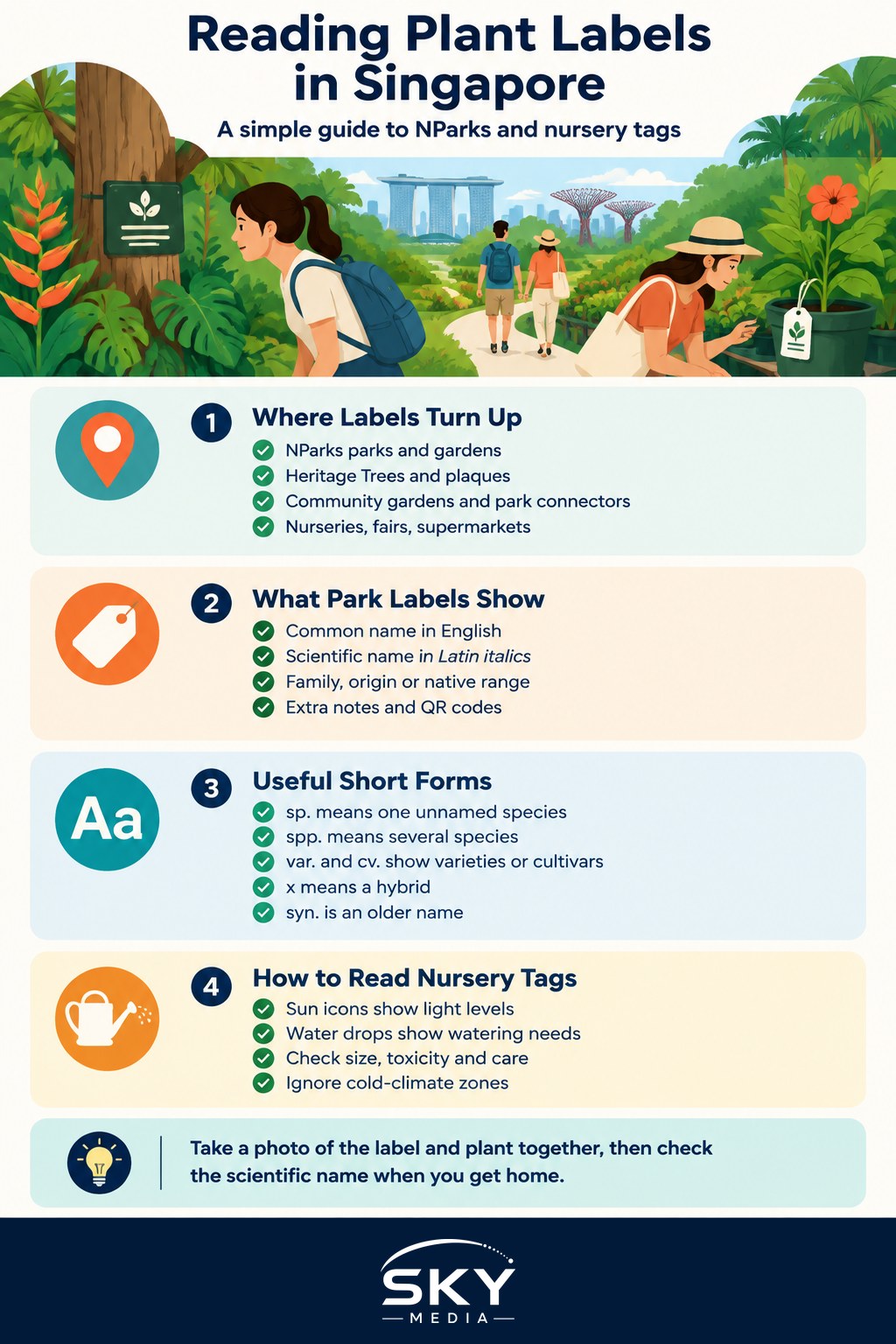
Where You Will See Plant Labels in Singapore
Different places use labels for different purposes, so the information on them varies.
- Public parks and gardens managed by NParks. NParks (National Parks Board) is the government agency that looks after parks, nature reserves, roadside greenery and the Singapore Botanic Gardens. Labels here are mainly educational.
- Heritage Trees. Some large, old or culturally important trees are recognised under NParks’ Heritage Tree scheme and may have a plaque nearby with the tree’s name and background.
- Community gardens and park connectors. Labels are often simpler, sometimes handwritten or added by volunteers.
- Nurseries and plant fairs. Tags are commercial. They focus on care: light, water and size, plus a name that may or may not be accurate.
- Supermarket and online plants. Often only a common or trade name, sometimes nothing at all.
Parts of a Typical Park or Garden Label
Labels at public plantings usually follow a similar pattern, though layout differs between parks and over the years. Common elements include:
- Common name in English. For example, a familiar name like “Rain Tree” or “Bird’s Nest Fern”. One plant can have several common names, and one common name can be used for different plants.
- Scientific name. Written in italics, with two parts: the genus (capitalised) and the species (lower case). This is the most reliable way to identify a plant anywhere in the world, including in China, where the same Latin name is used alongside the Chinese name.
- Family. A larger group the plant belongs to, usually ending in “-aceae”, for example Arecaceae for palms.
- Origin or native range. Where the plant naturally grows, such as “Native to Singapore” or a region like Tropical America.
- Extra notes. Some labels add uses, a short story or the plant’s conservation status.
- QR code. Many newer labels have one that links to more information online.
Chinese names are not always shown. If you want to know what a plant is called in Chinese, take the scientific name and search it on NParks’ Flora and Fauna Web, an online plant database, or a Chinese botanical reference. The Latin name is the bridge between languages.
Common Terms and Abbreviations Explained
These short forms appear on both park labels and nursery tags. Knowing them makes a big difference.
| What you see | What it means | Example of how it appears |
|---|---|---|
| sp. | One species in that genus, not identified exactly | Ficus sp. |
| spp. | Several species in that genus | Heliconia spp. |
| var. | A naturally occurring variety within a species | A name followed by var. and a third word |
| cv. or a name in ‘single quotes’ | A cultivar, a variety bred or selected by people | A species name followed by ‘Variegata’ |
| × | A hybrid between two plants | A genus name, then ×, then a species name |
| syn. | An older or alternative scientific name | syn. followed by the old name |
| Native | Occurs naturally in Singapore | Often shown as a word or a small icon |
A few other words you may meet:
- Variegata or variegated: leaves with white, cream or yellow patterns. These often need a bit more light than all-green forms.
- Epiphyte: a plant that grows on other plants, such as many orchids and ferns. It is not a parasite.
- Climber or creeper: grows upward on supports or spreads along the ground.
- Shrub, tree, palm, groundcover: describes the plant’s general form and size.
Reading Nursery Tags Before You Buy
Nursery and plant fair tags are about care, not education. They are often printed for many countries, so some advice does not match Singapore’s hot, humid climate.
- Light symbols. A full sun icon means several hours of direct sunlight. A half-shaded sun means partial shade or bright indirect light. A cloud or dark icon means shade. Most HDB corridors and windows offer partial light at best.
- Water drops. One drop means let the soil dry between watering; more drops means keep moist. In Singapore’s humidity, overwatering is a common mistake.
- Height and spread. Usually given for plants grown in the ground. In a pot, plants stay smaller.
- Temperature and “hardiness” zones. These matter for cold countries, not here. You can mostly ignore them.
- Pet or child warnings. Some tags mark plants as toxic if eaten. Take this seriously if you have young children, cats or dogs, and check with a vet or doctor if anyone swallows plant material.
If a tag only shows a trade name, ask the seller for the scientific name. Then you can look up proper care advice. Once the plant is home, keep the tag or make your own, as described in our guide on how to label and track your plants.
Tips for Newcomers Exploring Parks With Labels
Reading labels is a pleasant way to learn about your new home. A few friendly reminders:
- Look, do not pick. Removing plants, flowers or seeds from parks and nature areas is not allowed under NParks rules. Check NParks’ website for the current regulations.
- Do not move or take labels. They help everyone, including school groups and other visitors.
- Stay on paths so you do not damage roots or disturb wildlife.
- Take a photo of the label and the plant together. This helps when you look it up later.
- Compare with plants from home. Many tropical plants here are related to ones grown in southern China, such as Guangdong or Hainan, so you may recognise some families.
- Bring water and a hat. Even a short garden walk can be hot.
Using Labels to Choose Plants for Your Flat
Park labels can guide your shopping. If a plant thrives in a shaded part of a park, it may cope in a dim corridor. If it grows in open sun, it probably needs a sunny window or balcony. Note the scientific name, then look for the same plant at a nursery and compare its tag.
Labels are small, but they connect you to the plants, the climate and the people who care for Singapore’s greenery. Once you can read them, every walk through a park becomes a little lesson. If you enjoy decoding labels, you may also like our guide on how to read food labels in Singapore.
Further reading: Understanding NPK and Fertiliser Labels