

Most introductions to SingLit focus on English-language novels and poetry. But Singapore has long had four literary traditions, in English, Chinese, Malay and Tamil, and the Chinese-language one is among the oldest and most prolific. Singapore Chinese literature, often called Xinhua wenxue (新华文学, literally “Singapore Chinese literature”), has its own writers, prizes, journals and debates, and it offers a different window on the island’s history.
If you are new to Singapore, whether you read Chinese fluently, are rebuilding your reading after years away, or prefer translations, this guide gives you a starting point. For English-language works, see our guide on how to start reading Singapore literature.
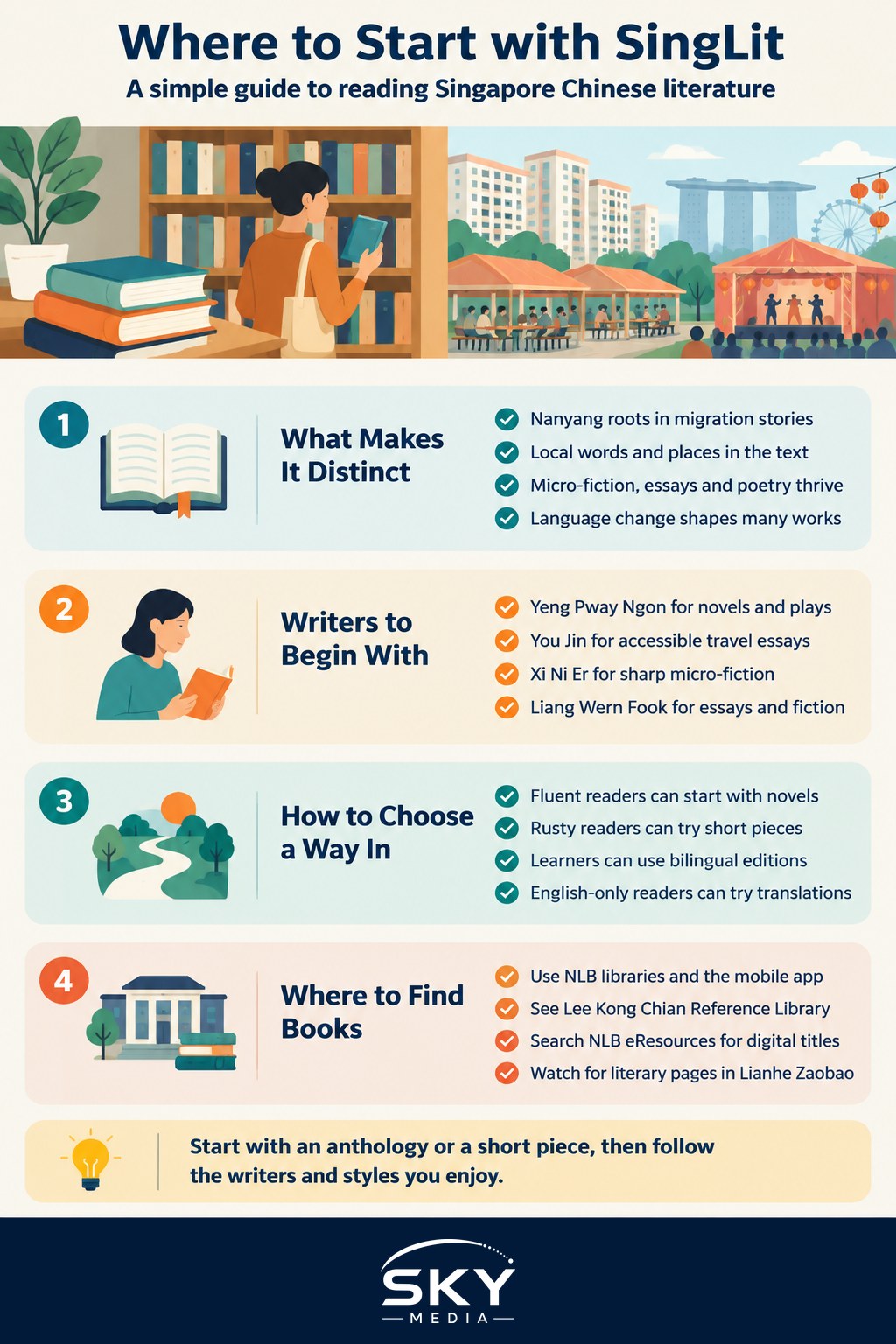
What Makes Singapore Chinese Literature Distinct
Readers from mainland China or Taiwan often expect Singapore Chinese writing to feel familiar. In some ways it does, but several features mark it out.
- Nanyang roots. Early Chinese writing in Singapore and Malaya, before independence, is often grouped as Mahua (马华) or Nanyang literature. Writers dealt with migration, plantation and port life, and the tension between China and their new home. Many readers start their history here.
- Local vocabulary. Expect Malay, Hokkien, Cantonese and English words mixed into the Chinese text, along with local food, places and slang. Seeing “巴刹” (pasar, a wet market) or “组屋” (HDB flat) is part of the flavour.
- Short forms thrive. Singapore has a strong tradition of micro-fiction (微型小说), essays (散文) and poetry, partly because newspaper supplements gave writers a regular outlet.
- Language anxieties. As English became the main language of work and school, many writers began to reflect on what it means to write in Chinese in Singapore. That theme runs through a lot of post-independence writing.
Writers Worth Knowing
This is not a complete canon, just names that come up again and again and are a reasonable place to begin. Availability changes, so search the library catalogue for current titles.
- Yeng Pway Ngon (英培安). Novelist, poet and playwright, and a Cultural Medallion recipient. His novels examine politics, memory and ordinary lives in Singapore. Several have been translated into English, which makes him a good bridge for bilingual readers.
- You Jin (尤今). One of the most widely read Singapore Chinese writers, known for travel essays and accessible prose. A friendly entry point if your Chinese reading is rusty.
- Xi Ni Er (希尼尔). Known for micro-fiction and poetry. His very short stories are ideal for reading on the MRT and often carry a sharp twist about Singapore life.
- Wong Yoon Wah (王润华) and Dan Ying (淡莹). A poet couple whose work, and academic writing in Wong’s case, helped shape modern Chinese poetry in the region.
- Liang Wern Fook (梁文福). Best known for xinyao (新谣), the Singapore Chinese folk-song movement of the 1980s, he also writes essays and fiction. His lyrics are a gentle introduction to local Chinese writing.
You will also meet many contemporary writers through newspapers, festivals and prizes. The Singapore Literature Prize has a Chinese-language category, and its shortlists are a useful reading list of recent work.
Choosing Your Way In
Your best starting point depends on how comfortably you read Chinese. This table suggests options for different readers.
| Your reading level | Good first choices | Why it works |
|---|---|---|
| Fluent Chinese reader | Novels and essay collections by established writers | Full access to style, humour and local language mixing |
| Comfortable but rusty | Micro-fiction, travel essays, xinyao lyrics | Short pieces build confidence without a big commitment |
| Learning Chinese | Bilingual editions, children’s and youth titles by local writers | Side-by-side text and simpler language |
| English-only reader | Translations of Singapore Chinese novels and anthologies | Gives the stories and context without the language barrier |
Anthologies are especially helpful at the start. Look in the library for collections of Singapore Chinese short stories, micro-fiction or poetry, including bilingual and translated anthologies. A good anthology lets you sample a dozen voices and then follow the ones you enjoy.
Where to Find and Borrow Books
You do not need to buy books to explore this field. Singapore’s public libraries are the obvious first stop.
- National Library Board (NLB) public libraries. Most branches have a Chinese collection for adults and children. Use the NLB catalogue or the NLB Mobile app to search by author in Chinese or English and reserve titles from other branches.
- Lee Kong Chian Reference Library. Located in the National Library Building on Victoria Street, it holds a substantial Singapore and Southeast Asia collection, including Chinese-language literary works and older journals. Reference materials are for use in the library rather than for loan, so check the rules before you go.
- NLB eResources. NLB offers e-books and digital newspapers and magazines that you can access with a library account. Search for Chinese titles and local authors there.
- Independent and Chinese bookshops. Singapore has bookshops that stock Chinese-language titles, including local publishers. Staff can often point you towards Singapore authors on the shelves.
- Newspaper literary pages. Lianhe Zaobao (联合早报), the main Chinese daily, has long published literary and cultural writing, and its arts pages are a good way to discover current writers.
If you are new to the library system, signing up for an NLB account is free for Singapore residents. Check the NLB website for current membership options for other pass holders.
Using the Singapore Writers Festival
The Singapore Writers Festival, usually held around November, is one of the easiest ways to meet the Chinese-language scene. The festival programme typically includes talks, readings and panels in all four official languages.
- Filter by language. When the programme is released, look for Chinese-language sessions. Panels with local writers often discuss their own reading lists.
- Attend author sessions. Hearing a writer read aloud helps with dialect words and local references that can be hard on the page.
- Visit the book stalls. Festival bookstores often stock local titles that are harder to find elsewhere.
- Check ticketing early. Some sessions are free and others need a festival pass. Confirm the current format, dates and venues on the official festival website.
If you enjoy hearing the language performed, our guide to Chinese language theatre in Singapore covers the stage side of the same tradition.
Reading With Your Family
Local Chinese literature is also a useful tool for families keeping up their Chinese. Children often find textbook Chinese dry, but stories set in HDB estates, hawker centres and school canteens feel closer to home.
- Borrow local Chinese picture books and youth fiction alongside the books you read.
- Read a micro-fiction piece together at dinner and talk about the twist.
- Listen to xinyao songs and look up the lyrics together.
For more ideas, see Keeping Up Your Child’s Chinese in Singapore.
A Simple First-Month Reading Plan
- Week one: borrow a bilingual or translated anthology and read a few stories.
- Week two: pick one writer you liked and find a short collection of their essays or micro-fiction.
- Week three: try a novel, in Chinese or in translation.
- Week four: attend a festival session, a library talk or a book club, and ask what others recommend.
Start small, follow your curiosity, and you will soon have your own map of Singapore’s Chinese literary world.