

If you moved to Singapore from mainland China and miss going to the theatre, you may wonder whether there is anything to watch in Mandarin. There is. Chinese theatre in Singapore has a long and lively history, and today you can find modern Chinese-language plays, musicals, devised works and readings throughout the year. Many productions are made by local companies, with stories about life in Singapore told in Mandarin and sometimes in dialects.
This guide is for Mandarin-speaking newcomers who want contemporary spoken drama, the kind called 话剧 (huaju) in China. It does not cover traditional Chinese opera, which deserves its own guide, or English-language theatre listings. It explains what local Chinese theatre is like, how to find shows, how to book, and what to expect on the night.
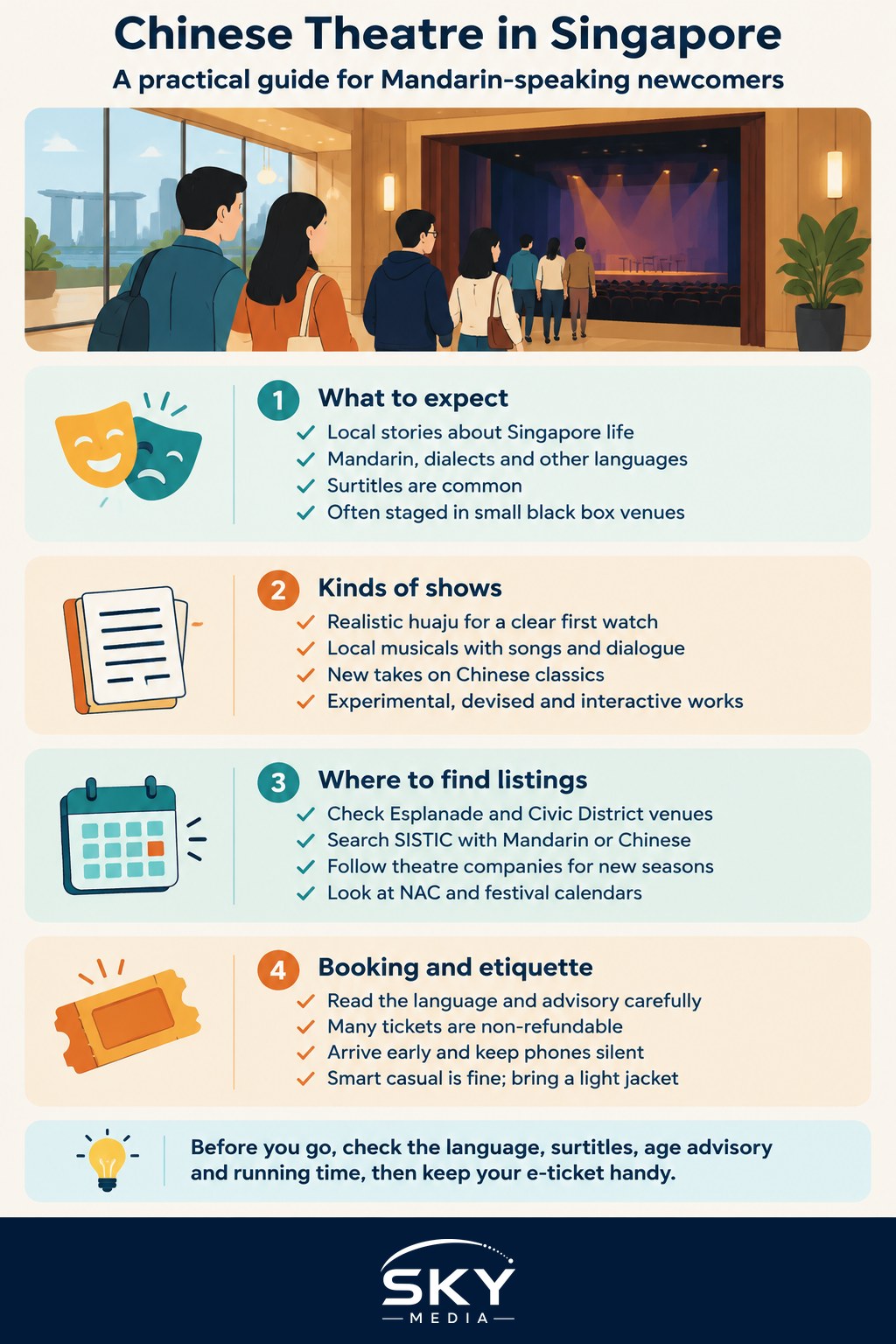
What Chinese Theatre in Singapore Is Like
Singapore’s Chinese-language theatre scene grew from schools, clan associations and amateur drama groups in the last century and developed into a professional scene with its own writers, directors and actors. Compared with what you may know from Beijing or Shanghai, you might notice a few differences:
- Local stories. Many plays explore Singapore themes: family and generations, housing, migration, identity, language and memory. Watching them is one of the best ways to understand how Chinese Singaporeans see their own society.
- Mixed language. Some productions mix Mandarin with English, Hokkien, Cantonese, Teochew or Malay, because that is how many Singaporeans actually speak. If you only know Mandarin, check the listing for languages used.
- Surtitles are common. Many shows display surtitles, often in both Chinese and English, above or beside the stage. This helps with dialect lines and local slang.
- Smaller venues. Alongside big theatres, a lot of interesting work happens in black box spaces holding a modest audience, which makes performances feel close and personal.
- Experimental work. Besides realistic dramas, you may see physical theatre, adaptations of classic Chinese texts, and new writing that plays with form.
Types of Chinese-Language Productions to Look For
| Type of production | What to expect | Good for newcomers who |
|---|---|---|
| Realistic spoken drama (huaju) | Story-driven plays, often about family and society | Want an easy first show in clear Mandarin |
| Local Mandarin musicals | Songs and dialogue, often light and family friendly | Prefer something lively or are bringing older parents |
| Adaptations of Chinese classics | New takes on famous novels, poems or plays | Enjoy seeing familiar texts treated in a fresh way |
| Experimental and devised works | Movement, multimedia, non-linear storytelling | Like art that challenges expectations |
| Children’s and youth theatre | Shorter shows, simple language, interactive moments | Want to support a child’s Chinese learning |
| Play readings and festival programmes | Short works, discussions with artists | Want to meet the local theatre community |
How to Find Chinese Theatre Listings
Shows are announced in several places, and following a few of them will keep you informed.
Major arts venues. Large venues such as the Esplanade, and venues around the Civic District, publish their programme online. Esplanade also runs an annual Chinese arts festival, Huayi, which usually brings together Chinese-language theatre, music and dance. Check the venue’s website for current dates and line-ups, since programmes change each year.
Ticketing platforms. Most professional productions sell tickets through Singapore ticketing websites such as SISTIC, where you can filter by genre and search in English. Search terms like “Mandarin”, “Chinese” or “华语” often help.
Theatre companies’ own channels. Singapore has several established Chinese-language theatre companies as well as independent groups. Once you find a show you like, follow that company’s website, newsletter or social media, since they announce new seasons there first.
Chinese-language media. Local Chinese newspapers and their websites often carry arts reviews, interviews and previews. Reading them is also good for learning local vocabulary.
Arts council and festival calendars. The National Arts Council (NAC) and festivals such as the Singapore International Festival of Arts list programmes that sometimes include Chinese-language works.
Community networks. Fellow newcomers and Chinese community groups often share tickets and invitations. Our guide to making friends as a Chinese newcomer has ideas for building that network.
Booking Tickets: A Quick Guide for Mainland Newcomers
Booking theatre tickets in Singapore is simple, but a few things differ from what you may be used to on Chinese apps.
- Read the listing carefully. Note the language (Mandarin, dialects, English), whether there are surtitles, the age advisory and the running time.
- Check the age rating. Singapore uses advisories for performances, such as general audience or advisory for mature content. If you are bringing children, check this first.
- Choose your seat. Prices and categories vary by show and venue. For small black box spaces, seating may be free seating, so arrive early.
- Pay online. Ticketing websites accept local and international credit cards and common local payment methods. Check which methods are accepted before you start.
- Keep your e-ticket. You will usually receive an e-ticket or QR code by email. Screenshot it in case of weak mobile signal.
- Know the refund rules. Many tickets are non-refundable. Read the terms before buying.
If you are still setting up your phone, our list of essential apps for Chinese newcomers covers payment and transport apps that make getting to the theatre easier.
Theatre Etiquette in Singapore
Most etiquette will feel familiar, but local audiences tend to be fairly strict about a few points:
- Arrive early. Latecomers may only be let in at a suitable break, or not at all.
- Phones fully silent and dark. Screen light is noticeable, especially in small venues. Photography and recording are usually not allowed.
- Food and drink. Usually not allowed inside the theatre itself.
- Dress. Smart casual is fine. Theatres are air-conditioned, so bring a light jacket.
- Post-show talks. Some performances include a post-show dialogue with the artists, sometimes in Mandarin. These are a great chance to ask questions.
Getting More From Each Show
Local Chinese theatre rewards curiosity. Before the show, read the synopsis and any director’s notes on the venue or company website. If the play includes Hokkien or Cantonese, do not worry; surtitles and context usually carry you through. After the show, look up reviews in Chinese and English media to see how local critics responded.
Theatre can also be a family activity. Children’s productions in Mandarin are a fun way to support language learning, as explained in our guide to keeping up your child’s Chinese in Singapore.
Becoming Part of the Scene
Once you have seen a few productions, you may want to go further. Many companies run volunteer programmes, workshops, play-reading sessions and amateur groups. Community centres and clan associations sometimes host drama interest groups too. These are welcoming ways to practise performing, meet locals who share your interests, and understand Singapore more deeply.
For a wider picture of the community you are joining, see our newcomer’s guide to the Chinese community in Singapore. Chinese theatre in Singapore is not a copy of the stage back home. It is its own tradition, and as a Mandarin speaker you are in a good position to enjoy it.
Further reading: Tamil Theatre in Singapore: A Beginner’s Guide · Peranakan Theatre and Storytelling in Singapore · Malay-Language Theatre in Singapore: Where to Start