

Important letters in Singapore do not always drop quietly into your letterbox. Bank cards, legal notices, some government letters and documents sent from overseas often arrive as registered mail, which means someone has to sign for them. For newcomers, the first missed delivery can be confusing: a slip in the letterbox, a post office you have never visited and a question about which ID to bring.
This guide explains how registered mail in Singapore generally works, from the delivery attempt to collection and authorising someone else. It focuses on letters and documents rather than parcels. Procedures and holding periods can change, so check the current details with SingPost, Singapore’s national postal service.
What Registered Mail Is and Why It Is Used
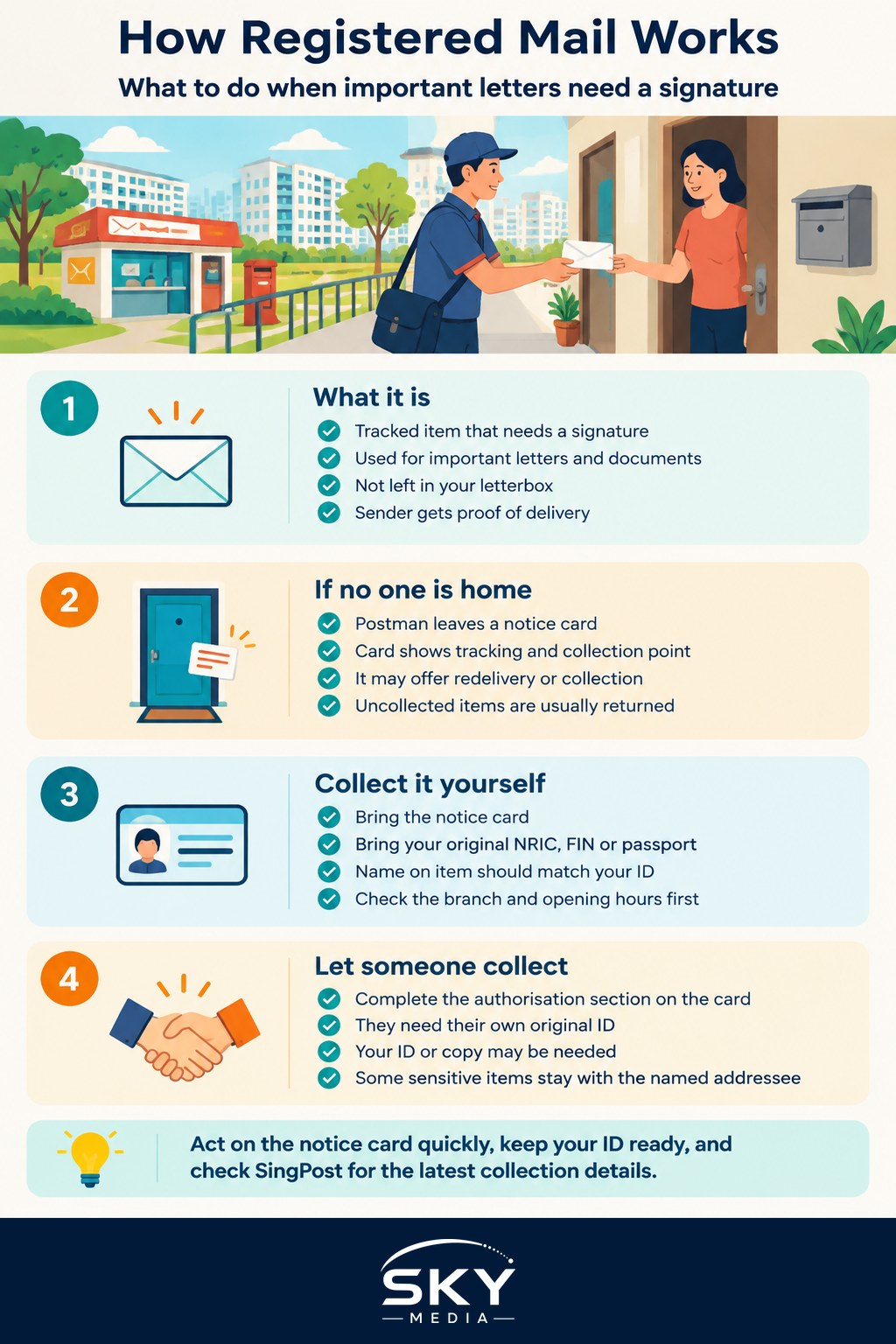
Registered mail is a postal service where an item is tracked and must be signed for on delivery. The sender gets proof that it reached the right address, which is why it is used for things that matter, such as:
- Replacement bank, credit or ATM cards and PIN mailers.
- Letters from lawyers, courts or debt collectors.
- Some letters from government agencies or statutory boards.
- Original documents sent from overseas, such as certificates or contracts.
- Items a sender wants proof of delivery for, such as tenancy notices.
Because a signature is needed, registered mail is handled differently from ordinary letters. It will not simply be left in your letterbox.
How the Delivery Attempt Works
When a registered item arrives at your address, the postman usually tries to deliver it in person. What happens next depends on whether someone is home.
- Someone is home. An adult at the address signs for the item. In some cases the postman may ask to see identification.
- No one is home. The postman leaves a notice card in your letterbox. This card is your key document. It typically shows the item’s tracking number, the post office or collection point where the item will be held, and instructions for collection or redelivery.
- Redelivery or collection. Depending on the options shown on the card and SingPost’s current services, you may be able to request redelivery online or collect it yourself.
Registered items are held for a limited period. If no one collects them, they are usually returned to the sender. The exact period is printed on the card or listed on SingPost’s website, so act on the notice within a few days.
Collecting at the Post Office
If you go to collect the item yourself, bring:
- The notice card left in your letterbox.
- Your original identification, such as your NRIC, your FIN card (the card issued to work pass and other pass holders), or your passport.
The name on the item should match your ID. If the letter is addressed to a slightly different version of your name, for example with or without a middle name, bring documents that show the link, and ask the counter staff what they accept. If the address on the item is one you have only just moved into, it helps to bring something that shows you live there.
Check the card carefully before you set off. Items are not always held at the post office nearest to your home, and opening hours vary between branches. Look up the branch on SingPost’s website first.
Authorising Someone Else to Collect
If you work long hours or are travelling, someone else can usually collect on your behalf. The notice card commonly has an authorisation section to complete. The person collecting generally needs:
- The notice card with the authorisation section filled in and signed by you.
- Their own original identification.
- Your identification, or a copy of it, if the card or counter staff require it.
Requirements can differ depending on the type of item. Some sensitive items, such as certain bank or government documents, may only be released to the named addressee. Check what the card says before sending a friend or family member.
Your Options at a Glance
| Option | What you need | Good for |
|---|---|---|
| Sign at the door | Someone at home to sign, ID if asked | People who work from home or have family at home |
| Collect at the post office | Notice card and your original ID | When you can visit the branch within the holding period |
| Authorise someone | Signed card, their ID, a copy of yours if required | Busy workers or people travelling |
| Request redelivery | Tracking number from the card, online request | When the card offers it and you can be home |
Setting Up Your Home So Mail Reaches You
Newcomers often miss registered mail for reasons that are easy to fix:
- Label your letterbox. Put your name, or the names of everyone in the household, on or inside the letterbox. Postmen deliver to the address, but a clear name helps avoid confusion in shared flats.
- Keep the letterbox locked. Notice cards and ordinary mail can contain personal details. A working lock protects you from identity theft.
- Update your address. Singapore Citizens and PRs must report a change of address to ICA (the Immigration and Checkpoints Authority) within the required time. Pass holders should follow ICA and MOM rules for updating their address. Then update your bank, insurer, employer and telco.
- Tell overseas senders the full address. Singapore addresses use a block number, street name, unit number in the format #floor-unit, and a six-digit postal code. Missing the unit number is one of the most common reasons mail goes astray.
- Check condo arrangements. In some condominiums, the guardhouse or management office receives items for residents. Ask how registered items are handled, since they normally need the addressee’s signature.
For parcels rather than letters, our guide on receiving parcels safely in Singapore condos covers lockers and guardhouse drop-offs. If you regularly receive post from home, see receiving parcels and mail from China in Singapore for international tracking and customs points.
Registered Mail for Businesses
If you run a company, official letters may go to the company’s registered office rather than your home. Make sure someone checks that mailbox regularly and can sign for registered items. The rules for that address are covered in our guide to registered office address rules in Singapore. Missing a registered letter from a regulator or a court can lead to deadlines passing without you knowing.
Quick Tips for Newcomers
- Act on a notice card within a day or two, rather than leaving it in a drawer.
- Photograph the card in case it gets lost.
- Keep your ID handy when you expect important post.
- Track the item online with the number on the card.
- Ask SingPost customer service if the card is unclear or the item is not at the branch.
Registered mail is one of those small systems that becomes routine once you have done it once. Keep your letterbox labelled, your address updated and your ID ready, and check SingPost’s website for the latest collection rules.
Further reading: Getting Mail for a Previous Occupant? What to Do in Singapore · How to Receive Big Deliveries When No One Is Home · Renting a SingPost PO Box in Singapore and How It Works