
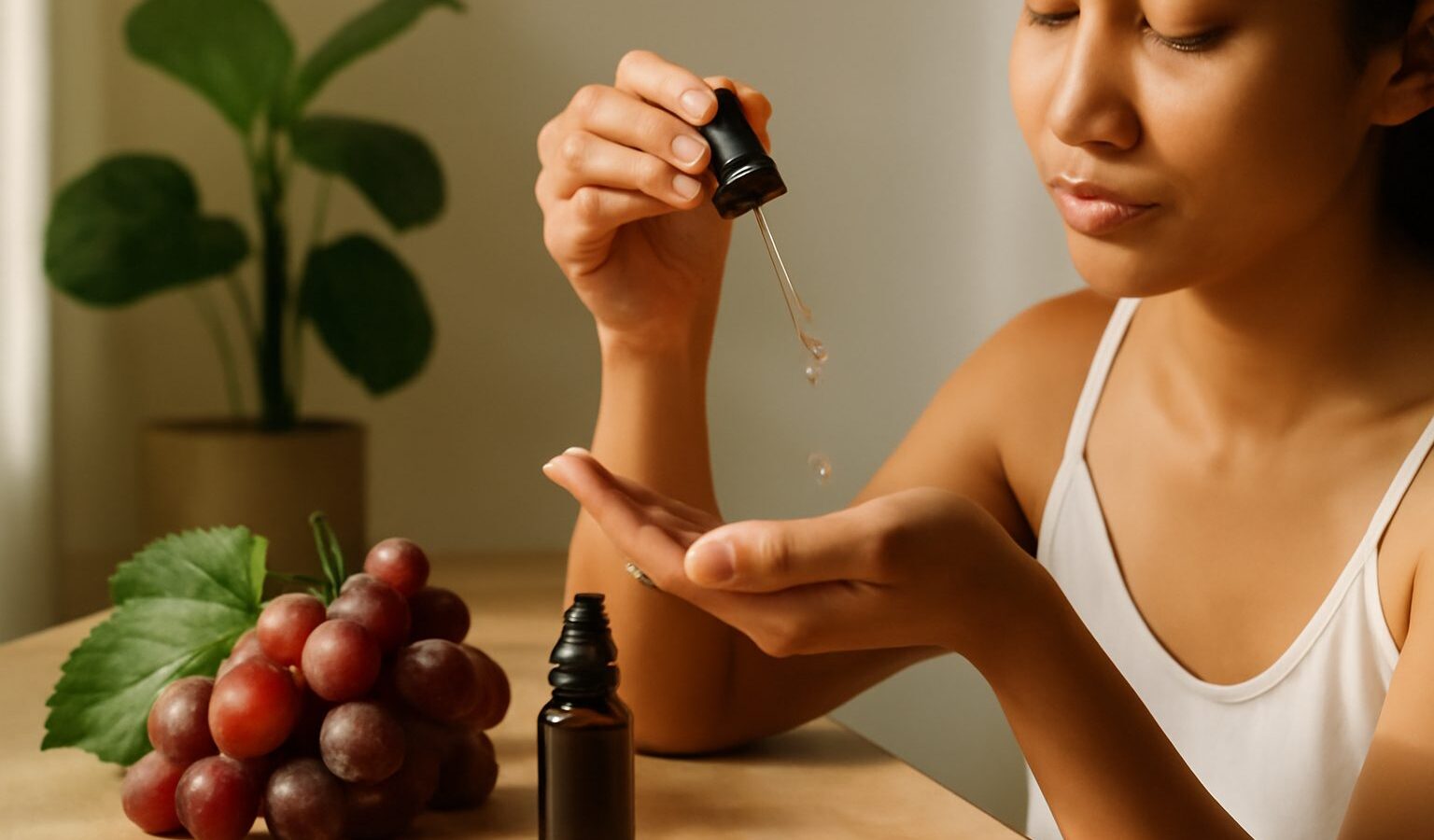
Resveratrol is best known as the compound in red grapes and red wine that gets a lot of hopeful health headlines. In skincare it has a more modest, more believable role: it is a plant antioxidant that helps protect skin from everyday environmental stress. If you have seen it on serums and night creams and wondered whether resveratrol skincare in Singapore is worth your attention, this guide lays out what it actually does, who it suits, and how to fit it into a routine that makes sense for our warm, sunny, humid environment, without overselling it.
What Resveratrol Is
Resveratrol is a polyphenol, a type of antioxidant that plants produce partly to defend themselves against stress. It is found in the skin of red grapes, in some berries, and in peanuts, among other sources. The wine connection is where most people first hear about it, though you certainly do not need to drink anything to get skincare benefits.
Applied topically, resveratrol works much like other antioxidants such as vitamins C and E. It helps neutralise free radicals, the unstable molecules driven by ultraviolet light and pollution that contribute to visible signs of ageing over time. Some laboratory research also points to soothing and skin-supporting properties, though a lot of that work is early-stage. For a wider view of how antioxidants slot into a routine, our explainer on green tea and antioxidants in skincare is a helpful companion, since green tea polyphenols work along broadly similar lines.
On a label you may see it as resveratrol itself, or as a more stable derivative. Like several plant antioxidants, pure resveratrol can be tricky to keep stable in a formula, so how well it is made matters as much as whether it is present at all.
What the Evidence Says
Time for honesty. The excitable claims about resveratrol as a longevity ingredient come mostly from lab and supplement research, not from proof that a face cream will turn back the clock. What the skincare evidence reasonably supports is that resveratrol is a capable antioxidant that can offer protective, supportive benefits at the skin surface, and that it is generally well tolerated.
It is often paired with other antioxidants, because antioxidants tend to work better as a network than alone. A resveratrol product used in the evening can complement a vitamin C serum used in the morning, giving you antioxidant support across the day. That said, resveratrol is a supporting ingredient, not a proven heavyweight active, and the strongest anti-ageing evidence still sits with well-studied ingredients like retinoids and daily sunscreen. This is general cosmetic information, not medical advice, and no serum treats a medical skin condition.
Who It Suits
Resveratrol is gentle and tends to suit most skin types, including sensitive skin that struggles with stronger actives. If acids and retinoids feel too harsh for you, an antioxidant like resveratrol is a calmer way to add protective support. Our guide to sensitive skin care walks through building a routine around tolerance.
It appeals particularly to people interested in preventive, everyday antioxidant care, and it is often positioned in night-time formulas. Because it is not an exfoliant or a strong active, it plays nicely alongside the rest of a simple routine rather than demanding one be built around it. If you are still assembling the basics, our step-by-step on building a skincare routine is the place to start.
Using It in Humid Singapore
The main things to get right in our climate are texture and expectations.
- Favour a light formula. Resveratrol turns up in everything from thin serums to rich night creams, and in Singapore humidity a lighter texture usually feels better and absorbs more comfortably.
- Consider it for evenings. Many resveratrol products are designed for night use, which pairs neatly with a daytime antioxidant like vitamin C. It is not a rule, just a common and sensible pattern.
- Store it away from light and heat. Antioxidants can degrade, and a hot, bright Singapore bathroom is not their friend, so a cooler cupboard helps them last.
- Keep sunscreen central. Antioxidants support sun protection, they never replace it, and our year-round ultraviolet levels make daily sunscreen non-negotiable.
Introduce it on its own and patch test first, following our guide on how to patch test new skincare. Adding one new active at a time is the simplest way to tell what your skin actually likes.
The Honest Wrap-Up
Resveratrol is a pleasant, well-tolerated plant antioxidant that makes a good supporting player, especially for people who prefer gentle, preventive care over strong actives. The buzz around it borrows heavily from supplement and longevity research, so keep your expectations for a topical version grounded: think everyday protective support, not a dramatic transformation.
Pick a light texture for our humidity, store it sensibly, patch test before you commit, and build the routine around sun protection rather than around any single antioxidant. If you have a persistent skin concern, a reaction that will not settle, or a change you are unsure about, see a doctor or dermatologist rather than expecting one ingredient to sort it out.