
After decades of work in Singapore, many mainland Chinese permanent residents (PRs) decide to spend their later years closer to family and hometown. If you plan to retire back to China from Singapore, the hardest part is often not the decision itself but the practical exit: what happens to your CPF, how you keep healthcare cover during the move, and how to bring your savings home in an orderly way.
This guide focuses on that exit process. It does not cover how much you need to retire, which we look at in the five years before you retire. Everything here is general information, not legal or financial advice. Rules change, so always confirm the current position with the official body named in each section.
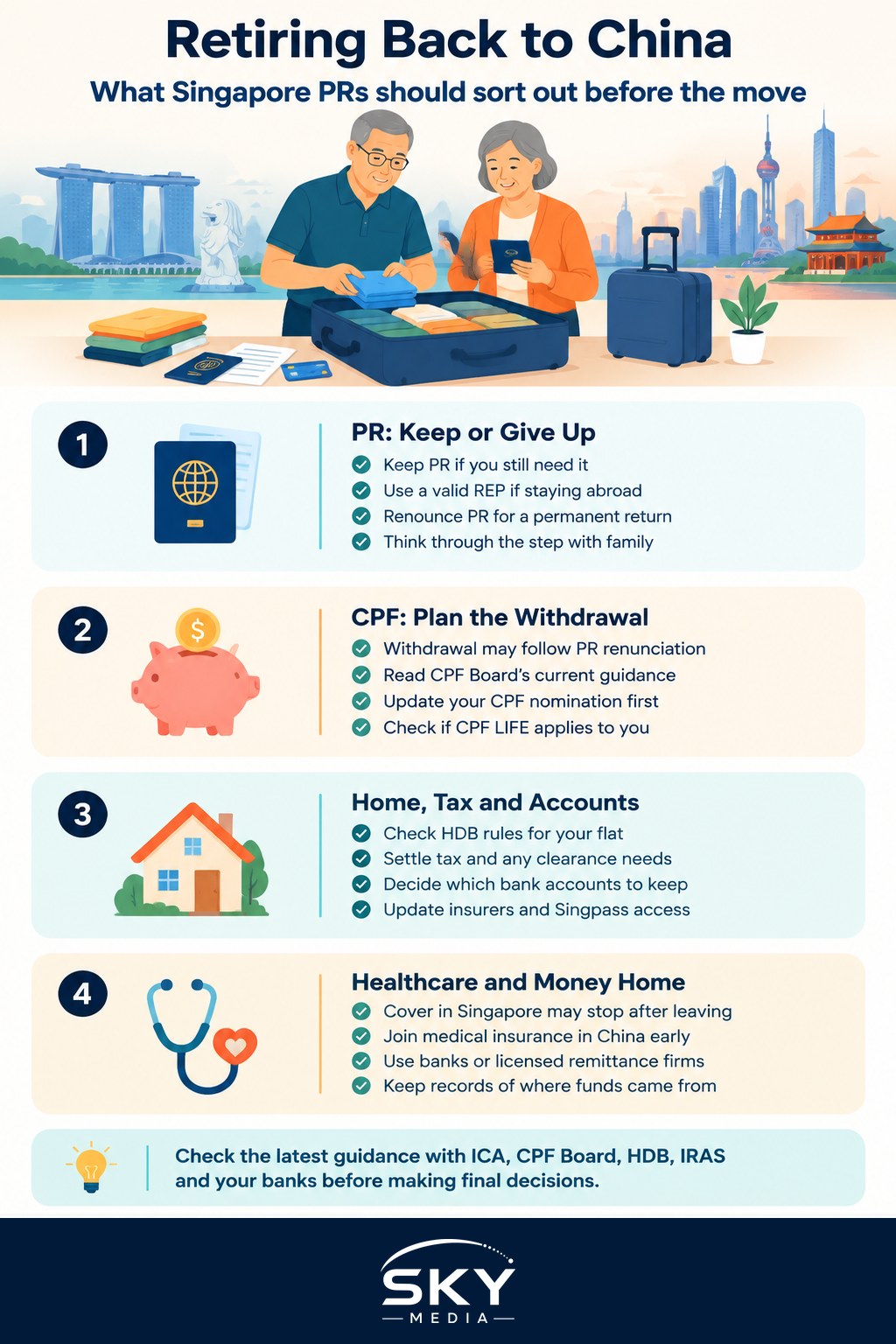
Step One: Decide Whether to Keep or Give Up Your PR
Your PR status is the key that unlocks, or locks, most other decisions. Broadly, you have two paths.
Keep your PR. Some retirees keep PR while living mostly in China, for example to stay connected to children in Singapore. You then need a valid Re-Entry Permit (REP) to keep your PR status while abroad. The Immigration and Checkpoints Authority (ICA) decides REP applications, and renewals are not automatic. Keeping PR also means your CPF generally stays in Singapore under normal withdrawal rules for your age.
Renounce your PR. If you are moving back permanently, you may choose to renounce PR through ICA. This is often the route people take when they want to withdraw their CPF savings in full on leaving. Renunciation is a significant step that is hard to reverse, so think it through with your family first.
| Decision | What it means for CPF | What it means for healthcare | Points to check |
|---|---|---|---|
| Keep PR and live in China | CPF stays under normal age-based rules | MediShield Life and MediSave remain, but only help for treatment in Singapore | REP validity with ICA |
| Renounce PR and leave permanently | May apply to withdraw CPF savings, subject to CPF Board rules | Singapore schemes no longer apply once withdrawn | Housing, tax and bank accounts settled first |
| Delay decision for a year | CPF stays put meanwhile | Keep private cover for time spent in China | Whether REP covers the trial period |
Withdrawing CPF When You Leave
The Central Provident Fund (CPF) is Singapore’s compulsory savings scheme, a little like a combined pension, housing fund and medical savings account in one. For PRs, CPF Board has provisions allowing savings to be withdrawn when you renounce PR and leave Singapore without the intention of returning. The exact conditions, required documents and processing steps are set by CPF Board, so read the current guidance on the CPF website before you begin.
Practical points to plan for:
- Order of steps. Withdrawal usually follows renunciation, so you may need to apply after you have given up PR. Plan your cash flow for the gap.
- Nominations. Update or confirm your CPF nomination so your wishes are clear in the meantime.
- CPF LIFE and annuities. If you have already started monthly payouts, ask CPF Board how withdrawal on leaving applies to your situation, as it can differ from someone who has not started.
- Housing loans. If you used CPF for a property, this links to how the property is sold and the CPF refunded to your account.
- Bank account for payment. Keep a bank account that can receive the funds and is easy to access from China.
Settling Property, Tax and Accounts in Singapore
Before you leave, close out the Singapore side carefully.
- Your HDB flat or private property. Owning an HDB flat comes with eligibility conditions. Check with the Housing & Development Board (HDB) what renouncing PR means for your flat and the timeline for selling. For private property, speak to your lawyer and agent about selling or renting.
- Income tax. The Inland Revenue Authority of Singapore (IRAS) has rules for people leaving Singapore, including tax clearance if you are still employed. Settle any outstanding tax and keep your login to the IRAS portal active for a while.
- Supplementary Retirement Scheme (SRS). If you have an SRS account, special rules apply to foreigners withdrawing. Check with your SRS bank and IRAS on the tax treatment.
- Bank and insurance. Decide which accounts to keep open. Many retirees keep one Singapore account for residual payments, refunds and dividends. Tell insurers your new address and check whether your policies still cover you overseas.
- Singpass. Ask whether you will still be able to access Singpass after leaving, as many final transactions depend on it.
Healthcare Cover During and After the Move
Healthcare is where gaps most often appear, especially for older retirees.
In Singapore: MediShield Life and MediSave help mainly with treatment in Singapore. Once you renounce PR and withdraw CPF, they no longer support you. If you have an Integrated Shield Plan, ask the insurer when cover stops.
In China: As a Chinese citizen, you can usually join basic medical insurance in China. For many returnees this is the urban and rural resident basic medical insurance (城乡居民医保) in the place where your household registration (hukou) is held. Enrolment periods and waiting periods vary by city, so contact the local medical insurance bureau early.
Restoring your hukou: Some people who settled abroad had their hukou cancelled. If that applies to you, check with the public security bureau in your hometown how to restore it, as many local services depend on it.
Bridging cover: Consider short-term private or travel medical insurance for the first months, until Chinese cover takes effect. Bring copies of your medical records and a supply of any regular medication, after checking with your doctor.
Our guides to claiming your China pension and keeping older Chinese insurance policies also help you see what you already have on the China side.
Moving Your Money to China
Bringing decades of savings home takes planning.
- Use regulated channels. Transfer through banks or licensed remittance providers. Avoid informal “money changers” that offer better rates without proper records.
- Understand China’s foreign exchange rules. China’s State Administration of Foreign Exchange (SAFE) sets rules for individuals converting and moving currency. Larger inbound transfers may need documentation of the source of funds, such as CPF statements, property sale documents and bank records. Keep these in order.
- Spread transfers if needed. Some families move money in stages to manage exchange rates and paperwork.
- Keep records. Proof of where the money came from helps if a bank or authority asks questions later.
Ask your bank in China which documents they need before the funds arrive. Requirements can differ between banks and cities.
Your Exit Checklist in Order
- Discuss the move with family and decide on keeping or renouncing PR.
- Check CPF Board, HDB, IRAS and ICA guidance for your situation.
- Arrange healthcare in China, including hukou and medical insurance enrolment.
- Sell or arrange your property and settle tax.
- Renounce PR (if chosen) and apply for CPF withdrawal.
- Move funds through regulated channels with full records.
- Keep one Singapore account and update addresses everywhere.
Finally, give yourself time to adjust. Even after a long-planned return, life in your hometown may feel different. Our article on reverse culture shock when moving back offers gentle advice for the first months home.
Official sources: CPF Board
Further reading: Can Foreigners Retire in Singapore? Pass Options and Realities