
Singapore is safe, clean, well connected and has excellent healthcare, so it is natural that people from overseas ask: can foreigners retire in Singapore? The short answer is that Singapore does not offer a dedicated retirement visa. Some foreigners do spend their later years here, but almost always through a family link, long-term residency gained earlier, or substantial investment. This guide explains the routes that exist, who they are generally meant for, and the costs foreign retirees should weigh honestly.
This is general information, not legal or financial advice. Immigration rules change, and eligibility is decided case by case by the authorities. Always check the current requirements with the Immigration & Checkpoints Authority (ICA), the Ministry of Manpower (MOM) or the Economic Development Board (EDB).
Why There Is No Retiree Visa
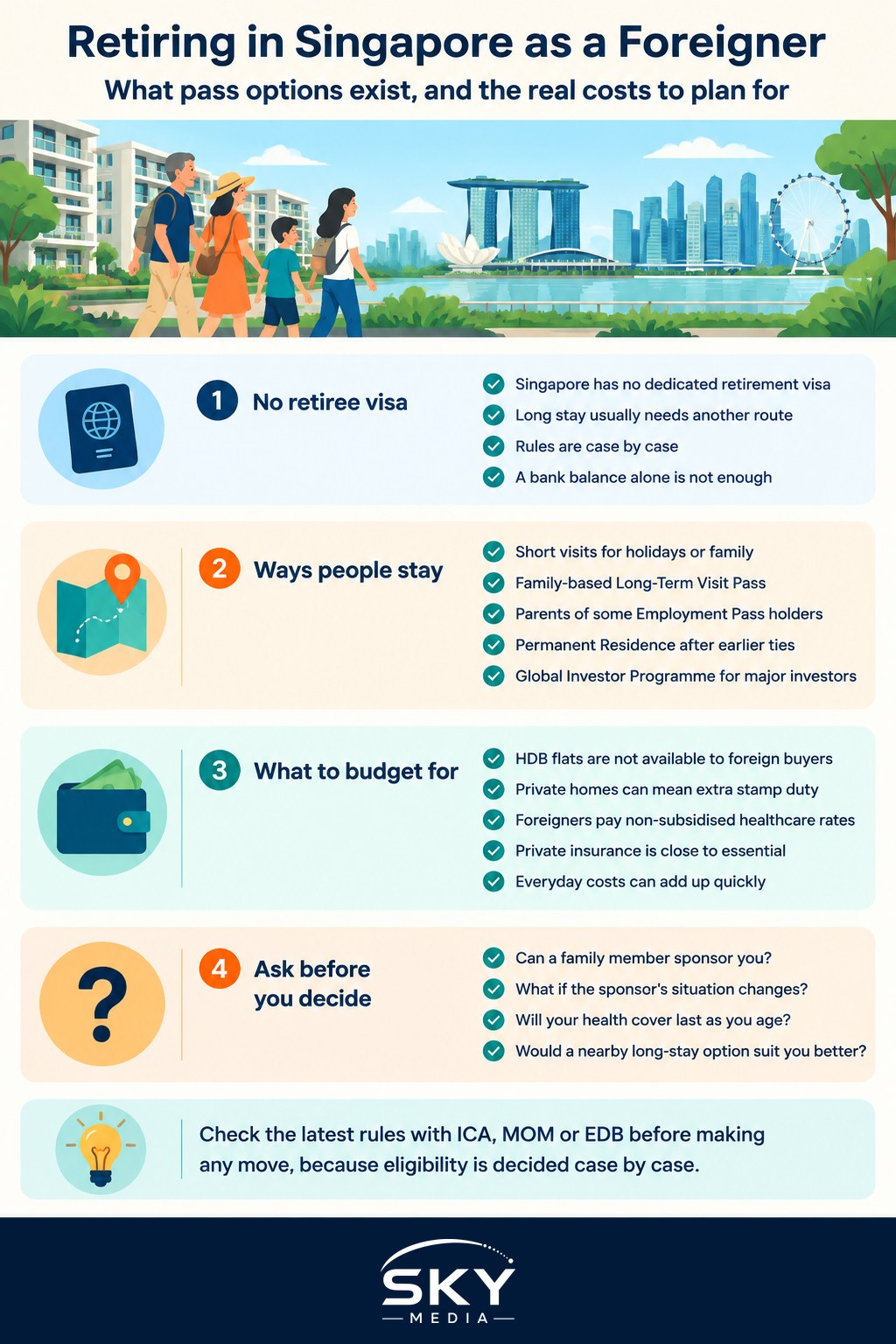
Many countries in the region have offered retirement or long-stay programmes for older foreigners who can show savings or a pension. Singapore does not. Its immigration framework is built mainly around work passes, family ties and permanent residence for people who contribute economically and integrate over time.
In practice, this means you cannot simply show a bank balance and receive a long-term pass to retire. Each route below has its own purpose and conditions.
Possible Routes for Foreigners Who Want to Stay Long Term
| Route | Who it is generally meant for | Key catch |
|---|---|---|
| Short-term visit pass | Tourists and visitors | Limited stay set at entry, not designed for living here |
| Long-Term Visit Pass (family-based) | Certain family members, such as parents of Singapore citizens or PRs, or spouses | Needs an eligible sponsor, approval is discretionary |
| Long-Term Visit Pass for parents of work pass holders | Parents of some Employment Pass holders | Tied to the child’s pass and salary criteria set by MOM |
| Permanent Residence | People with long work history, family ties or investment | Discretionary, assessed on many factors |
| Global Investor Programme | Substantial business owners and investors | Very high investment and business track record requirements |
Short-term visits
Visitors can enter on a short-term visit pass, with the length of stay determined at the checkpoint and depending on nationality and circumstances. This suits extended holidays or visiting family, but repeated long visits are not a reliable retirement plan, and ICA can refuse entry or extensions. Check the visa requirements for your nationality on the ICA website.
Family-based Long-Term Visit Pass
If you have a child who is a Singapore citizen or permanent resident, they may be able to sponsor you for a Long-Term Visit Pass (LTVP) through ICA. Spouses of citizens and PRs may also apply for an LTVP. Approval depends on factors such as the sponsor’s circumstances and is at ICA’s discretion. Passes are issued for a set period and must be renewed. If you are thinking of moving to join adult children here, ask them to check the latest criteria with ICA before you make plans. Our guide to marrying a foreigner in Singapore covers related spouse pass issues.
Parents of Employment Pass holders
MOM has a Long-Term Visit Pass for parents of certain Employment Pass holders. Eligibility is linked to the child’s pass type and salary, which MOM sets and revises. The parent’s stay depends entirely on the child’s pass. If the child changes jobs, leaves Singapore or loses the pass, the parent’s pass is affected too. Check current conditions on the MOM website.
Permanent Residence
Some foreigners who worked in Singapore for many years apply for PR and later retire here. PR applications are assessed on a range of factors, and approval is not guaranteed. PR is not a route designed for people arriving at retirement age without prior ties.
Global Investor Programme
EDB’s Global Investor Programme offers a path to PR for established business owners, family office principals and investors who meet demanding criteria on business track record and investment in Singapore. It is not a retirement scheme in the usual sense, and the thresholds are high. Read the current requirements on the EDB website directly and consider professional advice.
The Costs Foreign Retirees Should Weigh
Even with a pass, retiring in Singapore as a foreigner is expensive. Plan around these realities.
Housing
- Public housing is generally not available. Foreigners cannot buy HDB flats, and renting one has its own rules on who may rent.
- Private property purchase is possible, with restrictions and extra stamp duty. Foreign buyers pay Additional Buyer’s Stamp Duty (ABSD) at a significant rate set by IRAS, and landed property is restricted. See can foreigners buy property in Singapore for the basics.
- Renting is the most common choice, but private rents are high compared with many retirement destinations.
Healthcare
- Foreigners do not have MediSave or MediShield Life, which cover citizens and PRs.
- Public hospitals and polyclinics charge foreigners non-subsidised rates.
- International or local private health insurance is close to essential, and premiums usually rise with age. Pre-existing conditions may be excluded, so read the policy wording carefully.
Daily living and taxes
- Day-to-day costs such as transport and hawker food can be reasonable, but rent, healthcare, private transport and domestic help add up fast.
- Income tax treatment depends on your tax residency status and income type. Check with IRAS, and with tax authorities in your home country.
- You cannot rely on CPF, the national savings scheme for citizens and PRs, as a foreigner without employment history here.
For a sense of how much retirement here costs even for locals, see how much do you need to retire in Singapore.
Practical Questions to Ask Before You Decide
- Do you have a family member who could sponsor you, and are they likely to stay in Singapore long term?
- What happens to your pass if your sponsor’s situation changes?
- Can you get health insurance that covers you for many years, and what will it cost as you age?
- Is your pension or savings paid in a currency that may move against the Singapore dollar?
- Where would you go if your pass is not renewed?
- Would a nearby country with a long-stay programme suit you better, with Singapore as a frequent visit instead?
Alternatives Many Foreign Retirees Consider
Some people who love Singapore choose to live in a neighbouring country with a formal long-stay or retirement programme and visit Singapore regularly for family, healthcare or shopping. Malaysia, for example, has long-stay programmes, though conditions change often. Our guide to retiring in Malaysia explains what to check first, and much of it applies to foreigners too.
Retiring in Singapore as a foreigner is possible for some, but it is rarely simple. Treat any plan as conditional on a pass you do not control, budget generously for housing and healthcare, and confirm every rule with ICA, MOM or EDB before you move.
Frequently Asked Questions
Can foreigners get Singapore permanent residence just by retiring here? No. Permanent residence is not designed for people who arrive at retirement age without prior ties. Applications are judged on factors such as work history, family links and contributions, and approval is never guaranteed. Check the latest criteria with ICA before making any plans.
Can I get a Long-Term Visit Pass if my child is a PR? It is possible, because a child who is a citizen or PR may be able to sponsor a parent. Approval is at ICA’s discretion and the pass must be renewed. Ask your child to confirm the latest criteria with ICA before you commit to moving.
Do foreign retirees need health insurance in Singapore? In practice, yes. Foreigners do not have MediSave or MediShield Life and pay non-subsidised rates at public hospitals. Private cover is close to essential, but premiums tend to rise with age and pre-existing conditions may be excluded, so read policy wording closely.
What happens to a parent’s pass if the child’s Employment Pass ends? The parent’s pass is tied to the child’s, so it is affected too. If the child changes jobs, leaves Singapore or loses the pass, the parent’s stay can be cut short. MOM sets the conditions, so check its website for current rules.
Is it cheaper to retire in Malaysia and visit Singapore instead? Often it is, since rent and healthcare here are high compared with many retirement destinations. Malaysia has long-stay programmes, though conditions change often and must be checked directly. Some retirees live next door and visit Singapore for family, healthcare or shopping.
Official sources: ICA