

Leaving the island after a good stretch of your life here can be surprisingly hard, and the reverse culture shock Singapore leavers describe often catches them off guard. You expect the excitement of going home, seeing family, eating familiar food and slipping back into old routines. What many people do not expect is the quiet disorientation that follows, when home no longer fits the way it used to and you feel like a stranger in a place you know by heart.
This is a supportive, practical piece rather than any form of medical or professional advice. If low mood, anxiety or a sense of loss becomes persistent or overwhelming, please speak to a qualified doctor or counsellor. What follows is general guidance to help you understand the experience and settle back in more gently.
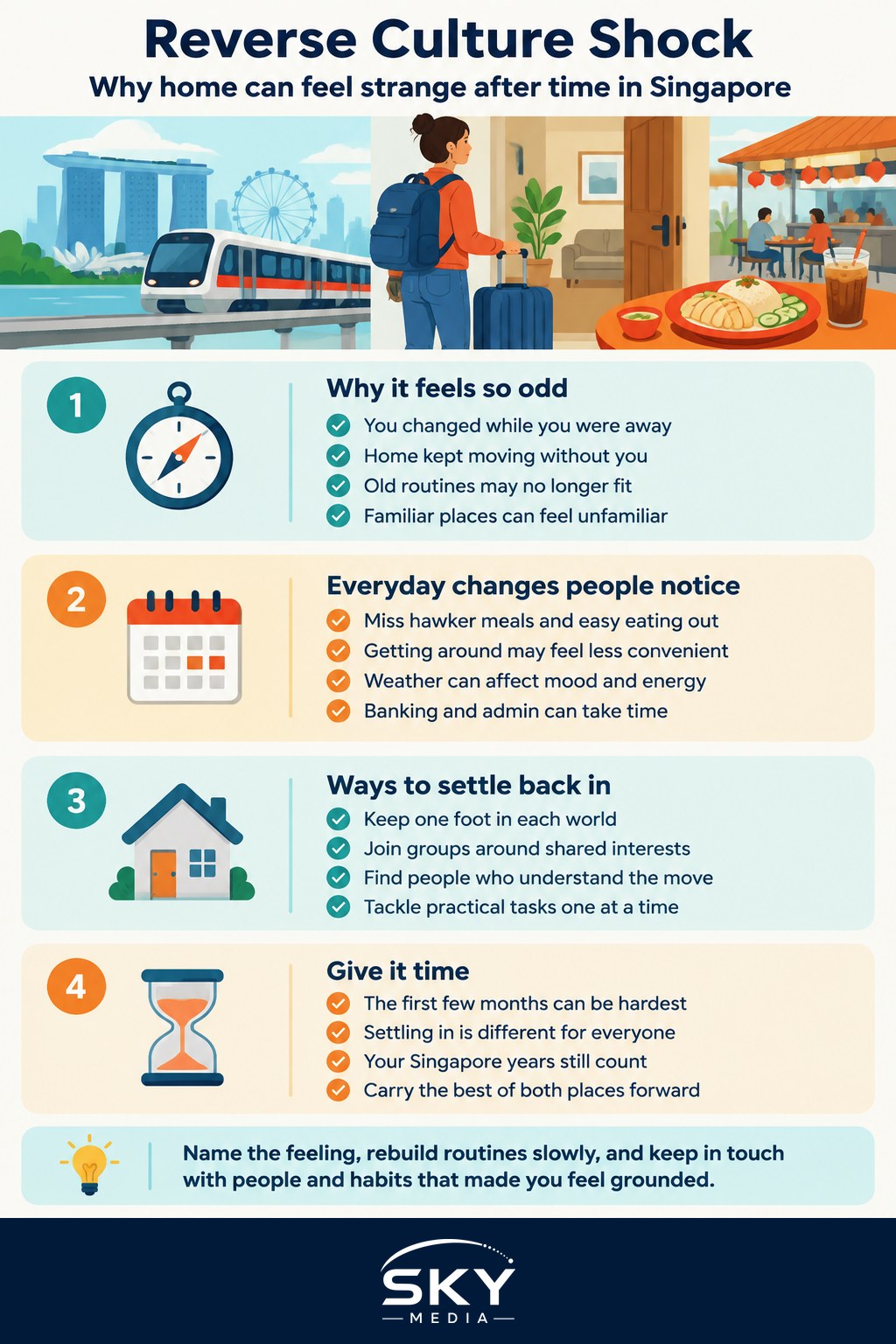
Why coming home feels so strange
Reverse culture shock is the emotional and practical adjustment of returning to your home country after living abroad. It is a normal, well recognised part of moving, yet it is talked about far less than the excitement of arriving somewhere new. The reason it stings is simple. While you were away you changed, and so did the place you left. You return with new habits, new reference points and a different sense of what normal looks like, then find that everyone at home has carried on without you.
After time in Singapore, certain things become second nature. You may be used to public transport that runs like clockwork, hawker meals that are quick and affordable, streets that feel very safe late at night, and a city that is clean, orderly and efficient. Back home you might suddenly notice slower systems, higher prices for eating out, or a pace of life that feels either too fast or oddly sluggish. None of this means one place is better than the other. It simply means your baseline shifted, and your senses are recalibrating.
There is an emotional layer too. In Singapore you may have built a tight expat or local community, learned to navigate a new culture and enjoyed the identity of being someone who lives abroad. Returning home can feel like losing that identity. Friends may ask about your time away once, then move on, and you can feel unheard when the experience meant so much to you. This gap between how big the chapter felt to you and how briefly others engage with it is one of the most common sources of the letdown.
The everyday adjustments people notice
The practical side of returning can be just as jarring as the emotional side. Small daily frictions add up, and it helps to expect them rather than be blindsided.
- Food and eating out. You may miss the ease and variety of hawker centres and the habit of eating out cheaply. Cooking more at home, or hunting down familiar dishes, can ease the transition.
- Getting around. If you gave up a car in Singapore and relied on the MRT and buses, driving again, or a patchier transport network, can feel like a step back.
- Weather. After years of warm, humid, stable weather, a cold or highly seasonal climate can affect your mood and energy more than you expect.
- Money and admin. Reopening bank accounts, sorting tax residency, updating your licence and re registering with local services all take time. Give yourself a buffer.
- Weather aside, the sheer familiarity can feel flat. Novelty was part of daily life abroad, and its absence can read as boredom at first.
The table below sums up common contrasts people notice when moving back. Treat it as a general orientation, not a scorecard, since every home country and every person is different.
| At a glance | Life in Singapore | Back home |
|---|---|---|
| Daily pace | Fast, efficient, always on | Often slower or differently paced |
| Getting around | Dense, reliable public transport | Frequently more car dependent |
| Eating out | Quick, affordable hawker culture | Usually a bigger treat or cost |
| Climate | Warm and humid year round | Seasonal, sometimes cold |
| Sense of novelty | High, everything felt new | Familiar, which can feel flat at first |
| Social circle | Built from scratch, close knit | Established, but moved on without you |
Practical ways to cope and reconnect
The good news is that reverse culture shock eases with time and a little intention. You cannot rush it, but you can smooth it.
Start by naming it. Simply knowing that this is a recognised experience, and not a personal failing, takes away a lot of its power. You are not ungrateful for being home, and you are not broken for missing your life abroad. Both feelings can sit side by side.
Keep one foot in each world for a while. Stay in touch with the friends you made in Singapore, cook the dishes you loved, and let yourself enjoy the memories rather than shutting them away. At the same time, give home a fair chance by rebuilding routines slowly. Join a class, a sports group or a community activity so that you are meeting people around a shared interest rather than waiting for old friendships to instantly feel the same.
Manage your expectations of others. Most people at home cannot fully picture your years away, and that is not a rejection. Find the one or two friends, or an online community of fellow returnees, who genuinely want to hear the longer story. Sharing with people who understand takes the pressure off everyone else.
Be patient with the practical rebuild. Sorting out housing, work, schools, healthcare and finances all at once is draining. Tackle the essentials first, accept that some things will feel clunky, and remember that competence returns quickly once you are back in the rhythm.
Finally, look after the basics. Sleep, movement, daylight, decent food and regular contact with people you trust do more for your mood than any single fix. If sadness lingers, or you feel isolated for weeks on end, reach out to a professional. Asking for support is a sensible step, not a weakness.
Giving yourself a fair timeline
Most people find the hardest phase is the first few months, when the novelty of being home wears off and the reality of rebuilding sets in. Many describe a dip somewhere in that early stretch, followed by a gradual return to feeling settled once new routines, friendships and a sense of purpose take hold. Everyone moves through it at their own speed, so try not to compare your timeline to anyone else’s.
It also helps to reframe the whole experience. Your years in Singapore were not something you have to leave entirely behind. They shaped how you see the world, how you handle change and what you value in daily life. Carry the best of it home with you, the openness, the appreciation for good food and safe streets, the confidence that you can build a life anywhere, and let it enrich the chapter you are starting now. Home may feel strange for a while, but with time and kindness towards yourself, it becomes home again.
Explore more
Making Friends in Singapore
First Month in Singapore
Moving to Singapore Checklist
Singapore Etiquette for Newcomers
Further reading: Moving Back to China in Retirement After Years as a Singapore PR