

For many Singapore families, the first real conversation about pocket money happens just before Primary 1, when a child will start buying food at the school canteen during recess. Others start earlier with a few coins for a toy, or later when a teenager begins travelling around on their own. Whenever it happens, pocket money in Singapore works best when parents decide on a clear structure up front instead of handing out cash whenever a child asks.
This guide stays narrow on purpose. It covers when to start, how to choose a structure, how to think about the amount, and the household rules that keep things fair. It does not try to teach every money concept at once. That can come later, built on top of a pocket money routine that already works.
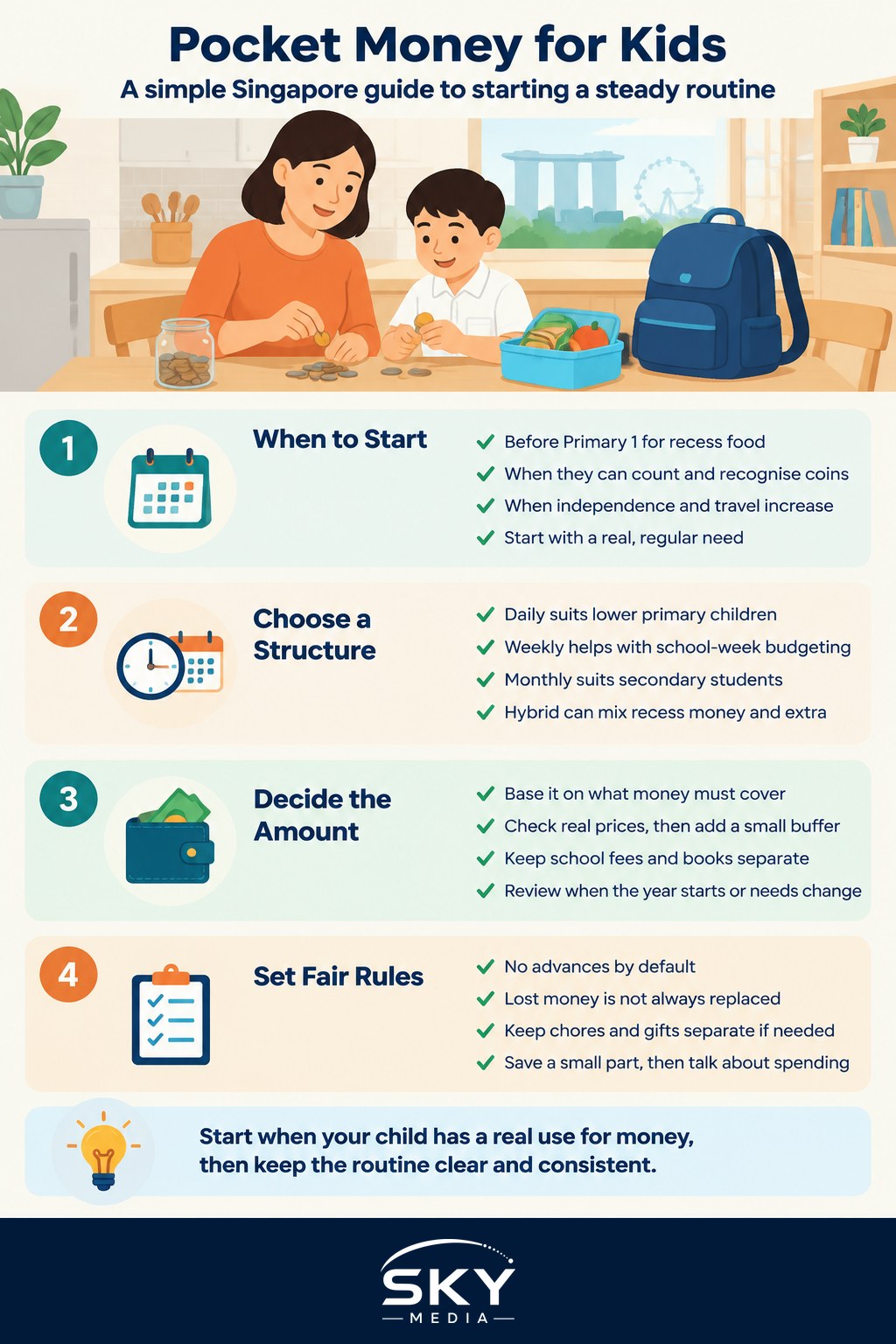
When to Start Pocket Money
There is no single correct age, but a few natural starting points come up again and again.
- Before Primary 1. Children need some money for recess food, and this is the most common starting point locally. A short “practice” period during the December holidays, where your child pays for a small snack with their own coins, builds confidence before school starts.
- When a child can count and recognise coins. Even in kindergarten, a small amount for a treat helps children connect money with choices.
- When independence grows. Upper primary or secondary students who travel alone, buy their own snacks after CCA (co-curricular activities), or go out with friends usually need a more flexible arrangement.
A useful test: start when your child has a real, regular use for money, rather than at a fixed age. If they never spend it, pocket money becomes a toy rather than a learning tool.
Choosing a Structure: Daily, Weekly or Monthly
How often you pay matters as much as how much. The right frequency depends on your child’s age and how well they can plan ahead.
| Structure | Best suited to | Advantages | Things to watch |
|---|---|---|---|
| Daily | Lower primary children | Simple, matches recess spending, limited risk if lost | Little room to practise saving or planning |
| Weekly | Middle to upper primary | Teaches budgeting across a school week, room to save a little | Some children spend it all early in the week |
| Monthly | Secondary students and older teens | Mirrors adult budgeting, builds planning skills | Needs maturity; easy to run out before month end |
| Hybrid (fixed recess money plus weekly extra) | Children moving between stages | Covers essentials while giving some choice | Rules must be very clear about what each part is for |
Many families move along this table as their child grows. A Primary 1 child might start on daily recess money, shift to weekly by Primary 3 or 4, and move to monthly in secondary school. Moving up a step can be framed as a reward for handling money responsibly.
Deciding How Much to Give
Parents often ask what amount is “normal”, but costs differ between schools, neighbourhoods and families, and prices change over time. Instead of copying another family’s figure, build the amount from your child’s actual needs.
- List what the money must cover. For a young child, this might be recess food and a drink. For a teenager, it might include snacks, some transport top-ups, and outings with friends.
- Check real prices. Ask your child what canteen food costs, or look at the menu during a school open house. For older children, look at what they currently spend.
- Add a small buffer. A little extra allows for choice and for saving. Without any spare, there is nothing to learn about.
- Decide what you will still pay for directly. School fees, books, uniforms, tuition, medical costs and family outings usually stay with parents. Make this clear so your child knows what pocket money is and is not for.
- Review at set points. Revisit the amount at the start of each school year or when circumstances change, not every time your child asks.
Siblings of different ages will usually get different amounts. Explain that this reflects different needs, not favouritism.
Household Rules That Keep Things Fair
Clear rules prevent arguments later. Agree on them together, write them down if it helps, and stick to them.
- No advances by default. If your child runs out early, let them experience the gap (within reason, and never by skipping meals). Some families allow one advance per term that is repaid from the next payment.
- Lost money is not automatically replaced. For young children, replace it once with a conversation about safe keeping. After that, the loss is a lesson.
- Decide whether chores are linked. Some families keep pocket money separate from basic chores, which are expected of everyone, and pay extra only for bigger optional jobs. Others link part of the money to chores. Either can work if it is consistent.
- Set a saving habit. Encourage your child to put aside a small portion, perhaps in a clear jar for younger children so they can see it grow, or in a bank account for older ones.
- Gifts are separate. Ang bao (red packet) money at Chinese New Year, birthday money and other gifts can follow their own rules, for example a share saved and a share to spend.
- Talk about purchases without lecturing. Ask what they bought and whether it was worth it. Curiosity works better than criticism.
Cash, Cards or Apps
Many Singapore schools still use cash at canteens, though cashless options are increasingly common. Check what your child’s school accepts before deciding.
- Cash is easy to understand and makes spending visible, which suits younger children.
- Stored value cards or school payment cards reduce the risk of losing notes and coins.
- Youth bank accounts and parent-linked apps offered by some banks let older children track spending and saving. Compare the features, fees and controls directly with the bank, as these change often.
A sensible path is cash first, then a gradual move to cards or apps as your child shows they can keep track.
Building on the Routine
Once pocket money is running smoothly, you have a ready-made base for broader money lessons. Our guides on teaching kids about money and teaching kids and teens about money in Singapore go into saving goals, needs versus wants, and planning for bigger purchases. If you want to reflect on how your own habits shape your children, understanding your money personality is a good place to start.
Start Small and Stay Consistent
Pocket money does not need to be complicated. Pick a starting point that matches a real need, choose a structure suited to your child’s age, build the amount from actual costs, and set a few clear rules. Consistency matters more than the exact figure, and your child will learn far more from a steady routine than from any single lecture.
Frequently Asked Questions
Should I give my child pocket money for good grades? It is usually better to keep pocket money separate from results. Linking cash to marks can make learning feel transactional, and the amount should come from your child’s real needs. If you want to reward effort, consider a non-cash treat or time together instead.
When can a teenager open a youth bank account? Banks set their own age rules and requirements, so ask the bank directly. A youth account or parent-linked app helps older children track saving and spending, but compare the features, fees and controls first, as they change often.
What should I do if my child spends all their pocket money in the first few days? Let them feel the gap within reason, and never by skipping meals. Then talk about what happened and what they could do differently, and try a shorter payment cycle if needed. Some families allow one advance per term, repaid from the next payment.
How do I handle a child comparing their allowance with classmates? Explain that amounts differ because families, schools and needs differ, and show your child how your figure was built from real costs. Invite them to ask for a review at set points, such as the start of a school year, instead of whenever they feel left out.
Can I give a kindergarten child pocket money? Yes, in small amounts for a treat, as it helps children connect money with choices once they can count and recognise coins. Keep it simple, use cash they can see, and focus on letting them decide rather than on the amount.
Further reading: The School Pocket Money Fund Explained