
Every car in Singapore has an ending, and how you handle it decides how much money you get back. Selling a car in Singapore is not one decision but a choice between several exits: sell it directly to another driver, trade it in or consign it to a dealer, export it overseas, or deregister and scrap it to claim a rebate from the Land Transport Authority (LTA). Each route suits a different situation, and the difference between the best and worst option can run into thousands of dollars. This guide explains your choices, how the rebate generally works, and why timing around your Certificate of Entitlement (COE) matters so much.
Rebate values, rules and rates change, so confirm current figures on One Motoring or with LTA before you commit. Treat everything below as how the system works, not as fixed numbers.
Your Options at the End of Ownership
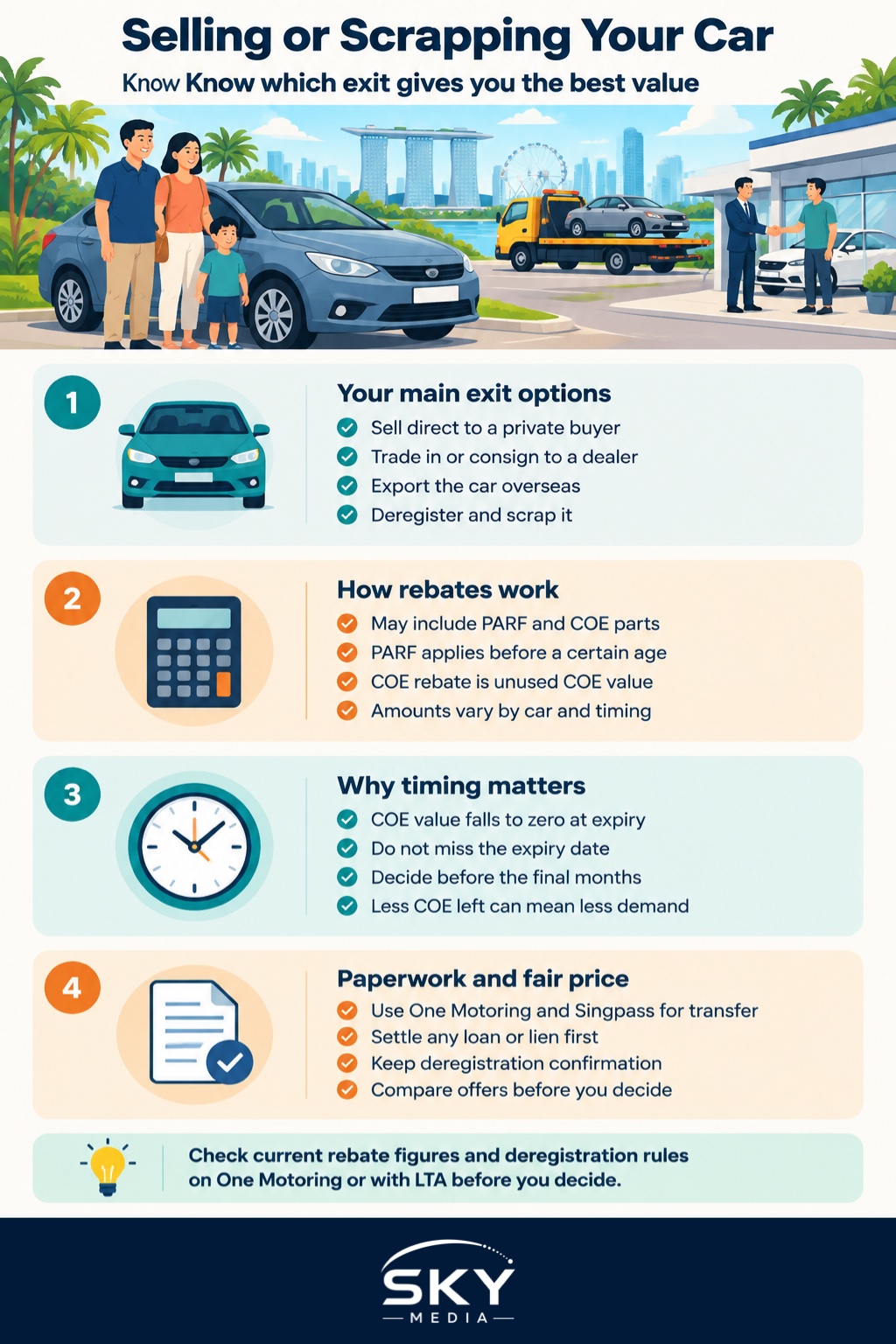
There is no single right answer. The best exit depends on how old the car is, how much COE is left, and whether you value the highest price or the least hassle.
- Sell direct to a private buyer. You handle the listing, the viewings and the ownership transfer yourself. This usually fetches the most money because there is no middleman, but it takes time and effort.
- Trade in or consign to a dealer. A dealer either buys the car outright (often when you buy your next one) or sells it on your behalf for a commission. Convenient and quick, but you accept a lower price for that convenience.
- Export the car. Exporters buy cars, often older ones, to ship overseas. When a car is exported rather than scrapped, the paperwork and rebate treatment differ, so the numbers can work out differently from local resale.
- Deregister and scrap. If the car has little resale value, or its COE is near expiry, you deregister it with LTA and send it to an approved scrapyard. In return you may claim a rebate, described below.
How the Rebate Generally Works
When you deregister a car, you may be entitled to a rebate made up of two possible parts: a PARF (Preferential Additional Registration Fee) rebate and a COE rebate. This is the money that makes scrapping worthwhile rather than just giving the car away.
In general terms:
- The PARF rebate is a percentage of the original Additional Registration Fee, and it applies to cars deregistered before they reach a certain age. Older cars past that age no longer qualify for the PARF portion.
- The COE rebate returns the unused, or remaining, value of the COE if you deregister the car before the COE runs out. The more time left on the COE, the larger this portion tends to be.
Because both parts depend on formulas, ages and the original fees paid, the actual amount varies from car to car. Do not rely on a figure someone quotes you. Use the official rebate calculator on One Motoring and confirm with LTA, since the rules and the way rebates are computed can change.
Timing Around COE Expiry
Timing is where people lose money without realising it. A COE runs for a fixed term, and its value winds down to zero at expiry. If you let the COE lapse completely, the COE rebate portion is gone, because there is no unused value left to return.
A few practical points:
- Do not run a car past its COE expiry unless you have renewed the COE, because once it expires you must deregister the car and any COE rebate is already spent.
- Decide your exit before the final months, not on the deadline day, so you have time to sell, export or scrap without pressure.
- A car with plenty of COE left is easier to sell, since the buyer inherits that remaining entitlement. As the COE winds down, private demand falls and scrapping or exporting often becomes the sensible route.
- If you are weighing whether to renew the COE and keep the car versus letting it go, remember that renewing commits you to another term of ownership costs.
Comparing Your Exit Options
Here is a side by side view to help you match the route to your situation. Notes are general; confirm any figures with LTA.
| Exit option | Best for | Notes |
|---|---|---|
| Sell direct to a buyer | Cars with resale demand and COE left | Highest price, most effort; you manage the transfer |
| Trade in with a dealer | People buying a replacement car | Fast and easy; price is lower than private sale |
| Consign to a dealer | Sellers who want help but a better price than trade-in | Dealer sells for you and takes a commission |
| Export | Older cars with little local demand | Rebate and paperwork differ from scrapping |
| Deregister and scrap | Low-value cars or COE near expiry | May qualify for PARF and COE rebates via LTA |
If you are trading in or consigning, get at least one independent quote first so you know whether the dealer’s offer is fair. A minute of comparison is worth a lot when the gap between offers can be large.
Paperwork and Getting a Fair Price
The admin depends on which route you take, but a few essentials apply across the board.
- For a direct sale, ownership passes through One Motoring using Singpass, and the buyer needs insurance in their name from the transfer date. Settle any outstanding loan or lien on the car first, because you cannot cleanly transfer or deregister a vehicle the financier still has a claim over.
- For scrapping or export, you deregister the car with LTA, use an approved scrapyard or a licensed exporter, and follow LTA’s current documentation steps. Keep the confirmation, as the rebate is paid based on the deregistration.
- For any route, cancel or transfer your own insurance once the car is no longer yours; your insurer may refund the unused premium.
To get a fair price, know your car’s realistic market value before you talk to anyone. Look at what similar cars with similar COE terms are actually selling for, weigh the rebate you would get from scrapping against a resale offer, and do not let a low trade-in quote anchor you. Sometimes the most money comes from a private sale; sometimes, for an old car near COE expiry, scrapping for the rebate genuinely beats everything else. The point is to run the comparison rather than take the first easy offer.
Explore more
Understanding why your car is worth what it is worth starts with Car Depreciation Explained in Singapore, which shows how COE and value fall over time. When you sell to a private buyer, Registering and Transferring a Car in Singapore covers the ownership handover step by step. Confirm all rebate figures and deregistration rules on One Motoring or with LTA before you decide.
Official sources: OneMotoring