
For many people living in Singapore, Chinese New Year means family in two places. Parents in Guangdong, grandparents in Johor, siblings in Penang or Fujian: the red packet tradition does not stop at the border. If you want to send ang bao overseas, the main challenge is not the money itself but the timing. Banks and remittance services in several countries slow down or pause over the festive holidays, and a transfer sent too late can arrive after the celebrations are over.
This guide covers how to plan around holiday cut-offs in Singapore, China and Malaysia, the digital options for cross-border red packets, and what to compare on fees and exchange rates. It is general information, not financial advice. Rules, limits and charges change, so always confirm current details with your bank or provider.
Why Timing Matters More Than Usual at CNY
Chinese New Year is a public holiday in Singapore, mainland China and Malaysia, but the holidays are not the same length in each place.
- Singapore usually observes two days of public holiday (with an extra day off in lieu if one falls on a Sunday).
- Mainland China has a longer Spring Festival break, and banks there may run reduced services for several days. Official holiday arrangements are announced by the State Council each year, sometimes with adjusted working weekends.
- Malaysia gazettes its own Chinese New Year holidays, and some states may differ slightly.
A cross-border transfer typically passes through banks in both countries, and sometimes an intermediary bank as well. If any of them is closed, the money waits. Transfers that are “instant” on an ordinary weekday may also be held for checks if the amount or pattern is unusual, and checks take longer when staff are on leave.
A Simple Planning Rule
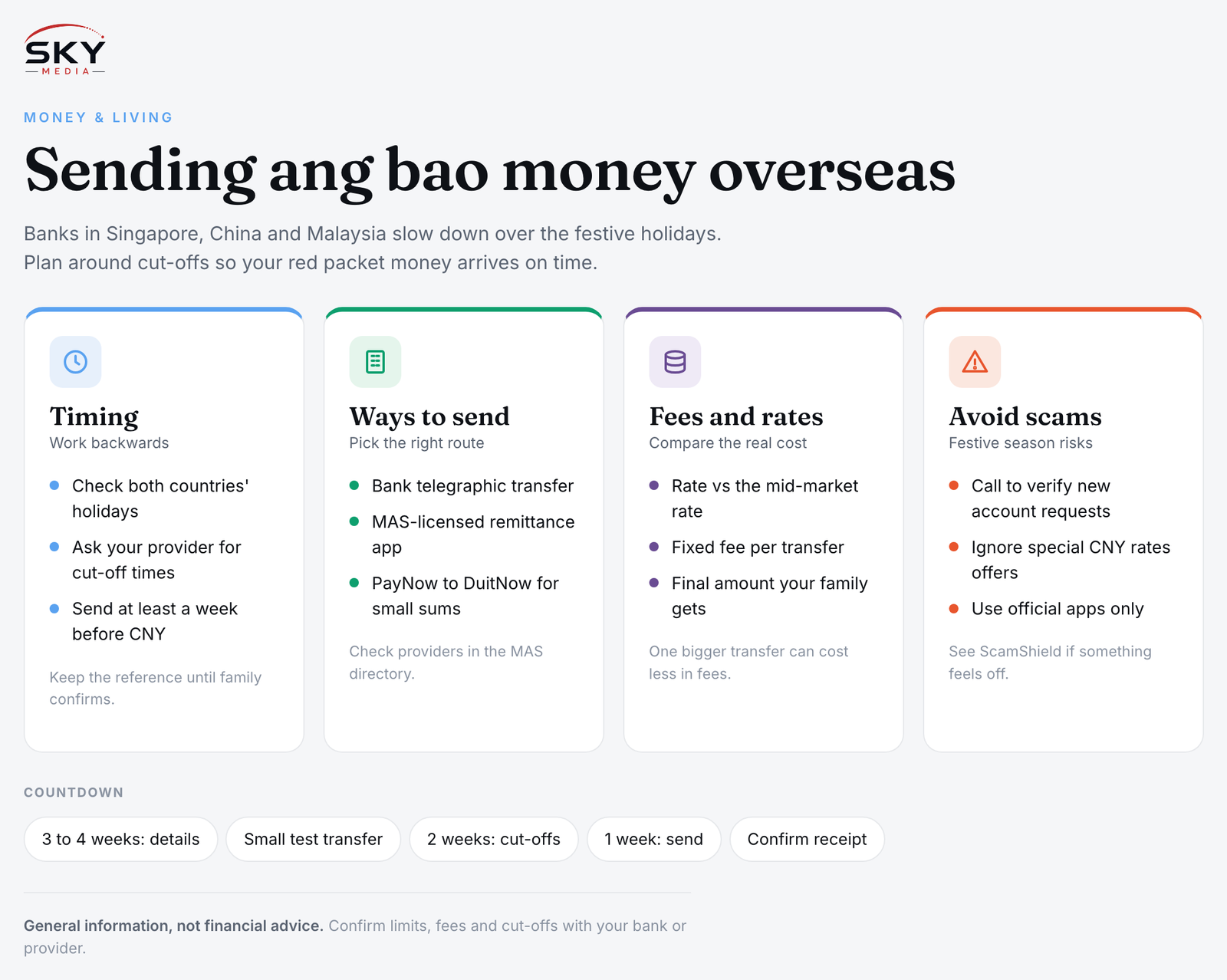
Work backwards from the day you want the money to arrive.
- Check the official public holiday calendar for both countries for that year.
- Ask your bank or remittance provider for its published cut-off times for the festive period. Many post notices on their websites or apps in January.
- Aim to send at least a week before the first day of the holiday, earlier if this is your first transfer to a new recipient.
- Keep the transaction reference until your family confirms receipt.
If you are planning physical red packets too, our guide on how to prepare ang bao money for Chinese New Year covers getting new notes in Singapore, which also has its own booking window.
Your Main Options for Sending Festive Money
Different methods suit different amounts and recipients. The table below compares the common routes in general terms. Exact speed, limits and fees depend on the provider and the destination.
| Method | Typical use | What to check |
|---|---|---|
| Bank telegraphic transfer (overseas wire) | Larger amounts to a family member’s bank account | Sending fee, any intermediary or receiving bank charges, exchange rate margin, holiday cut-offs |
| Licensed remittance company or app | Regular or mid-sized transfers to China, Malaysia and the region | MAS licence status, exchange rate shown upfront, delivery method (bank, e-wallet or cash pickup) |
| Linked real-time payment (such as PayNow to Malaysia’s DuitNow) | Smaller, quick transfers using a mobile number or proxy | Whether your bank supports it, per-transaction and daily limits, exchange rate applied |
| E-wallet transfer to a mainland account | Recipients who mainly use Alipay or WeChat Pay | Whether the service is offered by a licensed provider, recipient verification needs, limits |
| Hand-carried cash or red packets | Visiting family in person over the holidays | Customs declaration rules for cash above the threshold in each country, safety while travelling |
Bank Transfers
A bank telegraphic transfer is straightforward if your family has a bank account and you have their full details: account name exactly as registered, account number, bank name and branch, and the SWIFT code. For transfers to mainland China, the recipient’s name usually needs to be in Chinese characters exactly as on the account. Fees can come from three sources: your bank, any intermediary bank and the receiving bank. Ask whether you can choose to pay all charges upfront so your family receives the full amount, which matters if you want a lucky number like $888 to land intact.
Remittance Services and Apps
Remittance companies and apps are often cheaper and faster for regular transfers. In Singapore, these must be licensed by the Monetary Authority of Singapore (MAS). You can check a provider against the MAS Financial Institutions Directory on the MAS website before using it. Avoid informal “money changers” or individuals offering unusually good rates through chat groups. Unlicensed remittance is illegal and your money has little protection.
Linked Real-Time Payments
Singapore’s PayNow has been linked with some regional fast-payment systems, including Malaysia’s DuitNow, allowing participating banks to send smaller amounts using a mobile number. This can be handy for a last-minute ang bao to relatives in Malaysia. Not every bank participates, and there are per-transaction limits, so check in your banking app well before the holiday.
Digital Hongbao Across Borders
In mainland China, red packets are often sent digitally through WeChat or Alipay. Many newcomers from China ask whether they can do the same from Singapore.
- Sending to a mainland e-wallet: some licensed remittance providers in Singapore can credit a recipient’s Alipay or WeChat Pay account. The recipient may need to complete identity verification on their side. Check with the provider which recipients are eligible.
- In-app red packets: WeChat and Alipay’s own red packet features generally depend on how your account is set up and linked. Overseas-registered accounts may have restrictions. Do not rely on these features working for a festive deadline without testing them first.
- Keep it legitimate: avoid “agents” who offer to swap your Singapore dollars into a relative’s wallet through personal accounts. This can breach rules in both countries and expose you to scams or frozen accounts.
Comparing Fees and Exchange Rates
The headline fee is only part of the cost. Before you send, compare:
- The exchange rate offered against the mid-market rate you see on a financial news site. The gap is a hidden fee.
- The fixed fee per transfer.
- Receiving-side charges, especially for bank transfers.
- The final amount the recipient gets in their currency. Many apps show this before you confirm; use it as your comparison figure.
Several small transfers to different relatives may cost more in fixed fees than one transfer to a family member who shares it out.
Avoiding Festive Scams and Mistakes
CNY is a busy season for scammers, who know people are sending money and are in a hurry.
- Verify requests. If a relative messages asking you to send money to a new account, call them on a number you already know before transferring.
- Ignore unsolicited “special CNY rates” from strangers or unfamiliar websites.
- Double-check names and numbers. A wrong digit can take weeks to resolve, especially over the holidays.
- Use official apps only. Download banking and remittance apps from official app stores, and check the developer name.
- Keep records. Screenshot confirmations and save references until the money arrives.
The ScamShield website and app from the National Crime Prevention Council and Singapore Police Force has current scam alerts if something feels off.
A Countdown Checklist
- Three to four weeks before: confirm your family’s account or e-wallet details, and choose a provider. Do a small test transfer if it is a new route.
- Two weeks before: check holiday calendars and your provider’s festive cut-off notice.
- One week before: send the main transfer.
- After sending: share the reference with your family and ask them to confirm when it arrives.
Planning early means your festive greetings arrive on time. If you are also mapping out who gets how much this year, our guide on how to plan your ang bao giving in Singapore can help you set a festive budget that covers family both here and overseas.
Frequently Asked Questions
How early should I send money to family before the holiday? Aim to send at least a week before the first day of the holiday, earlier if it is a new recipient. Check the public holiday calendars of both countries and your provider’s festive cut-off notice, and keep the reference until receipt is confirmed.
How do I know a remittance service is legitimate? In Singapore, remittance providers must be licensed by MAS. Check the provider against the MAS Financial Institutions Directory before using it, and avoid informal money changers or individuals offering unusually good rates through chat groups.
Can I send a digital hongbao to Alipay or WeChat Pay from Singapore? Some licensed remittance providers can credit a mainland Alipay or WeChat Pay account, and the recipient may need to complete identity verification. In-app red packets from overseas-registered accounts may have restrictions, so test before a festive deadline.
How can I make sure a lucky amount like $888 arrives intact? Ask your bank whether you can pay all charges upfront, since fees can come from your bank, an intermediary bank and the receiving bank. With apps, use the final amount shown in the recipient’s currency as your comparison figure.
What scams should I watch for when sending money at CNY? Be wary of messages asking you to send money to a new account, unsolicited special CNY rates, and agents who swap money via personal accounts. Call the relative on a known number first, and check ScamShield for current alerts.
Further reading: Putting Your Child’s Ang Bao Money Into the CDA · Booking Your Haircut Before Chinese New Year: Timing, Price Increases and Taboos · How to Budget When You Support Family Overseas