
During the seventh lunar month in Singapore, you will see small spreads of food on the roadside, at the foot of HDB blocks, outside shops and on home altars. Plates of oranges, bowls of rice, roast meat, buns, sweets and cups of tea sit next to burning incense and joss paper. Most guides to the Hungry Ghost Festival list what not to do. This one looks at the hungry ghost food offerings themselves: what is usually offered, where, and what each item is commonly believed to mean.
Customs vary a lot between dialect groups, temples and families, so treat what follows as commonly seen practices rather than fixed rules.
Why Food Is Offered in the Seventh Month
In Chinese folk belief, Taoism and Chinese Buddhism, the gates of the underworld are believed to open during the seventh lunar month, allowing spirits to roam among the living. Some are ancestors who have family to remember them. Others are “wandering” or “hungry” spirits with no descendants to care for them.
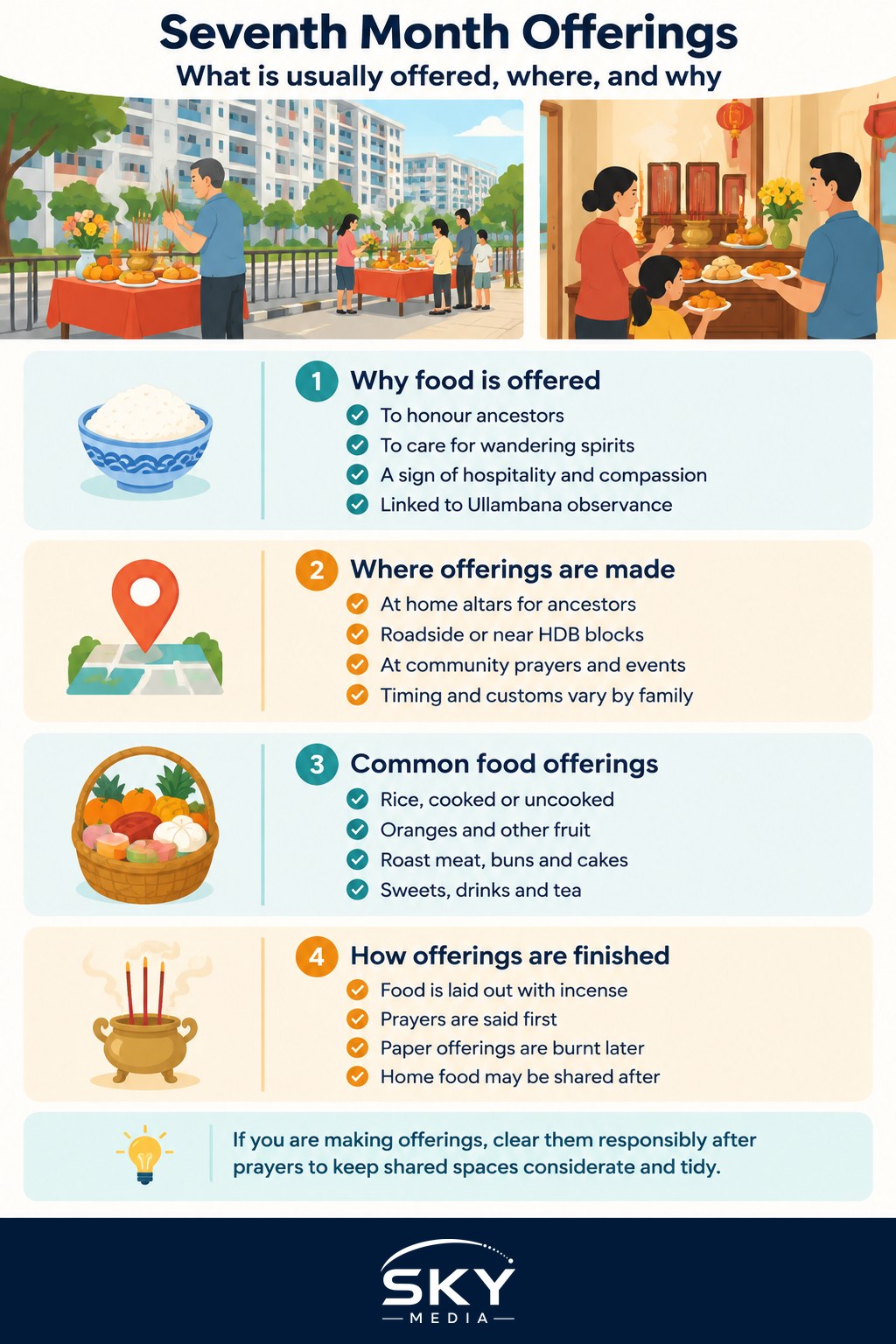
Offering food is an act of hospitality and compassion. Families feed their own ancestors at home and also set out food for the spirits outside, so that these “good brothers” (好兄弟, a polite term many use) are cared for and do not cause trouble. In Buddhist practice, the Ullambana (盂兰盆) observance links the month to generosity and to the story of Mulian, a disciple who sought to save his mother from suffering.
So the food has two purposes: respect for ancestors, and kindness towards the forgotten.
Home Offerings Versus Roadside Offerings
The setting changes what is offered and how.
At the home altar, families honour their own ancestors. The spread can look like a proper meal: rice, several cooked dishes, soup, tea or wine, fruit and dessert. Chopsticks and bowls are often set out as if for a family dinner, and the choice of dishes may reflect what late relatives enjoyed.
Outside the home, usually in the evening and often at the roadside, a grass patch or a designated burner area, families make offerings to wandering spirits. These tend to be simpler: uncooked or cooked rice, fruit, snacks, candles, incense and joss paper. Many households set these out on or around the first, fifteenth and last days of the month, though timing varies.
At community events, such as the prayers run by market or merchant associations, the offerings can be large and elaborate, with whole roast pigs, towers of buns and mountains of rice and fruit. Afterwards, some of this food is shared or distributed.
| Offering | Commonly seen where | What it is often believed to mean |
|---|---|---|
| Rice (cooked or uncooked) | Home altars and roadside | The most basic sustenance, so no spirit goes hungry |
| Oranges and other fruit | Everywhere | Good fortune, since the word for orange sounds like luck |
| Roast pork or whole roast pig | Home altars and community prayers | Abundance and a generous, respectful offering |
| Buns and steamed cakes | Community prayers | Prosperity and things “rising” |
| Sweets, biscuits and snacks | Roadside | Simple treats so spirits feel welcomed and content |
The Common Offerings and Their Meanings
Rice. Rice represents life itself. Bowls of cooked rice, or bags and trays of uncooked rice, are a basic offering. At big community prayers, large quantities of rice may be offered and later given to needy residents or welfare groups.
Oranges and mandarin oranges. The Cantonese and Teochew sounds for orange resemble words for luck or gold. Oranges are easy to keep, colourful and auspicious, so they turn up on almost every altar.
Other fruit. Apples (for peace, as “ping” sounds like the word for safety), bananas, pomelos and pineapples (whose Hokkien name “ong lai” sounds like “prosperity arrives”) are popular. Some families avoid certain fruits for their own reasons, so practice varies.
Roast pork and other meats. Roast pork, roast duck, chicken and pork belly are generous offerings associated with festive meals. Whole roast pigs are usually seen at larger community events. Families who are vegetarian, or who follow Buddhist vegetarian practices, offer vegetarian dishes instead.
Buns, kueh and steamed cakes. Steamed buns, sometimes stamped with red characters, and “huat kueh” (fluffy steamed cakes that split open on top) symbolise prosperity and rising fortune. Peach-shaped buns stand for long life.
Sweets, biscuits, drinks and cigarettes. Packets of sweets, biscuits, peanuts and canned drinks are common at roadside offerings. Some people also leave cigarettes or small cups of alcohol, reflecting the idea that spirits enjoy familiar comforts.
Tea and wine. Small cups of tea or Chinese wine are poured as a sign of respect, often three cups for the spirits or ancestors.
How Offerings Are Usually Arranged and Ended
There is a rhythm to many offerings, though families differ:
- Food is laid out, with incense lit and candles placed nearby.
- Prayers are said, inviting ancestors or spirits to partake.
- After a period, often measured by the incense burning down, joss paper and other paper offerings are burnt.
- Food may then be cleared. For home altars, many families eat the food afterwards as a blessed meal. For roadside offerings, practices differ: some clear the food away, while others leave it for a time.
Some families toss divination blocks to ask whether the spirits have finished eating before clearing up. This, too, varies.
Because uneaten food left outdoors can attract pests, town councils and NEA (National Environment Agency) encourage people to clear up offerings after prayers. If you are making offerings, clearing them responsibly is part of being considerate to neighbours.
Etiquette for Passers-By
If you are not taking part, a few simple courtesies go a long way:
- Do not step on or kick offerings. Walk around them, and keep an eye out for small spreads at night.
- Do not take or eat food from roadside offerings. It is meant for the spirits.
- Let children look, but not touch. Our guide on how to explain Hungry Ghost Month to children has age-friendly ways to talk about it.
- Be patient with smoke and ash. It is usually brief.
For a broader view of the month, including its stories and street events, read The Hungry Ghost Festival in Singapore, Explained. For the list of common dos and don’ts, see Hungry Ghost Festival customs and taboos for newcomers.
A Tradition of Feeding the Forgotten
Behind every plate of oranges or bowl of rice by the roadside is a simple idea: no one, living or dead, should be left hungry or forgotten. Whether you take part or simply walk past, understanding the meaning of these hungry ghost food offerings makes the seventh month feel less mysterious and more like what it is for many families: a season of remembrance, generosity and care.
Frequently Asked Questions
Can I eat the food left at roadside offerings? No. Food set out at the roadside is meant for the spirits and is not for passers-by. Eating or taking it is considered disrespectful, and food left outdoors can also attract pests. Home altar food is different, as many families eat it afterwards as a blessed meal.
What do vegetarian families offer during the seventh month? Vegetarian and Buddhist vegetarian households offer vegetarian dishes instead of meat, alongside rice, fruit, tea and sweets. The aim of the offering is hospitality and respect, not any particular dish, so families choose what fits their own tradition.
Why do some offerings include sweets, cigarettes or drinks? The idea is that spirits enjoy familiar comforts, so families add snacks, canned drinks, small cups of tea or wine and sometimes cigarettes to make them feel welcomed. Customs differ between dialect groups, temples and families, so there is no fixed list.
When should offerings be cleared away after prayers? Practice varies. Many families clear food after the incense burns down, while others leave roadside items a little longer. Because uneaten food attracts pests, town councils and NEA encourage people to clear offerings after prayers and keep the area clean for neighbours.
Does a first-timer need to offer a full meal for ancestors? Not necessarily. Home offerings can be as simple as rice, fruit, tea and incense, and families tailor the spread to their own tradition. If you are unsure, ask an elder or the temple you follow what is customary for your family.
Further reading: Where to Buy Joss Paper and Seventh Month Prayer Items in Singapore · Ullambana and Zhong Yuan: Buddhist and Taoist Seventh Month Rites Compared