
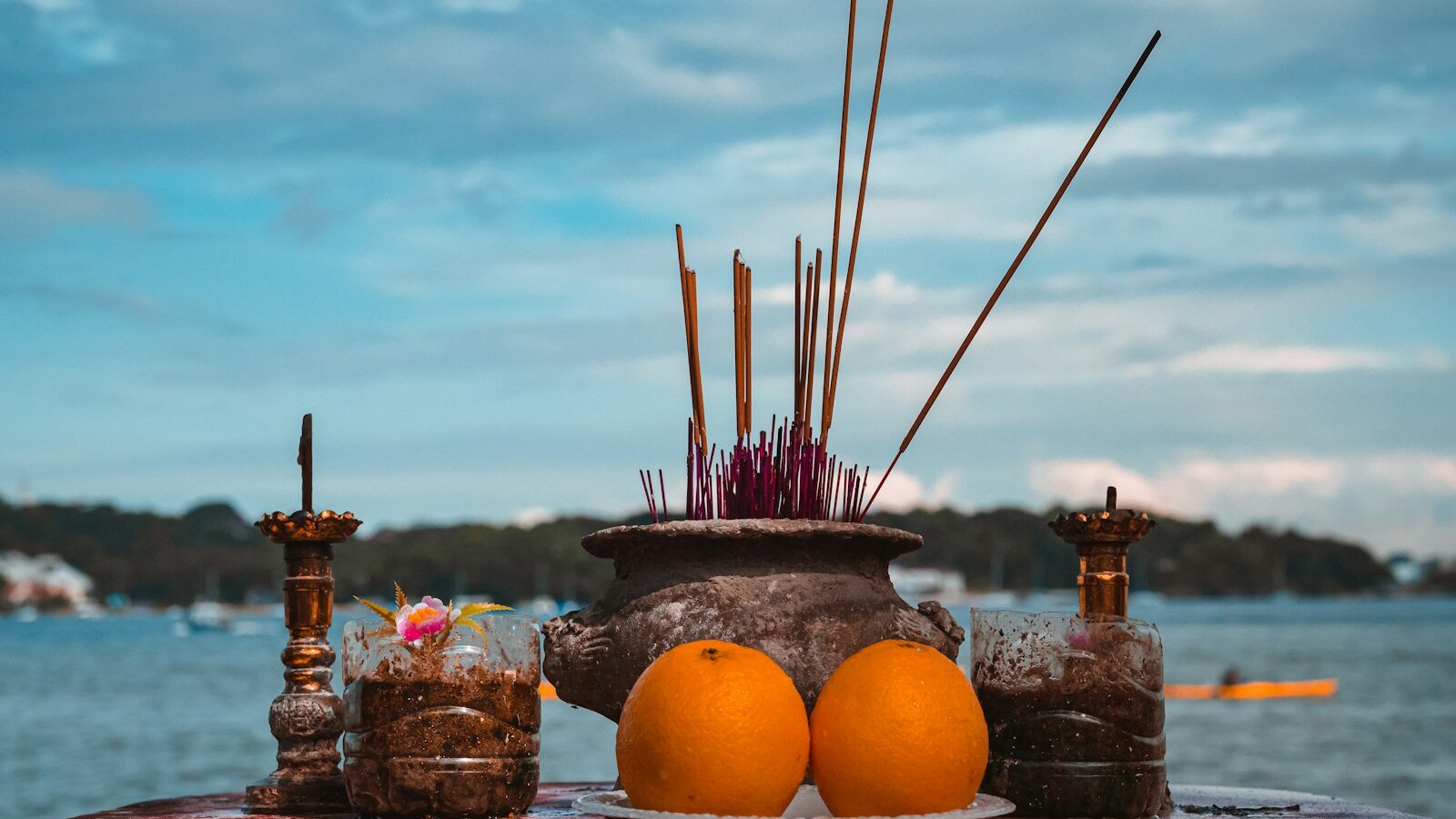
During the seventh month of the lunar calendar, you will see small offering tables outside flats, candles flickering by the roadside and the metal burners at HDB blocks working overtime. Many Taoist and Chinese folk religion families mark the Hungry Ghost Festival with prayers, and the 15th day of the month, known as Zhong Yuan Jie, is usually the high point.
If you are doing a zhong yuan prayer at home for the first time, perhaps because the older generation used to handle it, or you have just moved into your own flat, this guide covers the practical side: where to set up, what to lay out, when to pray and how to burn offerings safely in an HDB estate. Customs differ between dialect groups, temples and families, so treat this as a common pattern and follow your own family’s way where it differs.
Ancestors Inside, Wandering Spirits Outside
Many families observe two separate sets of prayers during the month, and it helps to keep them apart.
- Ancestor prayers take place at the family altar inside the home, if you have one. They honour your own departed relatives, much like prayers during Qing Ming. Our guide to setting up a prayer altar at home covers the permanent altar itself.
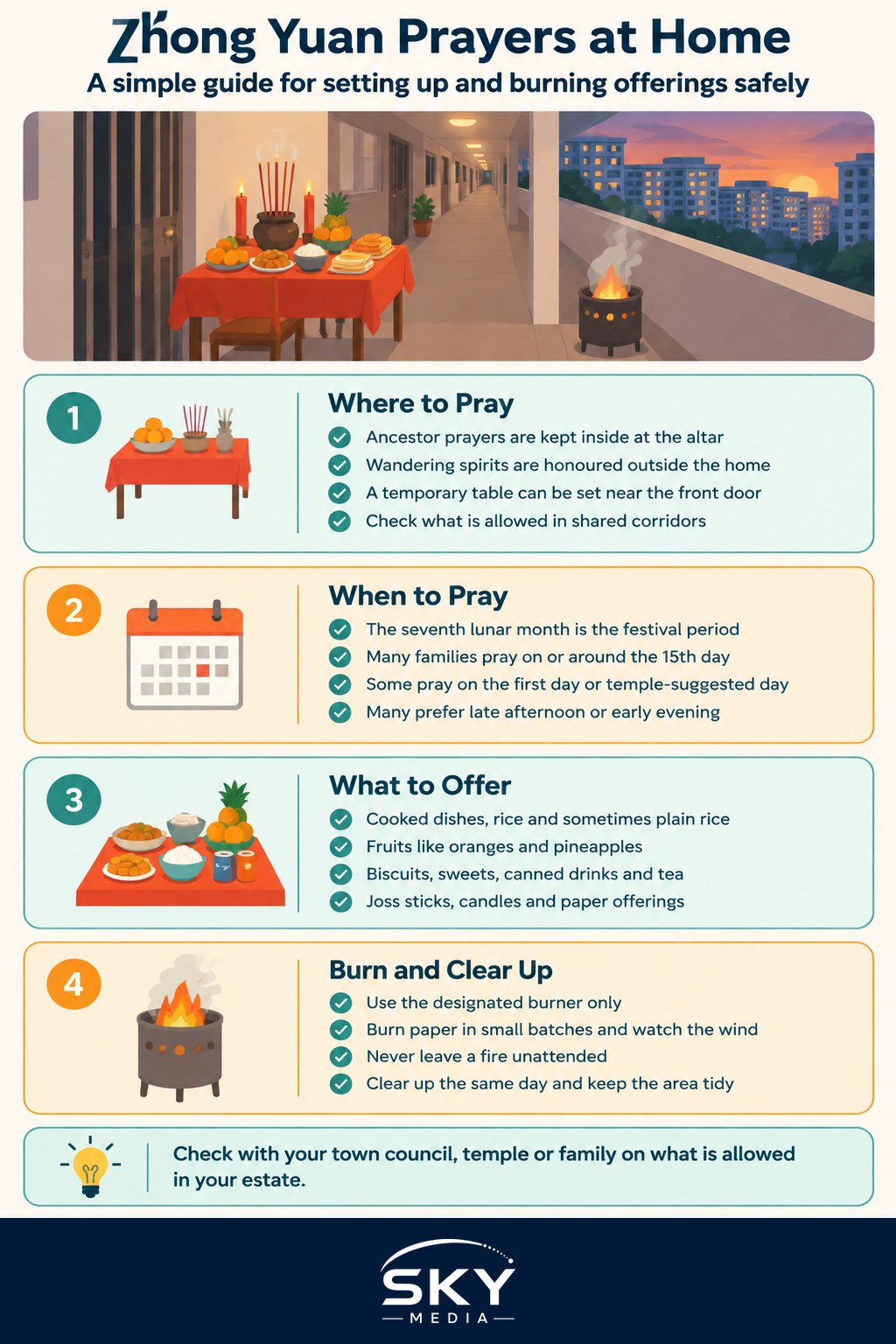
- Prayers for wandering spirits, often politely called “good brothers”, are commonly done outside the home. Many families set up a temporary table just outside the front door, along the roadside, or at a grass verge near the block. The idea, as many families explain it, is to offer hospitality to unattended spirits without inviting them in.
So for a typical HDB household, “at home” usually means a small, temporary table right outside the door or downstairs, plus a separate offering at the indoor altar for ancestors. Check with your neighbours or town council about what is acceptable in shared corridors, as space is shared and fire safety rules apply.
Choosing the Day and Time
The whole seventh lunar month is considered the festival period, but many households pray on or around the 15th day. Others pray on the first day, when the gates of the underworld are traditionally said to open, or on a day suggested by their temple. Look up the lunar dates for the year using a Chinese calendar, almanac or your temple’s notice, since the Gregorian dates shift every year.
Timing during the day varies by family:
- Many pray in the late afternoon or early evening, before dark.
- Some families prefer the morning for ancestors and the evening for wandering spirits.
- Avoid praying very late at night if you can, both out of custom for many families and out of consideration for neighbours, as burning creates smoke.
Laying Out the Offering Table
A simple folding table or a low stool covered with a red cloth works well for the outdoor setup. A common arrangement, from back to front:
- Joss stick holder (a small urn or a container filled with sand or uncooked rice) at the centre back.
- A pair of red candles, one on each side.
- Main offerings in the middle: cooked dishes, rice, and sometimes bowls of plain rice with chopsticks.
- Fruits, snacks and drinks at the front: oranges, bananas, pineapples, biscuits, sweets, canned drinks, sometimes tea or a small cup of wine.
- Paper offerings stacked neatly to the side, ready to burn at the end.
Some families leave chopsticks and cups out for the spirits, while others keep it to dry snacks and fruit. Many prefer items that can be eaten afterwards, as wasting food is discouraged in most households.
What Offerings Are Commonly Prepared
- Food: rice, a few home-cooked dishes such as braised pork, vegetables or noodles, and sometimes roast meat.
- Fruit: oranges and pineapples are popular because of their auspicious names in dialect and Mandarin.
- Snacks and drinks: packaged biscuits, sweets, canned drinks.
- Joss sticks and candles.
- Paper offerings: joss paper, “hell bank notes”, and paper replicas of clothing or everyday items. Shops near temples and in older estates sell ready-made sets for the seventh month, which make it easy if you are unsure what to buy.
The Prayer, Step by Step
Here is a simple sequence many families follow. Your elders or temple may do it differently.
| Step | What you do | What it means for many families |
|---|---|---|
| 1. Set up | Lay out the table, food and fruit, light the candles | Preparing a welcoming table |
| 2. Light joss sticks | Light an agreed number, hold them with both hands and bow | Inviting the spirits to accept the offerings |
| 3. Place joss sticks | Push them into the holder upright | Completing the invitation |
| 4. Wait | Leave the offerings for a while, often until joss sticks burn down | Giving time for the meal |
| 5. Burn paper | Burn joss paper in the designated burner | Sending offerings to the spirit world |
| 6. Clear up | Remove food, extinguish candles, clean the area | Ending respectfully and tidily |
During the wait, many families keep children close, avoid stepping on offerings and avoid moving the food. If you are unsure about a detail such as how many joss sticks to light, ask an older relative or the temple you are associated with. There is no single right number across all families.
Burning Joss Paper Safely in HDB Estates
This is the part where safety and courtesy matter most. Town councils usually place metal burners or bins at blocks during the seventh month, and these are where joss paper should go.
- Use the designated burner, not a void deck, corridor, drain, grass patch or rubbish chute. Burning outside designated burners can be a fire hazard and may breach town council or fire safety rules.
- Burn in small batches. Feed paper in gradually so the fire stays manageable and ash does not fly out.
- Mind the wind. On a breezy day, ash and burning scraps can float into corridors and windows.
- Never leave a fire unattended, and keep children and loose clothing well back.
- Do not burn plastic or packaging, only the paper offerings themselves.
- Extinguish candles and joss sticks before you leave the table.
The rules on burning and the location of burners are set by your town council and the Singapore Civil Defence Force (SCDF), and the National Environment Agency (NEA) has also issued guidance on reducing smoke and ash. Check your town council’s notice board or website for the current arrangements in your estate.
Clearing Up and Being a Good Neighbour
When you are done, clear everything the same day. Leftover food attracts pests, and wax on the floor is slippery. Most families take the food home to eat, which is common practice, while others discard it according to their own custom.
- Scrape wax drips off the floor and wipe the area clean.
- Bag any rubbish and put it in the proper bin.
- Keep the noise and smoke considerate, especially if neighbours are elderly, unwell or have young children.
Not everyone in your block will share these customs, and Singapore’s estates work because people give each other room. A tidy, short, well-managed prayer goes a long way.
If You Are New to These Customs
If you have just married into a family that observes the festival, or you are keeping up a parent’s practice, it is fine to keep things simple. A small table with fruit, a few snacks, candles and joss sticks, plus a modest amount of paper to burn, is a sincere offering. Many people find it helpful to watch how an older relative does it once before taking over.
The seventh month is also when community events take place, such as getai concerts and auction dinners. To understand the fundraising dinners you may hear about, read Zhong Yuan auction dinners explained.
Frequently Asked Questions
Do I need a separate prayer for ancestors during the Hungry Ghost month? Many families do two separate sets: ancestor prayers at the family altar indoors, and prayers for wandering spirits outside the home. Keeping them apart is common practice, but customs differ by dialect group and temple, so follow your own family’s way.
Can I put my offering table in the corridor outside my HDB flat? Check first. Space in shared corridors is common, and fire safety rules apply, so ask your neighbours or town council what is acceptable. Many families use a small temporary table at the front door or downstairs, rather than blocking the walkway.
What should I do with the food after the prayer? Clear everything the same day, because leftover food attracts pests. Most families take the food home to eat, which is common practice, while others discard it according to their own custom. Wasting food is discouraged in most households.
Is it all right to keep the offerings simple for my first time? Yes. A small table with fruit, a few snacks, candles and joss sticks, plus a modest amount of paper to burn, is a sincere offering. It helps to watch an older relative do it once first, or ask the temple your family is associated with.
Why avoid praying very late at night in an HDB estate? Many families avoid it out of custom, and also out of consideration, because burning creates smoke and ash that drifts into neighbours’ windows. Praying in the late afternoon or early evening, using the designated burner, is gentler on elderly or unwell neighbours.
Further reading: Ullambana and Zhong Yuan: Buddhist and Taoist Seventh Month Rites Compared