

Starting a sexual health conversation with a partner can feel more awkward than the intimacy itself. Many people in Singapore grew up in homes where sex was rarely discussed. Yet a short, honest talk about testing and protection before things get physical is one of the kindest things you can do for yourself and for someone you care about.
This guide is about the conversation, not the clinic. If you want to know where to get tested and what services are available, read our guide to sexual health and DSC clinic services in Singapore. Here, we focus on what to actually say, when to say it, and how to handle the replies you might get.
This is general information, not medical advice. For questions about specific infections, tests or protection methods, speak to a doctor, a polyclinic or a sexual health clinic.
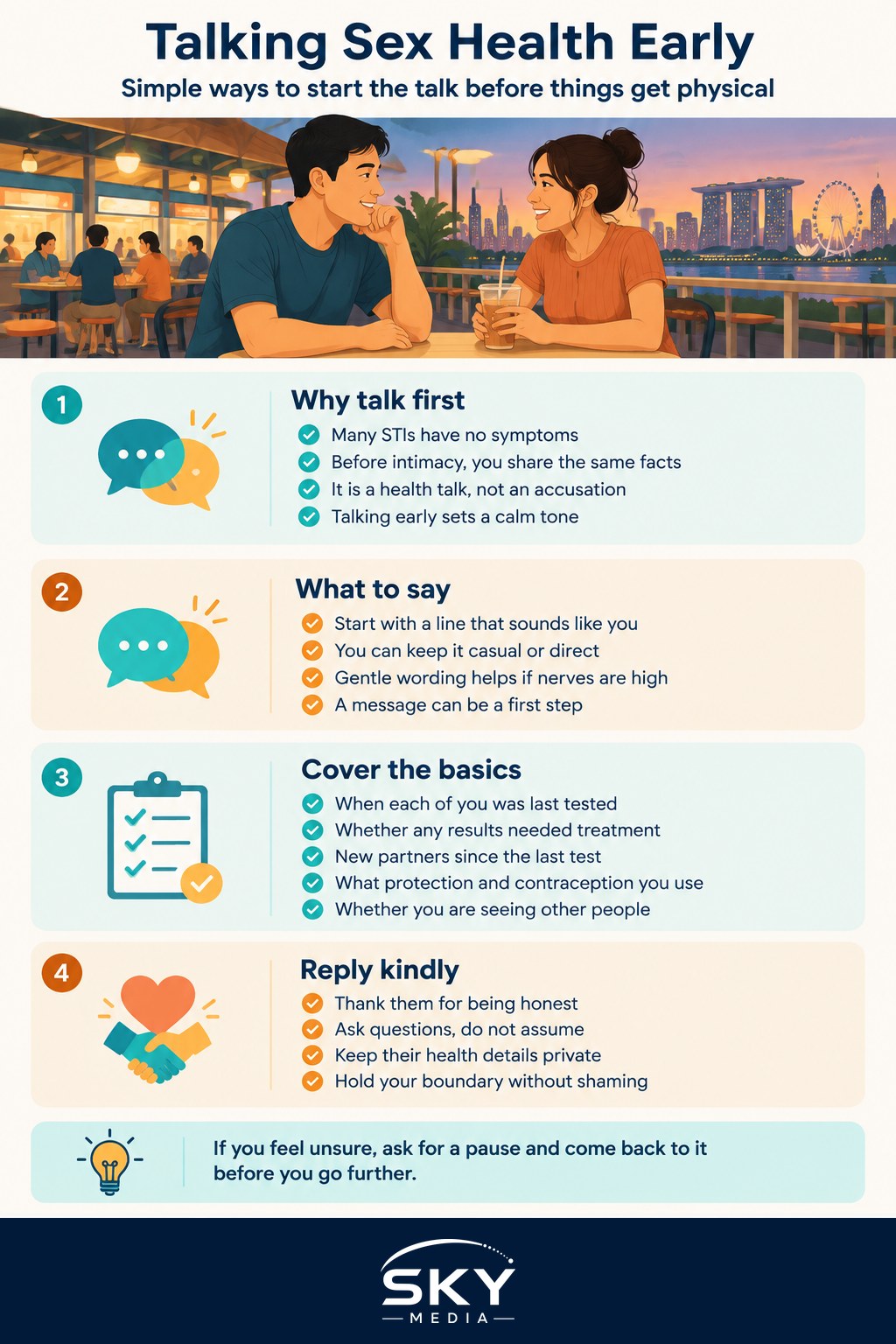
Why the Talk Matters Before, Not After
Most sexually transmitted infections (STIs) can show few or no symptoms, so “I feel fine” is not the same as “I have been tested”. Talking before intimacy lets you both make decisions with the same information. It also sets a tone for the relationship: you are two adults who can discuss real things calmly.
A few points to keep in mind:
- Timing matters. The best moment is when you are both clothed, sober and not in a rush. A calm walk, a quiet dinner or a message thread you can both reply to thoughtfully all work better than the bedroom.
- It is not an accusation. Asking about testing says nothing about your partner’s character. It is routine health care, like asking whether someone has a food allergy before cooking for them.
- It goes both ways. Be ready to share your own testing history. Going first makes it feel less like an interrogation.
Opening Lines That Feel Natural
The hardest part is usually the first sentence. Once it is out, most people feel relief. Pick a line that sounds like you and adjust it.
Casual and light:
– “Before we go further, can we do the boring-but-important health chat? I’ll start.”
– “I like where this is going, so I want to be upfront about testing and protection.”
Direct and simple:
– “When were you last tested for STIs? I was tested a few months ago and can share my results.”
– “I always use condoms with a new partner. Is that okay with you?”
Gentle, for a nervous partner:
– “I know this can feel awkward. I’m not judging anything, I just think it’s good for both of us to know where we stand.”
– “Would it help if we got tested around the same time? Then neither of us has to wonder.”
Messaging is fine as a first step, as long as you follow up in person. If you struggle with these talks in general, our piece on having difficult conversations with your partner covers the wider skills.
What to Cover: A Simple Checklist
You do not need a medical interview. Aim to cover these topics in whatever order feels natural:
- Testing. When each of you was last tested, and for what. Many people do not know exactly which tests they had, which is normal. A doctor can explain what a standard screen includes.
- Results. Whether anything came up, and if so, whether it was treated or is being managed.
- Activity since testing. Whether either of you has had new partners since the last test, because a test only reflects the past.
- Protection. What each of you expects to use, such as condoms, and for which activities.
- Contraception, where pregnancy is possible. Who is using what, and what the plan is if something goes wrong.
- Exclusivity. Whether you are seeing other people, as this changes how often testing makes sense. Our guide to having the exclusivity conversation can help if this part feels unclear.
Handling Common Responses
Here is how the conversation might go, and a calm way to respond to each reply.
| If your partner says… | What it might mean | A helpful reply |
|---|---|---|
| “I’ve never been tested.” | Often simply never thought about it | “That’s really common. Would you be open to getting a check before we’re intimate? I can go around the same time.” |
| “Don’t you trust me?” | Feeling judged or embarrassed | “It’s not about trust. I ask every new partner, and I’m happy to share my results too.” |
| “I don’t like condoms.” | A preference, sometimes discomfort | “I hear you. For me they’re a must with a new partner. We can talk again once we’ve both been tested and agreed to be exclusive.” |
| “I tested positive for something before.” | Honesty that took courage | “Thank you for telling me. Can you share what your doctor said? I’d like to understand how we can be safe together.” |
| “Can we talk about this later?” | Needs time to process | “Of course. Let’s come back to it before we take things further.” |
Notice that none of these replies argue or shame. You hold your boundary and keep the door open.
When Someone Shares a Diagnosis
If a partner tells you about a current or past STI, the most important thing is how you respond in the first few seconds. They have trusted you with private health information.
- Thank them for being honest. Many people never disclose.
- Ask, do not assume. Many infections are treatable, and others can be managed. Their doctor is the right source of detail, not internet forums.
- Take time if you need it. “I appreciate you telling me, and I’d like a day to think and read up” is a fair answer.
- Keep it private. Their health information is not yours to share with friends.
If you are the one disclosing, choose a calm moment, keep it factual, and have a sentence ready about how you manage it, for example: “I’m under a doctor’s care and I can tell you what they’ve advised about keeping a partner safe.”
Getting Tested Together
Some couples find it easier to turn testing into a shared task rather than a demand. Options include:
- Booking around the same time, whether at a GP, a polyclinic or a dedicated sexual health clinic, then sharing results.
- Agreeing on a waiting period. Some tests are more reliable a while after a possible exposure. Ask the clinic about timing so the result actually answers your question.
- Deciding what “results shared” means. Some people show the report; others simply say the results were clear. Agree on what feels respectful to both of you.
Remember that a clear result is a snapshot. If either of you has a new partner later, it is time to talk again.
Holding Your Boundaries Kindly
You are allowed to say no to intimacy until you feel comfortable, and so is your partner. Useful lines include:
- “I like you, and I’d still like us both to get tested first.”
- “Protection is non-negotiable for me right now. That’s about my health, not about you.”
- “If we can’t talk about this, I don’t think I’m ready to go further.”
If a partner reacts with anger, pressure or mockery whenever health comes up, treat that as useful information about how they handle care and respect. If they tend to shut down rather than argue, our guide on what to do when your partner avoids hard conversations offers practical next steps.
Keeping the Conversation Going
The first sexual health conversation with a partner does not need to be the last. As the relationship changes, check in again: when you decide to be exclusive, when you think about stopping condoms, or when either of you has a health concern. The more often you talk, the more ordinary it feels.
For questions about tests, treatment or protection, ask your GP, a polyclinic doctor or a sexual health clinic. They hear these questions every day.
Further reading: Intimacy and Sexual Health in Later Life in Singapore