

A share priced at a few cents feels like a bargain. Buy 10,000 of them for the cost of a nice dinner, and if the price rises a few cents you could double your money. That is the pitch behind penny stocks on SGX, and it is why these counters attract chat-group tips and forum hype. The reality is that a low share price tells you almost nothing about value, and penny stocks come with risks that larger, well-traded shares mostly do not.
This guide explains those risks in plain terms: liquidity, the history of SGX’s minimum trading price rule, what the watch list means, and how pump-and-dump schemes work. It is general information, not financial advice. Check the latest rules with SGX and the Monetary Authority of Singapore (MAS), and consider speaking to a licensed financial adviser before investing.
What Counts as a Penny Stock in Singapore
There is no single legal definition. In everyday use, investors call a share a “penny stock” when it trades below about 20 cents, or sometimes below a dollar, and the company has a small market capitalisation (the total value of all its shares). Many are listed on Catalist, SGX’s sponsor-supervised board for smaller and growing companies, though some sit on the Mainboard too.
A low price on its own is not the problem. A share at 5 cents can belong to a company worth more than one at $5, simply because it has issued far more shares. What makes penny stocks risky is the combination that usually comes with them: small companies, thin trading, limited analyst coverage and, too often, weak finances.
If you are new to investing, start with the basics in Investing in SGX Stocks: Getting Started before looking at the speculative end of the market.
Liquidity: The Risk Nobody Talks About Until It Is Too Late
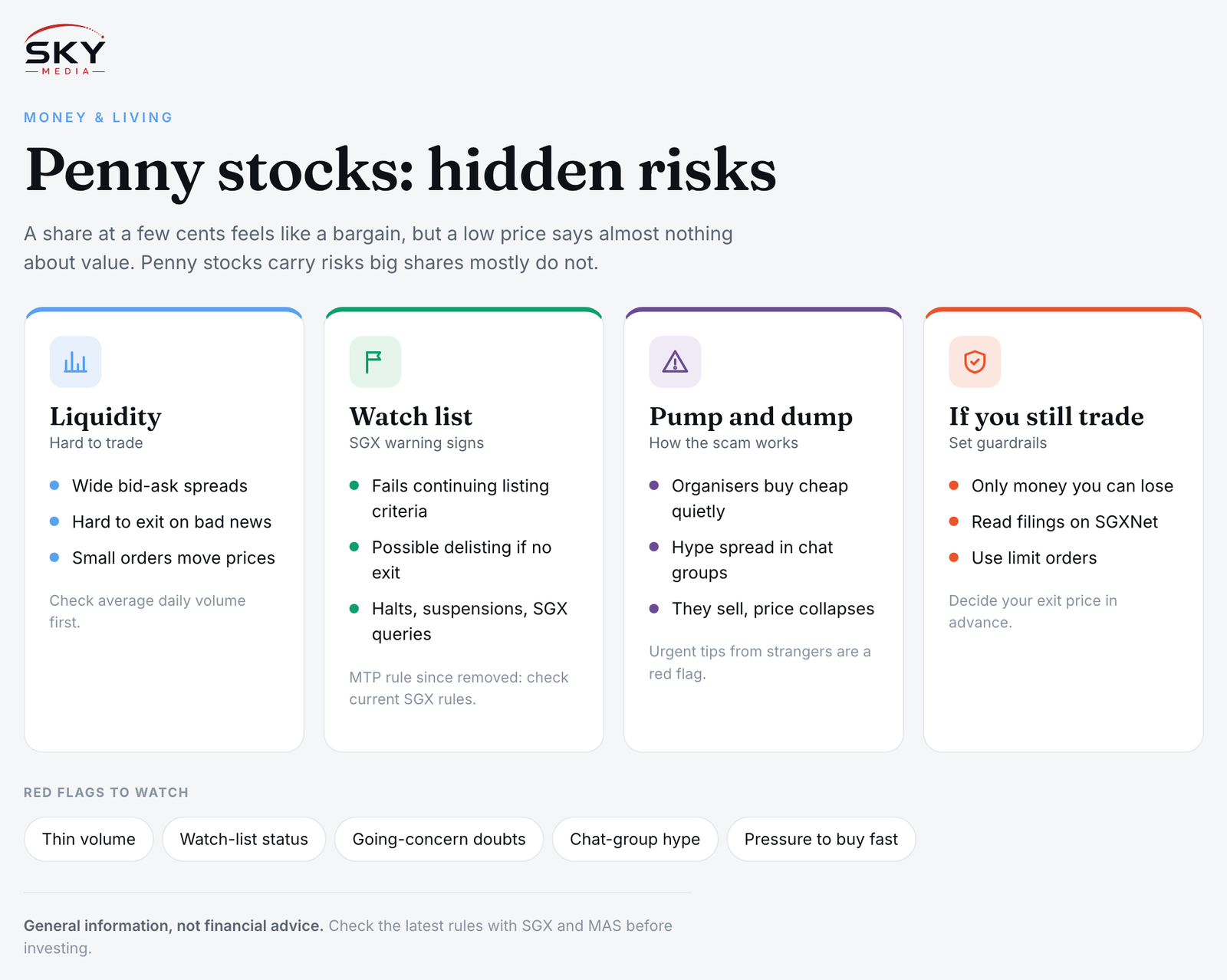
Liquidity is how easily you can buy or sell a share without moving its price. Large blue chips trade millions of shares a day, so you can usually sell at close to the last price. Many penny stocks trade only a few lots a day, and some go whole days without a single trade.
Low liquidity hurts you in several ways:
- Wide bid-ask spreads. The gap between the highest buyer and lowest seller can be a large percentage of the share price. On a 4-cent stock, a spread of even half a cent is more than 10%, so you start out behind.
- Hard to exit. When bad news hits, buyers can disappear. You may have to accept a much lower price, or be unable to sell at all.
- Easy to move. A relatively small order can push the price up or down sharply. That volatility looks exciting on the way up and brutal on the way down.
- Fees bite harder. Brokerage fees, clearing fees and minimum commissions take a bigger share of small trades.
Before buying any counter, look at its average daily volume and the order book depth, not just the last traded price.
The Minimum Trading Price Rule and the Watch List
In 2015, after a sharp collapse in several heavily traded penny counters in 2013 wiped out large sums for retail investors, SGX introduced a minimum trading price (MTP) requirement for Mainboard companies. The idea was that shares trading persistently below 20 cents could be placed on the watch list, pushing companies to consolidate shares or improve their standing. SGX also cut the standard board lot from 1,000 to 100 shares around the same time.
SGX’s regulatory arm, SGX RegCo, has since reviewed and changed its watch-list criteria, and the MTP criterion has been removed. Rules like these are revised from time to time, so check the current requirements on the SGX website rather than relying on older articles or forum posts.
The watch list itself still matters. A company can be placed on it when it fails to meet specific continuing listing criteria set by SGX. Being on the watch list is a public warning sign. If the company cannot meet the exit requirements within the time allowed, it may face delisting, and shareholders can be left holding shares that are difficult or impossible to trade. Check whether a counter is on the watch list before you buy, and read its announcements on SGXNet.
Other warning signs to look out for include trading halts, suspensions, repeated queries from SGX about unusual price movements, and auditors expressing doubts about whether the company can continue as a going concern.
How Pump-and-Dump Schemes Work
Penny stocks are the favourite target of market manipulation because their prices are easy to move. A typical pump-and-dump follows a familiar pattern:
- Accumulate. Organisers quietly buy a large position in an illiquid counter at low prices.
- Pump. They spread excitement through chat groups, social media or “insider tip” messages, often hinting at a takeover, new contract or hot sector.
- Ride the wave. Retail buyers pile in, volume spikes and the price climbs fast.
- Dump. The organisers sell into the buying, the price collapses, and late buyers are left with heavy losses.
Market manipulation is an offence under the Securities and Futures Act, and MAS and the Commercial Affairs Department investigate such cases. But enforcement after the fact does not return your money. The best defence is scepticism: if a stranger, a group chat or an “investment mentor” is urging you to buy a specific small counter quickly, treat it as a red flag. MAS keeps an Investor Alert List of unregulated entities, and the MoneySense website has practical guidance on spotting investment scams.
Penny Stocks Compared With Larger SGX Shares
| Factor | Typical penny stock | Typical large-cap SGX share |
|---|---|---|
| Daily trading volume | Often thin, sometimes none | Usually high and steady |
| Bid-ask spread | Can be a large % of price | Usually a small % of price |
| Analyst coverage | Little or none | Covered by several brokers |
| Information quality | Limited, mostly company announcements | Detailed reports and wide media coverage |
| Exposure to manipulation | Higher, prices are easy to move | Lower, prices need large volumes to shift |
| Delisting risk | Higher if finances are weak | Generally lower |
These are general patterns, not rules. Some small companies are well run and fairly priced; some large ones disappoint. But the odds and the safety margins differ.
If You Still Want to Trade Penny Stocks
Some investors accept the risks knowingly. If you do, set guardrails first:
- Use money you can afford to lose entirely. Treat it as speculation, separate from your emergency fund, CPF savings and long-term portfolio.
- Size small. Keep any single penny stock to a small slice of your total investments.
- Read the filings yourself. Annual reports, auditor’s opinion, cash position, debt and any going-concern warnings on SGXNet tell you more than any tip.
- Check volume before you buy. Ask how many days it would take to sell your position at the current volume.
- Use limit orders. Market orders on illiquid counters can fill at very poor prices.
- Decide your exit in advance. Know at what price you will cut losses, and stick to it.
- Ignore urgency. Real opportunities rarely require you to buy within the hour.
If buying small quantities of higher-quality shares is what attracts you to penny stocks, consider odd lots instead. Buying Odd Lots on SGX explains how to buy fewer shares of established companies. Newly listed small companies carry their own set of risks, covered in IPO Investing on the SGX.
Key Takeaways
Penny stocks on SGX are cheap per share, not necessarily cheap in value. Thin liquidity, wide spreads, watch-list and delisting risk, and exposure to pump-and-dump schemes make them far riskier than their price suggests. SGX’s rules on minimum trading prices and the watch list have changed over the years, so verify the current position with SGX. If you choose to speculate, use only money you can afford to lose, do your own research on SGXNet, and walk away from anyone pressuring you to buy fast.
Further reading: Reading Stock Charts: Candlesticks and Moving Averages for Beginners · CFD Trading in Singapore: How Leverage Can Hurt You